McCune-Albright Syndrome: Symptoms, Diagnosis, And Treatment
Rare genetic disorder affecting bones, skin pigmentation, and endocrine function with precocious puberty and fibrous dysplasia.
Author: Expert Medical Reviewer. Revised: January 2026.
What is McCune-Albright syndrome?
McCune-Albright syndrome (MAS) is a rare genetic disorder characterized by the classic triad of polyostotic fibrous dysplasia of bone, café-au-lait skin pigmentation, and autonomous endocrine hyperfunction, most commonly precocious puberty. This mosaic condition arises from postzygotic activating mutations in the GNAS gene, leading to constitutive activation of the G-protein alpha subunit (Gsα) and uncontrolled cyclic AMP (cAMP) signaling in affected tissues. The mutation occurs early in embryonic development, resulting in a patchwork of normal and mutated cells, which explains the variable expressivity and severity among individuals.
Fibrous dysplasia replaces normal bone with fibro-osseous tissue, café-au-lait spots result from melanocyte hyperactivity, and endocrine issues stem from glandular overactivity. MAS affects approximately 1 in 100,000 to 1 in 1,000,000 people, with females more commonly presenting due to overt precocious puberty symptoms. It is not inherited in a Mendelian fashion but occurs sporadically.
Who gets McCune-Albright syndrome?
MAS typically manifests in early childhood, with symptoms often appearing by age 3. Girls are diagnosed more frequently because precocious puberty is a prominent feature, presenting as early as 4-6 months with vaginal bleeding or breast development. Boys may exhibit milder or later-onset puberty changes like testicular enlargement or body odor. Bone lesions can cause pathologic fractures or deformities from infancy, while café-au-lait spots are often present at birth.
The disorder affects all ethnic groups equally and shows no geographic predilection. Severity varies: some have monostotic fibrous dysplasia (one bone), while others have polyostotic involvement, potentially leading to significant morbidity.
What causes McCune-Albright syndrome?
MAS results from somatic mosaicism of gain-of-function mutations in exon 8 of the maternal allele of the GNAS gene on chromosome 20q13.3. These mutations, commonly R201C or R201H, impair the GTPase activity of Gsα, causing persistent cAMP elevation. This leads to:
- Bone: Excessive proliferation of fibroblasts and irregular bone formation (fibrous dysplasia).
- Skin: Hyperpigmentation via melanocyte stimulation.
- Endocrine: Hormone overproduction in gonads, thyroid, pituitary, adrenals, or parathyroids.
The postzygotic timing determines mutation burden and phenotype; earlier mutations cause more severe, widespread disease.
What are the clinical features of McCune-Albright syndrome?
Skin features
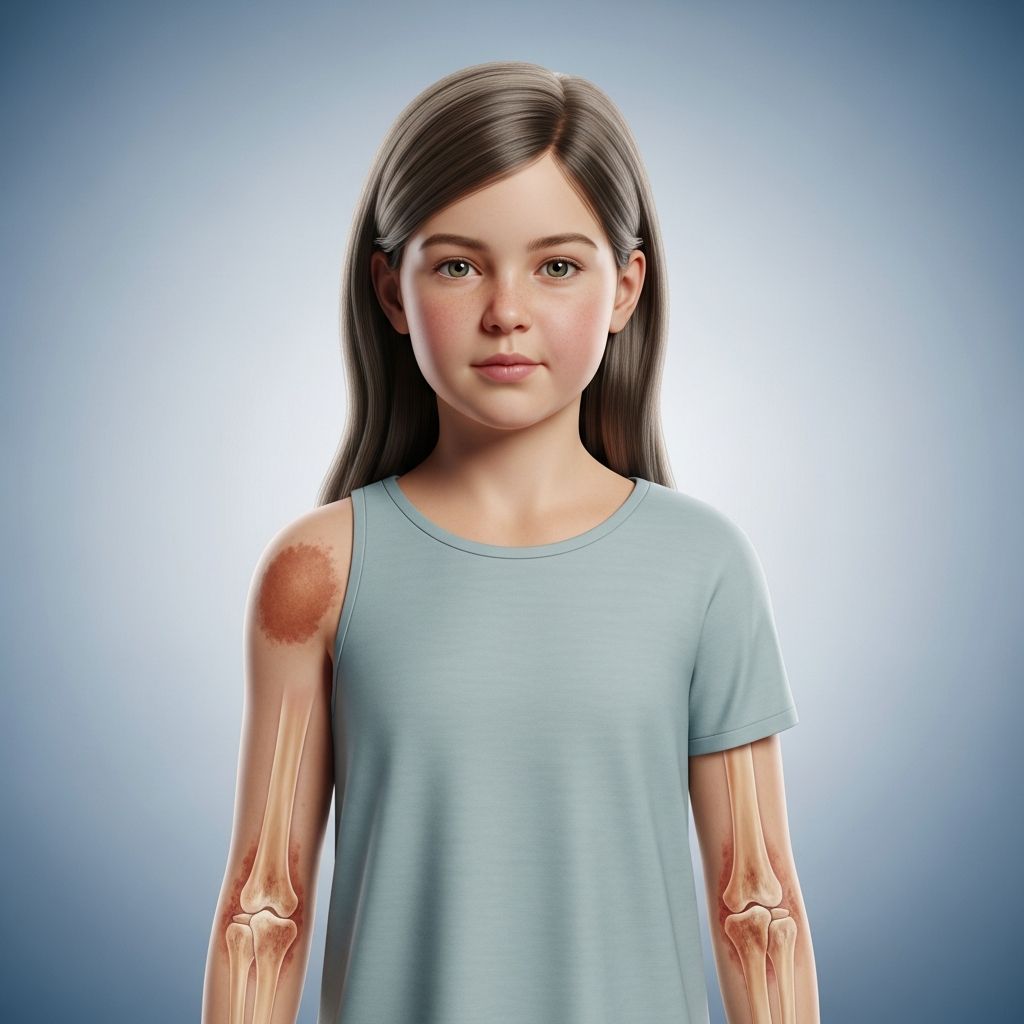
Café-au-lait macules are hyperpigmented patches with irregular ‘coast of Maine’ borders, often respecting midline and present at birth. They result from increased melanin due to cAMP-mediated alpha-MSH activity.
Bone lesions
Polyostotic fibrous dysplasia affects multiple bones, replacing normal bone with woven bone and fibrous stroma, leading to fragility, pain, fractures, and deformities. Common sites: long bones, craniofacial bones (causing asymmetry, vision/hearing loss), spine, ribs. Radiographically, lesions show ‘ground-glass’ appearance. Hypophosphatemia from FGF23 excess worsens bone health.
Endocrine manifestations
- Precocious puberty: Peripheral in girls (ovarian cysts, estradiol excess, menses by age 3); boys less affected.
- Hyperthyroidism: Common, with goiter and elevated T4.
- Growth hormone excess (gigantism/acromegaly): From pituitary adenomas, causing overgrowth.
- Cushing syndrome: Neonatal, transient adrenal hyperactivity.
- Hyperparathyroidism: Elevated PTH, hypophosphatemia.
- Others: Prolactinemia, renal phosphate wasting.
Diagnosis
Diagnosis requires clinical triad plus genetic confirmation of GNAS mutation in affected tissues (lesional fibroblasts, not blood). Evaluate with:
Related Stories



- Imaging: Skeletal X-rays/CT (ground-glass lesions), bone scan, head MRI.
- Labs: Hormone panels (estradiol, testosterone, TSH, GH, cortisol, PTH, phosphate), GnRH test.
- Biopsy: Fibrous dysplasia confirmation.
Multidisciplinary assessment for vision, hearing, growth.
Treatment
Management is symptomatic and multidisciplinary, focusing on complications.
| Manifestation | Treatments |
|---|---|
| Fibrous dysplasia | Bisphosphonates (pain/fractures), surgery for deformity/fracture, denosumab for refractory cases. |
| Precocious puberty | Anti-estrogens (tamoxifen, fulvestrant), aromatase inhibitors; avoid GnRH agonists. |
| Hyperthyroidism | Antithyroid drugs, thyroidectomy if severe. |
| GH excess | Octreotide, pegvisomant, surgery. |
| Hypophosphatemia | Phosphate/calcitriol supplements. |
Pain management, monitoring for scoliosis, hearing/vision loss essential.
What is the outcome for McCune-Albright syndrome?
Prognosis varies; bone lesions stabilize post-puberty but deformities persist. Endocrine issues may resolve or require lifelong therapy. Early intervention improves quality of life, reducing fractures, growth abnormalities, and psychosocial impact of puberty. Lifelong monitoring needed.
Frequently asked questions
Is McCune-Albright syndrome inherited?
No, it arises from de novo somatic mutations, not germline.
Can McCune-Albright syndrome be cured?
No cure; treatment is supportive.
Does McCune-Albright syndrome affect intelligence?
Typically not, unless craniofacial lesions impact brain.
How is fibrous dysplasia monitored?
Annual imaging, bone scans, DEXA.
References
- McCune-Albright syndrome — healthfinder.fl.gov. 2023. https://quality.healthfinder.fl.gov/health-encyclopedia/HIE/1/001217
- McCune-Albright Syndrome – StatPearls — NCBI Bookshelf, NIH. 2023-10-01. https://www.ncbi.nlm.nih.gov/books/NBK537092/
- McCune-Albright Syndrome | Causes, Symptoms & Care — FD/MAS Alliance. 2024. https://fdmasalliance.org/mccune-albright-syndrome/
- Fibrous Dysplasia / McCune-Albright Syndrome — NORD (rarediseases.org). 2023. https://rarediseases.org/rare-diseases/fibrous-dysplasia/
- McCune Albright Syndrome: Symptoms, Causes, Treatment & Outlook — Cleveland Clinic. 2023-08-23. https://my.clevelandclinic.org/health/diseases/22171-mccune-albright-syndrome
- McCune-Albright syndrome – Genetics — MedlinePlus, NIH. 2023. https://medlineplus.gov/genetics/condition/mccune-albright-syndrome/
- Best practice management guidelines for fibrous dysplasia/McCune-Albright syndrome — displasiafibrosa.es. 2022. http://displasiafibrosa.es/wp-content/uploads/2022/02/07-Best-practice-management-guidelines.pdf
Similar Articles








Read full bio of medha deb