Measles Images and Visual Identification Guide
Visual guide to recognizing measles rash progression across skin types and stages.
Measles Images and Clinical Identification
Measles, also known as English measles, rubeola, or morbilli, is a highly contagious viral infection characterized by fever and a distinctive rash pattern. Understanding the visual presentation of measles is essential for healthcare professionals and caregivers to ensure prompt recognition and appropriate management of suspected cases. This comprehensive guide provides detailed information about the appearance and progression of measles rash across different stages and skin types.
Understanding Measles Transmission and Incubation
Measles is known for its exceptionally high transmissibility among human infectious diseases, spreading primarily through airborne transmission. The incubation period for measles typically ranges from 10 to 14 days from exposure to onset of symptoms, though it can extend from 7 to 23 days in some cases. Understanding the timeline of measles helps clinicians correlate symptom onset with potential exposure events.
The contagious period is critical for infection control: people are infectious from 4 days before to 4 days after rash onset. This means transmission can occur during the prodromal phase before the characteristic rash appears, making early recognition of prodromal symptoms particularly important for preventing spread.
Prodromal Symptoms and the Three C’s
Before the measles rash appears, patients typically experience a prodromal phase lasting 2 to 4 days, though this can range from 1 to 7 days. During this phase, patients develop what clinicians refer to as “the Three C’s”:
- Cough – a persistent symptom indicating respiratory involvement
- Coryza – a runny nose and upper respiratory symptoms
- Conjunctivitis – red and watery eyes reflecting viral inflammation
Additionally, patients experience fever that increases stepwise to a peak of 103–105°F (39.4–40.6°C). A distinctive feature of measles is that this high fever persists even after the rash develops, differentiating it from some other viral exanthems.
Another important clinical finding during the prodromal phase is the appearance of Koplik spots – small white spots that appear inside the cheeks (buccal mucosa). These spots are pathognomonic for measles and represent an early indicator that a measles rash will soon develop, typically within 2 to 3 days.
Characteristics of the Measles Rash
General Description
The measles rash is classically described as a morbilliform rash, which literally means a measles-like rash. The rash exhibits specific characteristics that help distinguish it from other viral exanthems:
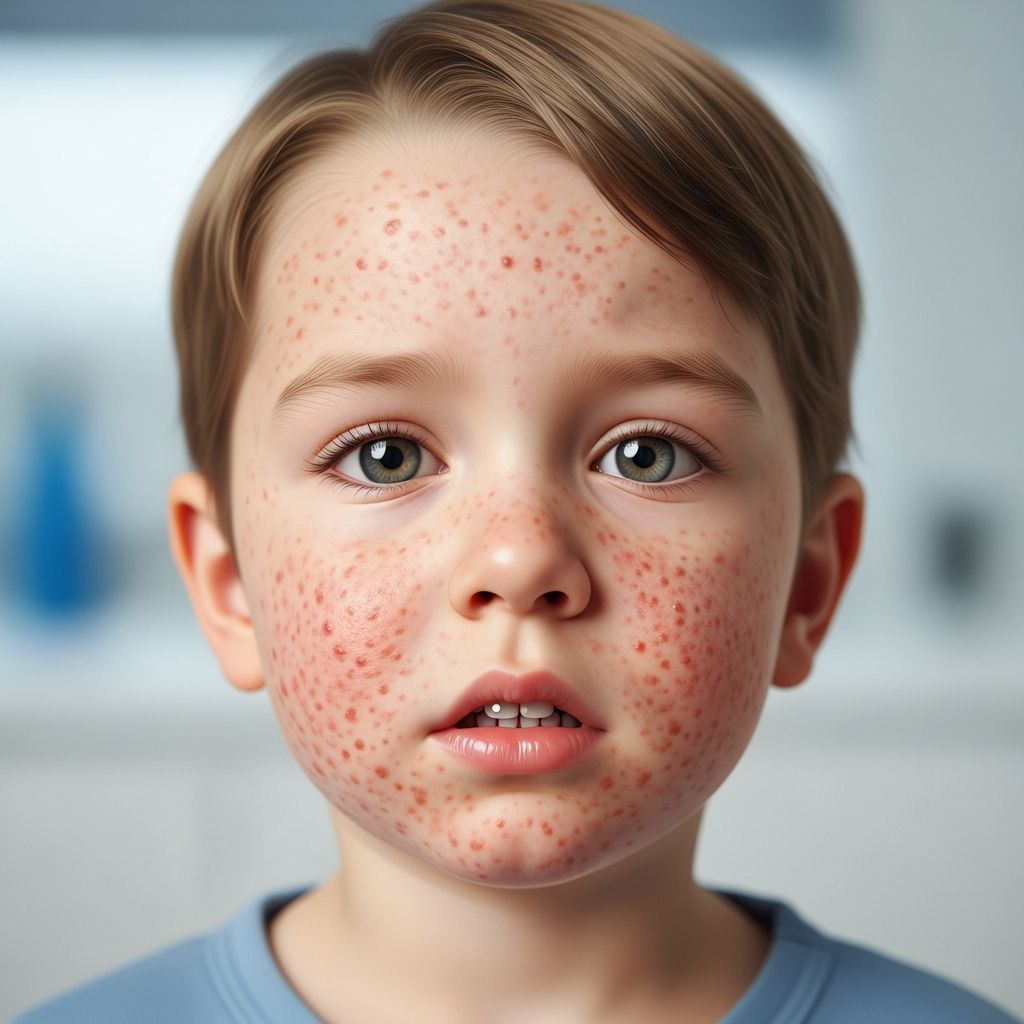
- Appearance: Red, blotchy, and maculopapular in nature, meaning it consists of both flat red spots (macules) and raised bumps (papules)
- Blanching: The rash initially blanches (turns white) when pressure is applied, but after 3 to 4 days, it no longer blanches with pressure
- Color: The rash appears as pink or red spots that may coalesce as it spreads across the body
- Pruritus: The measles rash is typically not itchy, which can help differentiate it from other conditions
Related Stories



Rash Distribution Pattern
One of the most characteristic features of measles is its distinctive distribution pattern across the body. The rash typically develops 3 to 5 days after initial symptoms appear. The spatial progression follows a predictable sequence:
- Initial onset: The rash begins on the face near the hairline or behind the ears
- Progression: The rash spreads downward and around to the rest of the body over the next several days
- Distribution: The rash typically reaches the hands and feet as it progresses
- Notable sparing: The measles rash characteristically spares the palms of the hands and the soles of the feet, which helps distinguish it from other viral exanthems like mpox
This cephalocaudal (head-to-toe) distribution pattern is so consistent that it serves as a diagnostic hallmark of measles infection.
Duration and Resolution
The measles rash typically lasts between 4 to 7 days, with most sources indicating resolution after 5 to 6 days. An important clinical observation is that the rash fades in the same order it appeared – beginning on the face and progressively resolving downward across the body. This predictable resolution pattern further aids in clinical recognition and documentation of measles cases.
Measles Rash Appearance on Different Skin Tones
Visual recognition of measles across diverse populations is essential for equitable healthcare. The appearance of the measles rash can vary based on skin tone, which is important for healthcare providers to understand to avoid missed diagnoses.
On lighter skin, the rash appears as distinct red or pink spots that stand out clearly against the surrounding skin. On darker skin tones, the rash may be more difficult to visualize, as red coloration is less apparent against darker pigmentation. The maculopapular texture and raised nature of the rash typically remain apparent regardless of skin tone, though careful examination may be required. Healthcare professionals should be trained to identify measles across all skin types by assessing both the texture of the rash and its distribution pattern, rather than relying solely on color recognition.
Distinguishing Measles from Other Viral Exanthems
Several other viral infections produce rashes that can resemble measles, making differential diagnosis important for appropriate management. The following comparison helps distinguish measles from similar conditions:
| Characteristic | Measles | Chickenpox | Mpox |
|---|---|---|---|
| Rash Development Speed | Rapid | Rapid | Slow |
| Initial Location | Face, spreads downward | More concentrated on torso | More concentrated on face |
| Palms and Soles | Absent | Absent | Present |
| Associated Fever Timing | Fever present with rash onset | Fever often decreases as rash appears | Fever develops with rash |
Rubella, also called German measles, is another condition that may appear similar but typically presents with a milder rash and less severe systemic symptoms compared to measles. Understanding these distinctions helps clinicians provide accurate diagnoses and appropriate management.
Diagnostic Confirmation
While clinical appearance and history are important, laboratory confirmation of measles is often necessary. Diagnostic methods include:
- Serological testing: Blood tests for measles IgM and IgG antibodies, with IgM elevated during active infection and IgG appearing during recovery
- Viral culture: Throat and nasopharyngeal swabs, particularly useful in immunocompromised patients where serological evidence might be absent
- Immunofluorescence testing: Antigen detection in patients with poor immune response
These diagnostic tools provide definitive confirmation of measles infection and support public health surveillance efforts.
Prevention Through Vaccination
Measles can be effectively prevented through vaccination with the live attenuated measles vaccine. The vaccine is available as a single-antigen preparation or combined with mumps and/or rubella vaccines. The combined measles, mumps, and rubella (MMR) vaccine is now part of routine immunization programs in most industrialized countries.
Full protection against measles requires two doses of the MMR vaccine after 12 months of age. While a single dose provides some protection, 99% of people who receive two doses will be fully protected against the disease. People who received measles vaccines before 1968 may require revaccination, as vaccines used before that time may not have conferred lifelong immunity.
Clinical Significance and Complications
Recognition of measles through visual identification is important because measles can lead to serious complications, particularly in young children, pregnant women, and immunocompromised individuals. Early identification allows for appropriate monitoring, supportive care, and public health measures to prevent transmission to vulnerable populations. The distinctive morbilliform rash, combined with prodromal symptoms and specific distribution pattern, makes measles identifiable to trained healthcare providers, supporting timely intervention and disease surveillance.
Frequently Asked Questions
Q: What does the measles rash look like in its early stages?
A: In its early stages, the measles rash appears as flat red spots (macules) and raised bumps (papules) that begin on the face near the hairline or behind the ears. The rash is red or pink in color and blanches (turns white) when pressure is applied initially. It typically appears 3 to 5 days after the onset of fever and other prodromal symptoms.
Q: How long does the measles rash last?
A: The measles rash typically lasts between 4 to 7 days, with most cases resolving after 5 to 6 days. The rash fades in the same order it appeared, beginning on the face and progressively resolving downward across the body.
Q: Why is the measles rash difficult to see on darker skin?
A: The measles rash appears as red or pink discoloration, which is less visually apparent against darker skin pigmentation. However, the characteristic maculopapular texture and distribution pattern remain consistent. Healthcare providers should assess both the texture and distribution pattern rather than relying solely on color recognition.
Q: How can I distinguish measles rash from chickenpox rash?
A: Measles rash typically develops rapidly, starts on the face, and spreads downward while sparing the palms and soles. Chickenpox rash is more concentrated on the torso and also spares palms and soles. Additionally, measles rash is maculopapular and blotchy, while chickenpox typically includes vesicles (fluid-filled blisters) at some stages.
Q: What are Koplik spots and why are they important?
A: Koplik spots are small white spots that appear inside the cheeks (buccal mucosa) during the prodromal phase of measles, typically appearing 2 to 3 days before the characteristic rash develops. They are pathognomonic (uniquely characteristic) of measles and serve as an early diagnostic indicator of impending measles rash development.
Q: Is the measles rash itchy?
A: No, the measles rash is typically not itchy, which helps differentiate it from other conditions such as chickenpox or allergic rashes. The absence of pruritus is a characteristic feature of measles.
Q: When is someone contagious with measles?
A: A person with measles is contagious from 4 days before the rash appears to 4 days after rash onset. This means transmission can occur during the prodromal phase when only fever and respiratory symptoms are present, before the diagnostic rash appears.
References
- Measles Updates — New Mexico Environmental and Community Education Development (NMECECD). 2025. https://www.nmececd.org/wp-content/uploads/2025/03/02.2025-Measles-EC-Call-002.pdf
- Clinical Information – Measles — American Academy of Dermatology (AAD). 2025. https://www.aad.org/member/clinical-quality/clinical-care/emerging-diseases/measles/clinical-information
- Viral skin infections: Specific viral exanthems — DermNet New Zealand. 2025. https://dermnetnz.org/cme/viral-infections/specific-viral-exanthems
- Measles: A guide for education settings — Health New Zealand | Te Whatu Ora. 2025. https://www.tewhatuora.govt.nz/for-health-professionals/clinical-guidance/diseases-and-conditions/measles/measles-education-settings
- Measles (morbilli) — DermNet New Zealand. 2025. https://dermnetnz.org/topics/measles
- Measles: Skin Assessment Guidance — Johns Hopkins University Public Health. 2025. https://publichealth.jhu.edu/sites/default/files/2025-04/Skin-Assessment-Guidance_Measles-4.7.2025.pdf
Similar Articles








Read full bio of Sneha Tete