Median Canaliform Nail Dystrophy: Causes And Treatment
Understanding the causes, symptoms, diagnosis, and treatment of this distinctive nail plate disorder affecting thumbnails primarily.
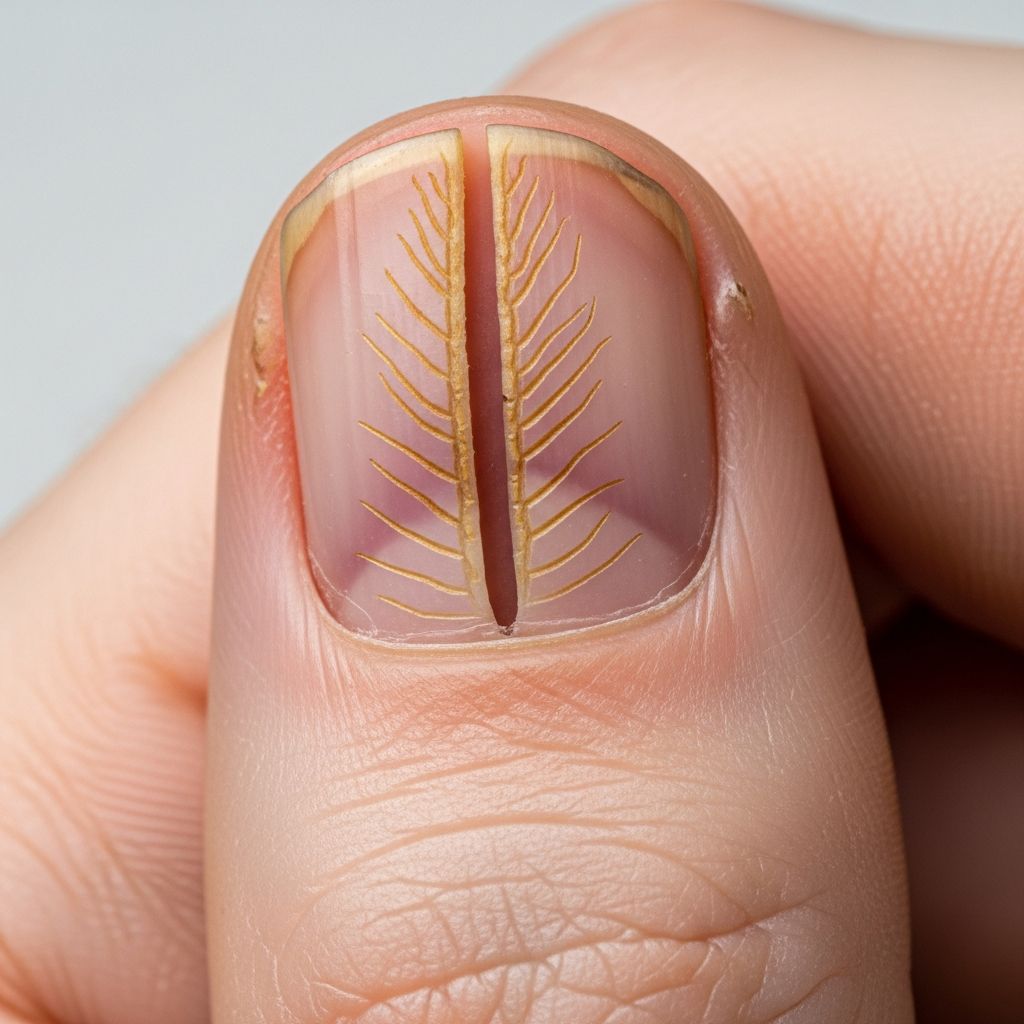
Median canaliform nail dystrophy, also known as median nail dystrophy or dystrophia unguis mediana canaliformis, is a distinctive acquired nail disorder characterized by a midline
longitudinal furrow or split
in the nail plate, accompanied by transverse ridges angled backwards in afir-tree pattern
.Introduction
This condition manifests as a central canal or groove running longitudinally down the middle of the nail, often resembling an upside-down Christmas tree due to lateral fissures or cracks extending from the center. It primarily affects the thumbnails but can involve other nails, resulting from temporary defects in nail matrix keratinocyte adhesion that compromise the nail plate’s tensile strength.
The disorder is clinically striking and typically self-resolving, though it can persist if underlying causes like trauma continue. Early recognition aids in distinguishing it from similar conditions and guiding appropriate management.
Demographics
Median canaliform nail dystrophy can occur in
all age groups
, including children, with no gender predilection—men and women are affected equally. Familial cases have been documented, suggesting a possible genetic predisposition in rare instances, though most are sporadic.The mean age of onset is around 25-26 years, but pediatric presentations highlight its broad demographic reach. It affects individuals across ethnicities without reported disparities.
Causes
The primary etiology is
microtrauma to the nail matrix
, leading to a transient defect in keratinocyte adhesion and reduced nail plate strength. This trauma may stem from habitual behaviors such as rubbing the proximal nail fold with the index finger tip, nail picking, or repetitive pressure.- Idiopathic/sporadic cases: Most common, with no identifiable trigger.
- Trauma-related: Chronic or acute injury to the matrix, including self-inflicted habits like nail biting or manicure overuse.
- Drug-induced: Rare associations with systemic isotretinoin therapy.
- Associated conditions: Linked to psoriasis, lichen planus, eczema, or fungal infections like onychomycosis impacting the matrix.
- Familial: Genetic clustering reported, though uncommon.
Risk factors include family history, autoimmune diseases (e.g., lupus), and exposure to irritants or chemicals in nail products. Unlike habit-tic deformity, which causes transverse ridges without a true midline split, median canaliform dystrophy features a prominent central canal.
Clinical Features
The hallmark is a
longitudinal split or furrow
extending from the proximal nail fold to the free edge, typically midline but occasionally paramedian. Transverse ridges or splits branch obliquely backwards toward the nail fold, creating the characteristic fir-tree appearance.Common findings include:
- Primary involvement of both thumbnails, though unilateral or other nails/toenails possible.
- **Enlarged lunulae (macrolunulae)** and proximal nail fold thickening/redness.
- Nail thinning, brittleness, discoloration (yellowish/brownish), and fragility prone to breaking.
- Spoon-shaped deformity (koilonychia) in severe cases.
- Pain, tenderness, or discomfort around the affected area.
The split’s depth correlates with trauma intensity; lateral cracks give the evergreen branch-like pattern. Symmetry is usual, but asymmetry occurs.
Complications
While often cosmetic, complications include:
- Nail deformity leading to functional impairment in daily tasks like gripping or typing.
- Secondary infections from cracks, especially if hygiene is poor.
- Pain and tenderness exacerbating with pressure or further trauma.
- Psychosocial impact from visible changes, particularly on thumbnails.
- Progression to permanent dystrophy if causes persist untreated.
Rarely, associated systemic conditions like psoriasis may worsen overall nail health.
Diagnosis
Diagnosis is primarily
clinical
, based on the characteristic fir-tree midline split. No specific lab tests are required unless differentials are suspected.Related Stories



Histopathology (if biopsied) reveals parakeratosis, melanin accumulation in nail bed keratinocytes, and absence of keratinocytic adhesions with dyskeratosis.
Key diagnostic clues:
| Feature | Description |
|---|---|
| Midline canal | Longitudinal from cuticle to edge |
| Fir-tree ridges | Oblique transverse splits backward |
| Lunula | Enlarged (macrolunulae) |
| Symmetry | Often bilateral thumbnails |
Patient history of trauma or habits supports diagnosis.
Differential Diagnoses
Several conditions mimic median canaliform nail dystrophy:
- Habit-tic deformity: Transverse washboard ridges from proximal fold picking; no true midline split, depression present.
- Psoriasis/Lichen planus: Pitting, onycholysis; systemic signs.
- Onychomycosis: Subungual hyperkeratosis, yellowing; KOH positive.
- Trachyonychia: Rough, sandpaper-like nails.
- Median nail dystrophy variants: Subtypes like thumb-specific or dorsal splitting.
Dermoscopy aids differentiation; biopsy rarely needed.
Treatment
No curative treatment exists; management focuses on
cause elimination
and symptom relief.- Behavioral modification: Cease nail picking, rubbing, or trauma; protective gloves for irritant exposure.
- Topical therapies: Corticosteroids for inflammation; antifungals if infection suspected.
- Supportive care: Nail hardeners, biotin supplements (limited evidence).
- In severe cases: Intralesional steroids or address underlying psoriasis.
Spontaneous resolution occurs with trauma cessation, often within months as nail grows out.
Outcome
Prognosis is excellent with early intervention; nails normalize as the matrix recovers. Persistence risks permanent changes, but most cases resolve without scarring. Patient education on avoiding habits prevents recurrence.
Frequently Asked Questions (FAQs)
Q: What causes median canaliform nail dystrophy?
A: Primarily microtrauma to the nail matrix from habits like rubbing or picking, leading to defective keratinocyte adhesion.
Q: Does it only affect thumbnails?
A: Thumbnails are most common (often bilateral), but other fingernails and toenails can be involved.
Q: Is median canaliform nail dystrophy permanent?
A: No, it typically resolves spontaneously once trauma stops, with new nail growth normalizing appearance.
Q: How is it different from habit-tic deformity?
A: Habit-tic shows transverse ridges without a midline canal; median canaliform has a central split with fir-tree branches.
Q: Can children get this condition?
A: Yes, it affects all ages, including children, with equal gender distribution.
Q: Is treatment always necessary?
A: Often not; stopping the cause suffices, but topicals help symptoms.
References
- Median canaliform nail dystrophy – Dr. Breslavets | CMSD — Canadian Medical Skin Dermatology. 2023. https://cmsderm.ca/median-canaliform-nail-dystrophy/
- Median Nail Dystrophy: Causes, Symptoms And Treatment — Medicover Hospitals. 2024. https://www.medicoverhospitals.in/diseases/median-nail-dystrophy/
- Median nail dystrophy — Wikipedia (informed by primary sources). 2024. https://en.wikipedia.org/wiki/Median_nail_dystrophy
- Median Nail Dystrophy Involving the Thumb Nail — PubMed Central (PMC). 2015-12-01. https://pmc.ncbi.nlm.nih.gov/articles/PMC4763640/
- Median canaliform nail dystrophy — DermNet NZ. 2024. https://dermnetnz.org/topics/median-canaliform-nail-dystrophy
- Is there a difference between habit tic and median canaliform nail dystrophy of Heller? — NSI Journal. 2023. https://nsijournal.com/is-there-a-difference-between-habit-tic-and-median-canaliform-nail-dystrophy-of-heller/
- Nail Dystrophies — Merck Manuals Professional Edition. 2024. https://www.merckmanuals.com/professional/dermatologic-disorders/nail-disorders/nail-dystrophies
Similar Articles








Read full bio of Sneha Tete