Melanocytic Naevi In Skin Of Color: Images And Clinical Guide
Explore melanocytic naevi in darker skin tones: images, characteristics, diagnosis, and management strategies.
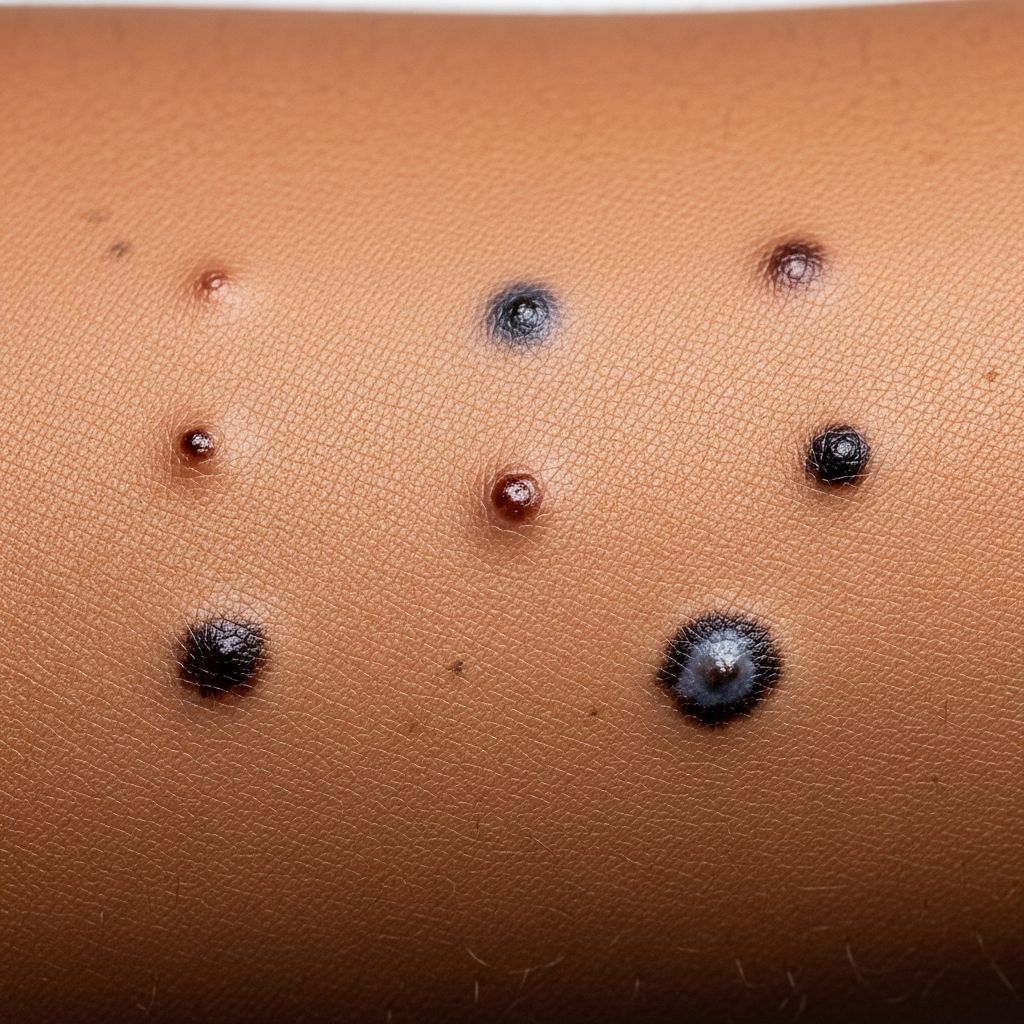
Melanocytic naevi, commonly known as moles, are benign proliferations of melanocytes, the pigment-producing cells in the skin. In individuals with skin of colour—typically Fitzpatrick skin types IV–VI—these lesions often appear darker, more uniform, and may exhibit distinct clinical and dermoscopic features compared to those in lighter skin tones. This article presents authoritative images and detailed descriptions to aid dermatologists, healthcare providers, and patients in recognizing and managing melanocytic naevi in diverse skin types.
Introduction to Melanocytic Naevi
A
melanocytic naevus
is a common benign skin lesion resulting from the local proliferation of melanocytes. These can be congenital (present at birth) or acquired (developing later). In skin of colour, naevi tend to be more heavily pigmented, often black or dark brown, due to higher baseline melanin production. Most individuals have 20–50 naevi, influenced by genetics, sun exposure, and immune status. Unlike in fair skin, where naevi may fade, those in darker skin often persist and darken with age or sun exposure.Key characteristics include:
- Uniform colour, typically black in dark skin.
- Round or oval shapes, flat or raised surfaces.
- Possible hypertrichosis (increased hair) in compound or intradermal types.
Clinical Features in Skin of Colour
In darker skin, melanocytic naevi present with intensified pigmentation, making them stand out against the background skin tone. Junctional naevi appear as flat, evenly coloured mid-to-dark brown or black macules. Compound naevi are raised brown bumps, often hairy with a warty surface. Intradermal naevi are paler raised bumps, sometimes skin-coloured or pink, but in skin of colour, they retain more pigment.
Congenital melanocytic naevi, which form early in gestation (5th–24th weeks), are larger and may cover extensive areas like a ‘garment naevus’ or include satellite lesions. They can itch due to reduced sebaceous and eccrine gland function, leading to dryness and fragility. Puberty often causes darkening, raising, and increased hairiness.
| Type | Clinical Appearance in Skin of Colour | Common Locations |
|---|---|---|
| Junctional | Flat, uniform black/brown macule | Trunk, limbs |
| Compound | Raised, dark brown, hairy bump | Face, back |
| Intradermal | Raised, paler but pigmented dome | Face, scalp |
| Congenital | Multi-shaded patch, possible satellites | Extensive, e.g., garment-like |
Images from clinical cases show these features vividly: a black junctional naevus on the arm of a patient with Fitzpatrick type V skin appears uniformly pigmented without irregularity, distinguishing it from melanoma. Another depicts a compound naevus on the cheek, raised with terminal hairs.
Dermoscopic Features
Dermoscopy is crucial for evaluating naevi in skin of colour, where clinical darkness can mimic malignancy. Benign naevi show
uniform pigment patterns
: homogenous blue-grey in blue naevi, regular globules in compound types, or network patterns in junctional ones.- Single colour or symmetric patterns: Nearly always benign; darker in pigmented skin.
- Vascular patterns: Comma-like or hairpin vessels in dermal naevi, often obscured by pigment.
- Congenital patterns: Irregular globules, fibrillar structures, or ‘cobblestoning’.
In halo naevi, a white rim surrounds the central lesion, with dermoscopy revealing symmetric hypopigmentation and fading globules. Nail apparatus naevi show uniform longitudinal melanonychia bands. The ‘ugly duckling’ sign— a naevus differing from others—warrants biopsy, especially if asymmetric or multicomponent.
Related Stories



Types of Melanocytic Naevi
Junctional Melanocytic Naevi
These flat lesions feature melanocytes at the dermo-epidermal junction. In skin of colour, they are sharply demarcated black macules, uniform under dermoscopy with regular networks. Image: Uniform black naevus on thigh.
Compound Melanocytic Naevi
Nests at junction and dermis create raised, darker lesions. Often hairy; dermoscopy shows globules atop networks. Prevalent on sun-exposed areas.
Intradermal Melanocytic Naevi
Confined to dermis, these are dome-shaped, less pigmented but still brown in dark skin. Prominent comma vessels on dermoscopy.
Congenital Melanocytic Naevi
Present at birth, linked to genetic mutations (e.g., NRAS). Giant forms (>20cm) risk neurocutaneous melanosis. In skin of colour, satellites are hyperpigmented.
Special Types
- Spitz naevus: Pink/brown dome in youth; starburst pattern.
- Blue naevus: Steel-blue homogenous.
- Reed naevus: Dark spindle cells on limbs.
- Halo naevus: Fading with immune response.
Diagnosis and Differential
Diagnosis relies on history, exam, and dermoscopy. ABCDE rule (Asymmetry, Border irregularity, Colour variation, Diameter >6mm, Evolving) applies but adapt for skin of colour—uniform black is often benign. Biopsy for atypia. Differentials: melanoma (asymmetric), seborrhoeic keratosis, pigmented BCC.
Complications and Risks
Benign but psychological impact from visibility. Rare melanoma risk in giant congenital naevi (2–5%). Itch, ulceration in large lesions. Neurocutaneous melanosis in 15% of giant cases.
Management
Observation for typical naevi. Excision for symptomatic, changing, or cosmetic concerns. Laser for hypertrichosis. Sun protection vital.
Frequently Asked Questions (FAQs)
Q: Are melanocytic naevi in dark skin more likely to be cancerous?
A: No, most are benign. Uniform dark colour is typical; monitor for ABCDE changes.
Q: How do naevi differ in skin of colour vs. white skin?
A: Darker, more persistent pigmentation; single uniform colour common on dermoscopy.
Q: When should a naevus be biopsied?
A: If atypical (ugly duckling), changing, symptomatic, or high-risk patient.
Q: Can congenital naevi disappear?
A: Rarely; they often enlarge proportionally or darken at puberty.
Q: Is dermoscopy useful in skin of colour?
A: Yes, reveals patterns obscured clinically, confirming benignity.
This article synthesizes clinical insights for better naevus recognition in diverse populations, emphasizing images for visual learning.
References
- Congenital melanocytic naevi — DermNet NZ. 2023-05-15. https://dermnetnz.org/topics/congenital-melanocytic-naevi
- Benign mole (melanocytic naevi) — MySkinDoctor. 2024-01-10. https://www.myskindoctor.co.uk/benign-mole-melanocytic-naevi/
- Moles (melanocytic naevi, pigmented nevi) — DermNet NZ. 2024-08-20. https://dermnetnz.org/topics/melanocytic-naevus
- Dermoscopy of benign melanocytic lesions — DermNet NZ. 2023-11-05. https://dermnetnz.org/cme/dermoscopy-course/dermoscopy-of-benign-melanocytic-lesions
- Intradermal and Compound Naevi (Moles) — Patient.info. 2024-02-14. https://patient.info/doctor/dermatology/intradermal-and-compound-naevi
- Melanocytic naevi: new classification — DermNet NZ. 2023-07-22. https://dermnetnz.org/cme/dermoscopy-course/melanocytic-naevi-new-classification
Similar Articles








Read full bio of medha deb