Melanocytic Naevi: 7-Group Dermoscopic Classification Guide
Explore the seven-group dermoscopic classification of melanocytic naevi for precise diagnosis and melanoma differentiation.
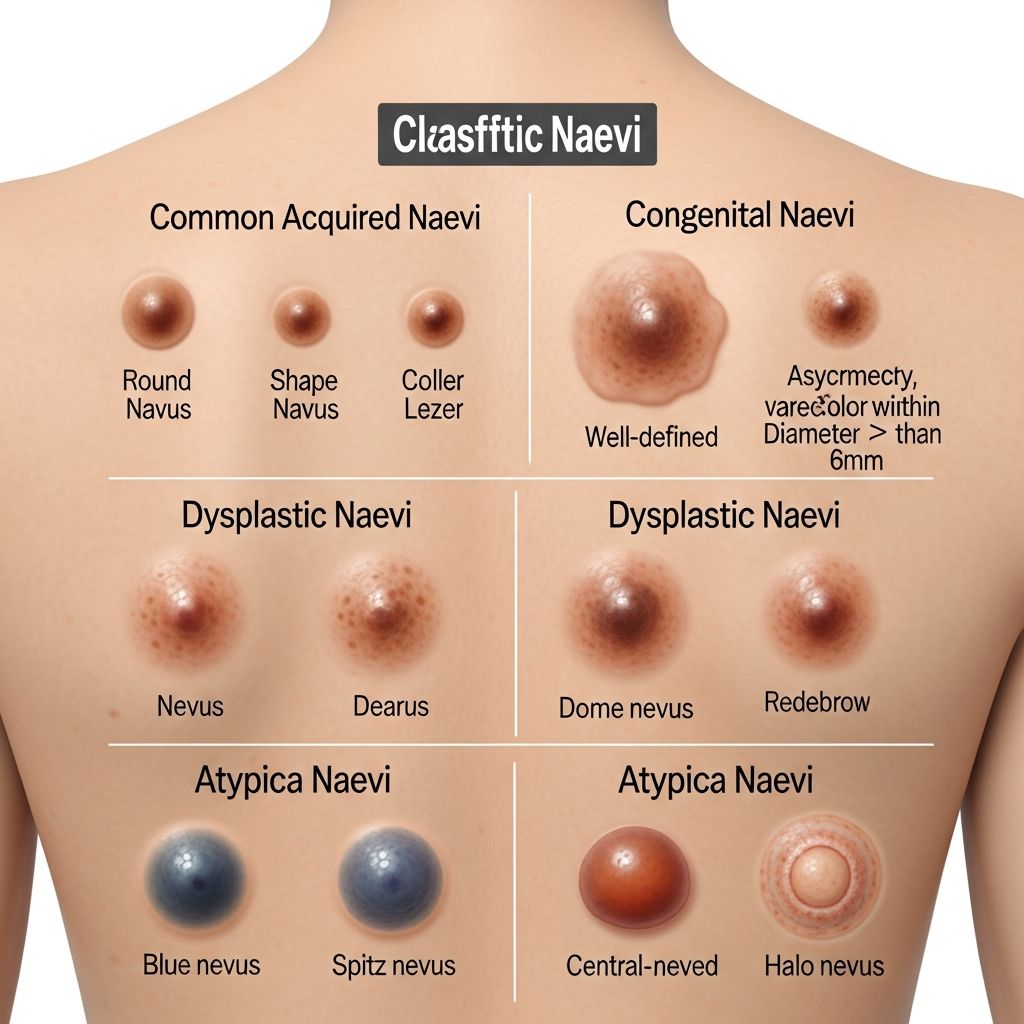
Melanocytic Naevi: New Classification
Melanocytic naevi, commonly known as moles, are benign proliferations of melanocytes that vary widely in appearance. Traditional classifications relied on history (congenital vs. acquired) and histopathology (junctional, compound, dermal), but these often proved imprecise for clinical diagnosis. Advances in dermoscopy have revolutionized this field by revealing pigment patterns that allow for more accurate categorization. The historical model suggesting naevi progress from junctional to compound to dermal has been debunked through detailed dermoscopic analysis of numerous lesions. Instead, dermoscopy identifies distinct patterns based on pigmentation distribution, enabling clinicians to recognize benign naevi and spot the ‘ugly duckling’—a lesion differing from an individual’s typical naevi, which may signal melanoma.
This new classification divides melanocytic naevi into seven groups, providing a practical framework for describing dermoscopic features. Clinicians are encouraged to adopt this system to enhance diagnostic precision, particularly in distinguishing benign lesions from malignancy. The classification emphasizes symmetry, uniform structure, and specific pigment networks, which are hallmarks of benignity. Below, we explore each group in detail, including clinical presentation, dermoscopic hallmarks, and histopathological correlates where applicable.
Structureless Naevi
Structureless naevi represent one of the simplest patterns in the new classification. These lesions appear as uniform areas of pigmentation without discernible internal structures under dermoscopy.
- Clinical features: Flat, tan to brown macules, often on the trunk or limbs of children and young adults.
- Dermoscopic features: Homogeneous pigmentation lacking networks, globules, or dots. The uniformity is key to benignity.
- Histopathology: Lentiginous proliferation of melanocytes at the dermoepidermal junction with minimal nesting.
These naevi are common and stable, rarely evolving into concerning lesions. Their lack of structure differentiates them from more complex patterns.
Globular Naevi
Globular naevi are characterized by rounded, sacculated globules of pigment, reflecting aggregated melanocytes.
- Clinical features: Dome-shaped papules, typically brown, on the back or extremities.
- Dermoscopic features: Large, well-defined globules of uniform size and color, often with peripheral reticular fading. Symmetry is prominent.
- Histopathology: Compound naevi with nests of melanocytes in the dermis, showing maturation downward.
This pattern is prevalent in younger patients and aligns with the compound naevus subtype. Dermoscopy reveals a cobblestone-like appearance due to the globules.
Reticular Naevi
Reticular naevi display a mesh-like pigment network, indicative of junctional melanocytic nests.
- Clinical features: Flat to slightly elevated macules, light to dark brown.
- Dermoscopic features: Delicate, regular reticular pattern with thickened lines and thin meshwork. Uniform pigmentation throughout.
- Histopathology: Junctional naevi with melanocytes aligned along the basement membrane.
The reticular pattern is a classic benign feature, contrasting with atypical networks seen in melanoma.
Complex (Plexiform) Naevi
Complex or plexiform naevi combine multiple patterns, such as globules and reticular elements, creating a heterogeneous yet organized appearance.
- Clinical features: Variably elevated lesions with irregular borders but symmetrical overall shape.
- Dermoscopic features: Coexistence of globules, networks, and structureless areas in a symmetric fashion.
- Histopathology: Features of both junctional and compound naevi with maturation.
Despite apparent complexity, these remain benign if patterns are symmetrically distributed.
Starburst Naeevus / Reed Naevi
Starburst and Reed naevi exhibit a radial streaming pattern, often in younger individuals.
- Clinical features: Dark brown to black papules, commonly on limbs.
- Dermoscopic features: Starburst pattern with pigmented streaks radiating from a central globule; may evolve to globular over time.
- Histopathology: Spindle-shaped melanocytes in the dermis, akin to Reed naevus; H-RAS mutations noted.
These are benign but can mimic melanoma; follow-up dermoscopy tracks regression of streaks.
Blue Naevi
Blue naevi are distinguished by their deep dermal pigmentation, appearing blue-black clinically.
| Clinical features | Dermoscopic features | Histopathology |
|---|---|---|
| Flat to elevated, blue to black | Homogeneous steel-blue pigmentation | Dermal melanocytes with spindled morphology |
These naevi lack epidermal involvement, explaining their uniform blue hue under dermoscopy. Cellular blue naevus variants may show more cellularity.
Site-Related Naevi
Naevi in specific anatomical sites display unique dermoscopic patterns adapted to local skin architecture.
| Site | Clinical features | Dermoscopic features | Histopathology |
|---|---|---|---|
| Acral | On palms/soles | Parallel furrow or lattice patterns | Melanocytes along ridges/furrows |
| Subungual (nails) | Under nails | Band-like pigmentation | Nail matrix involvement |
| Facial | On face | Pseudonetwork around follicles | Intradermal with neurotization |
| Lips | Congenital/prepubertal | Reticular with globules | Compound pattern |
| Nipple | Congenital/prepubertal | Specialized structures | Deep dermal extension |
Acral naevi, for instance, show parallel lines due to skin furrows, crucial for differentiating from acral melanoma. Facial naevi often mimic lentigo maligna but feature wrinkled pseudonetworks.
Naevi with Special Features
This heterogeneous group includes naevi altered by inflammation, regression, or other phenomena.
| Type | Clinical features | Dermoscopic features |
|---|---|---|
| Combined naevi | Two patterns colliding | Overlapping globular/reticular |
| Halo naevi | Depigmented halo | Central naevus with white rim |
| Irritated naevi | Erythematous | Peripheral dotted vessels |
| Cockade naevus | Targetoid | Central structureless, peripheral network |
| Meyerson naevus | Eczematous halo | Yellow clods, vessels |
| Recurrent naevi | Post-biopsy | Reinke’s phenomenon |
Halo naevi indicate immune regression, with lymphocytic infiltrates histologically. Meyerson naevi feature eczematous changes, resolving with treatment.
Unclassifiable Naevi
Some naevi defy categorization due to atypical or evolving features. These warrant close monitoring or biopsy if asymmetric or changing. Dermoscopy guides triage: benign unclassifiable naevi lack melanoma-specific criteria like atypical networks or blue-white veils[10].
Frequently Asked Questions (FAQs)
Q: What is the main advantage of the new dermoscopic classification of melanocytic naevi?
A: It provides precise, non-invasive diagnosis based on pigment patterns, improving differentiation from melanoma compared to traditional histopathology.
Q: How do globular naevi differ from reticular naevi under dermoscopy?
A: Globular naevi show rounded globules, indicating dermal nests, while reticular naevi display a meshwork from junctional activity.
Q: Are acral naevi more likely to be malignant?
A: No, but their parallel patterns must be distinguished from acral melanoma’s irregular lines; dermal maturation confirms benignity.
Q: What causes halo naevi?
A: Lymphocytic destruction leads to regression, creating a white halo; associated with vitiligo in some cases.
Q: When should an unclassifiable naevus be biopsied?
A: If it changes, is asymmetric, or differs from a patient’s other naevi (ugly duckling sign).
Clinical Implications and Management
The new classification enhances patient care by reducing unnecessary biopsies. Regular dermoscopic monitoring detects evolution early. For congenital naevi, size-based classification (small <1.5 cm, medium 1.5-10 cm, giant >20 cm) complements dermoscopy, noting deeper dermal involvement. Genetic factors like BRAF mutations in acquired naevi underscore benign evolution.
In practice, educate patients on self-examination: ABCDE rule (Asymmetry, Border irregularity, Color variation, Diameter >6mm, Evolving) alongside dermoscopy. Sun protection prevents new naevi and malignant transformation risk.
References
- Melanocytic naevi: new classification — DermNet NZ. 2008 (updated). https://dermnetnz.org/cme/dermoscopy-course/melanocytic-naevi-new-classification
- Melanocytic naevi pathology — DermNet NZ. Accessed 2026. https://dermnetnz.org/topics/melanocytic-naevi-pathology
- Congenital melanocytic naevi — DermNet NZ. Accessed 2026. https://dermnetnz.org/topics/congenital-melanocytic-naevi
- Melanocytic naevus — DermNet NZ. Accessed 2026. https://dermnetnz.org/topics/melanocytic-naevus
- Benign melanocytic lesions — DermNet NZ. Accessed 2026. https://dermnetnz.org/cme/lesions/benign-melanocytic-lesions
- Dermoscopy of benign melanocytic lesions — DermNet NZ. Accessed 2026. https://dermnetnz.org/cme/dermoscopy-course/dermoscopy-of-benign-melanocytic-lesions
Similar Articles




Read full bio of Sneha Tete