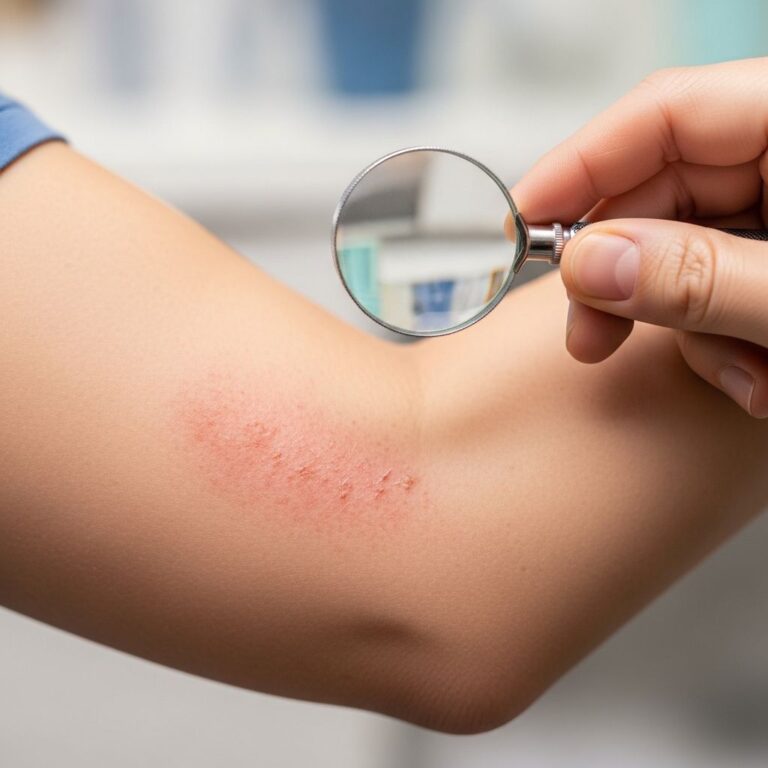
Melanocytic Naevi Pathology: Key Histologic Features
Comprehensive pathology of melanocytic naevi: from common moles to atypical variants and differentials.
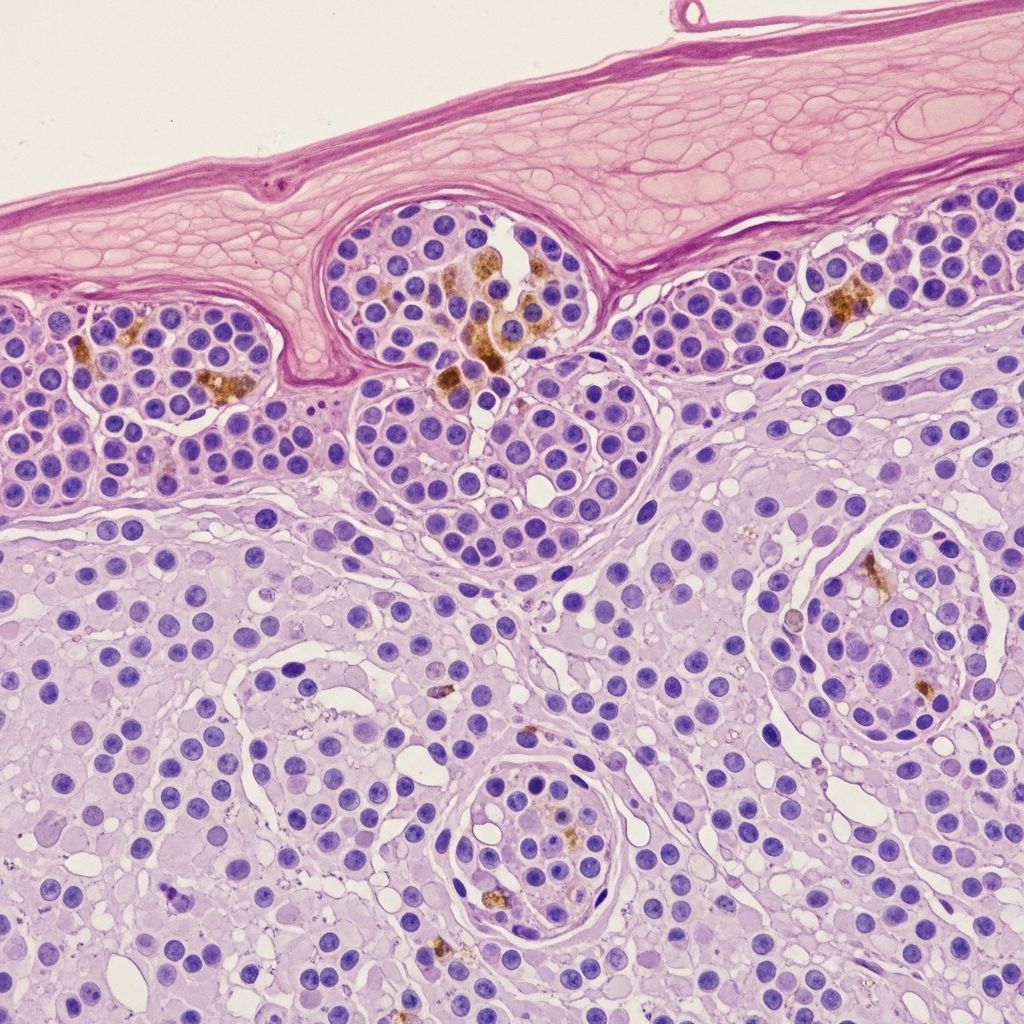
Acquired melanocytic naevus, commonly known as a mole, represents a frequent benign tumour arising from melanocyte proliferation, typically emerging during childhood and adolescence. Sun exposure, especially in early life, plays a pivotal causative role, often complemented by an initiating point mutation in the BRAF gene, most commonly the V600E variant. These lesions undergo evolutionary changes over time: initially presenting as macular with nests of melanocytes confined to the dermoepidermal junction, they progressively extend into the dermis, becoming elevated. Mature forms cease junctional activity, transitioning to predominantly intradermal locations.
Clinical features
Junctional naevi manifest as pigmented macules. Compound naevi feature a central raised area encircled by flat pigmentation. Intradermal naevi appear dome-shaped, nodular, or polypoid, potentially losing pigmentation, particularly on facial sites.
Pathology
Junctional naevus
Junctional naevi are characterized histologically by proliferating melanocytes at the dermoepidermal junction. These cells form nests that are oval or cuboidal, featuring clear cytoplasm and variable pigmentation levels. The nests are uniformly sized, regularly spaced, and lack significant cytological atypia, maintaining a sharp lateral demarcation from surrounding epidermis.
- Nests confined to the junctional zone.
- Cells show uniform nuclei with inconspicuous nucleoli.
- Minimal or absent dermal component.
Compound melanocytic naevus
Compound melanocytic naevi exhibit nests of melanocytes both at the dermoepidermal junction and within the dermis. The epidermis may appear normal, acanthotic, or resemble seborrhoeic keratosis. A hallmark is
maturation
with depth: superficial melanocytes are epithelioid and pigmented, transitioning to smaller, less pigmented, spindle-shaped cells deeper in the dermis. Nests decrease in size and become more separated by fibrous stroma.- Biphasic distribution: junctional and dermal nests.
- Progressive maturation and reduced pigmentation downward.
- Lymphocytic infiltrate may be present but sparse.


Intradermal naevus
Intradermal naevi lack junctional activity, with melanocyte nests confined to the dermis. These lesions often display
pseudo-inclusions
—invaginations of cytoplasm into the nucleus mimicking inclusions or multinucleation. Deeper cells may neurotise (become spindle-shaped) or undergo fatty differentiation. Rarely, bone formation occurs, termed naevus of Nanta.- Dome-shaped or polypoid architecture.
- Neurotisation and lipomatous change common.
- Loss of pigmentation with maturation.

Special types of melanocytic naevi
Meyerson naevus
The Meyerson naevus features an eczematous halo around a junctional, compound, or intradermal naevus. Histology reveals subacute spongiotic dermatitis overlying or surrounding the naevus nests, with exocytosis of lymphocytes into the epidermis.

Balloon cell naevus
Balloon cell naevi contain large melanocytes with abundant clear, foamy cytoplasm due to vacuolated degeneration. Diagnosis requires over 50% balloon cells. These are typically compound or intradermal and lack atypia.

Halo naevus
Halo naevi show regression via lymphocytic destruction of melanocytes, resulting in a depigmented halo. Dense dermal lymphocytic infiltrates surround and infiltrate naevus nests, often obscuring cytology. Association with vitiligo is noted.
Related Stories





Naevus with atypical melanocytic proliferation
Naevus from sites like auricle, breast, conjunctiva, or ankle may exhibit atypical epidermal proliferations with pagetoid spread and cytological atypia, mimicking dysplasia. Benign clues include circumscription, maturation, and lack of diffuse atypia. Complete excision is advised to avoid partial biopsy pitfalls.
Melanocytic acral naevus with intraepidermal ascent of cells (MANIAC)
MANIAC describes acral naevi with marked pagetoid ascent, sometimes reaching upper epidermis, mimicking melanoma in situ. Key benign features: nested architecture, ascent above nests (not diffuse lentiginous), melanin ‘smoke stacks’ in stratum corneum, and dermal maturation.


Symmetric atypical melanocytic proliferation of sun-exposed skin (SAMPUS)
SAMPUS overlaps with dysplastic naevi, showing lentiginous proliferation, cytological atypia, and focal pagetoid spread on sun-damaged skin. Symmetry and lack of severe atypia distinguish it from melanoma.


Differential diagnosis
The primary concern is melanoma, distinguished by cytological atypia, asymmetry, poor circumscription, lack of maturation, deep mitoses, and necrosis. Other differentials include:
- Congenital naevi: Infiltrative growth around adnexa, vessels, nerves; deep extension.
- Spitz naevus: Epithelioid/spindle cells, symmetry, Kamino bodies.
- Blue naevus: Dendritic melanocytes in dermis, heavy pigmentation.
- Dysplastic naevus: Bridging nests, lamellar fibroplasia, moderate atypia.
| Feature | Benign Naevus | Melanoma |
|---|---|---|
| Circumscription | Sharp | Poor |
| Maturation | Present | Absent |
| Mitoses | Rare/superficial | Numerous/deep |
| Atypia | Mild/None | Severe |
Frequently Asked Questions (FAQs)
What causes melanocytic naevi?
Melanocytic naevi result from BRAF mutations and UV exposure, leading to localized melanocyte proliferation.
How do naevi evolve histologically?
They progress from junctional (macular) to compound (elevated) to intradermal (nodular) with maturation.
What is a halo naevus?
A naevus undergoing regression with lymphocytic infiltrate and depigmented halo.
Are acral naevi with pagetoid spread always malignant?
No, MANIAC describes benign acral naevi with nested pagetoid ascent and maturation.
How to differentiate SAMPUS from melanoma?
SAMPUS shows symmetry, focal atypia on sun-damaged skin; melanoma has asymmetry and severe atypia.
This article provides an in-depth exploration of melanocytic naevi pathology, emphasizing histological hallmarks for accurate diagnosis. Early recognition of benign variants prevents unnecessary interventions, while vigilance for malignant mimics ensures patient safety. Melanocytic naevi, though common, require nuanced pathological assessment given their spectrum from innocuous moles to precursors of concern. Understanding maturation, circumscription, and site-specific variations is crucial for dermatopathologists. Sun protection remains key in prevention, as UV drives both naevus formation and melanoma risk. Congenital counterparts differ with infiltrative patterns and neurocutaneous risks.
References
- Melanocytic naevi pathology — DermNet NZ. 2023-01-01. https://dermnetnz.org/topics/melanocytic-naevi-pathology
- Congenital melanocytic naevi pathology — DermNet NZ. 2023-01-01. https://dermnetnz.org/topics/congenital-melanocytic-naevus-pathology
- Congenital melanocytic naevi — DermNet NZ. 2023-01-01. https://dermnetnz.org/topics/congenital-melanocytic-naevi
- Body Site Distribution of Acquired Melanocytic Naevi — PMC (NCBI). 2022-10-20. https://pmc.ncbi.nlm.nih.gov/articles/PMC9588131/
- Moles (melanocytic naevi) — DermNet NZ. 2023-01-01. https://dermnetnz.org/topics/melanocytic-naevus
Similar Articles








Read full bio of medha deb