Melanoma In Situ: A Guide To Diagnosis, Treatment, And Outcomes
Early-stage melanoma confined to the epidermis: detection, diagnosis, treatment, and prognosis for optimal outcomes.
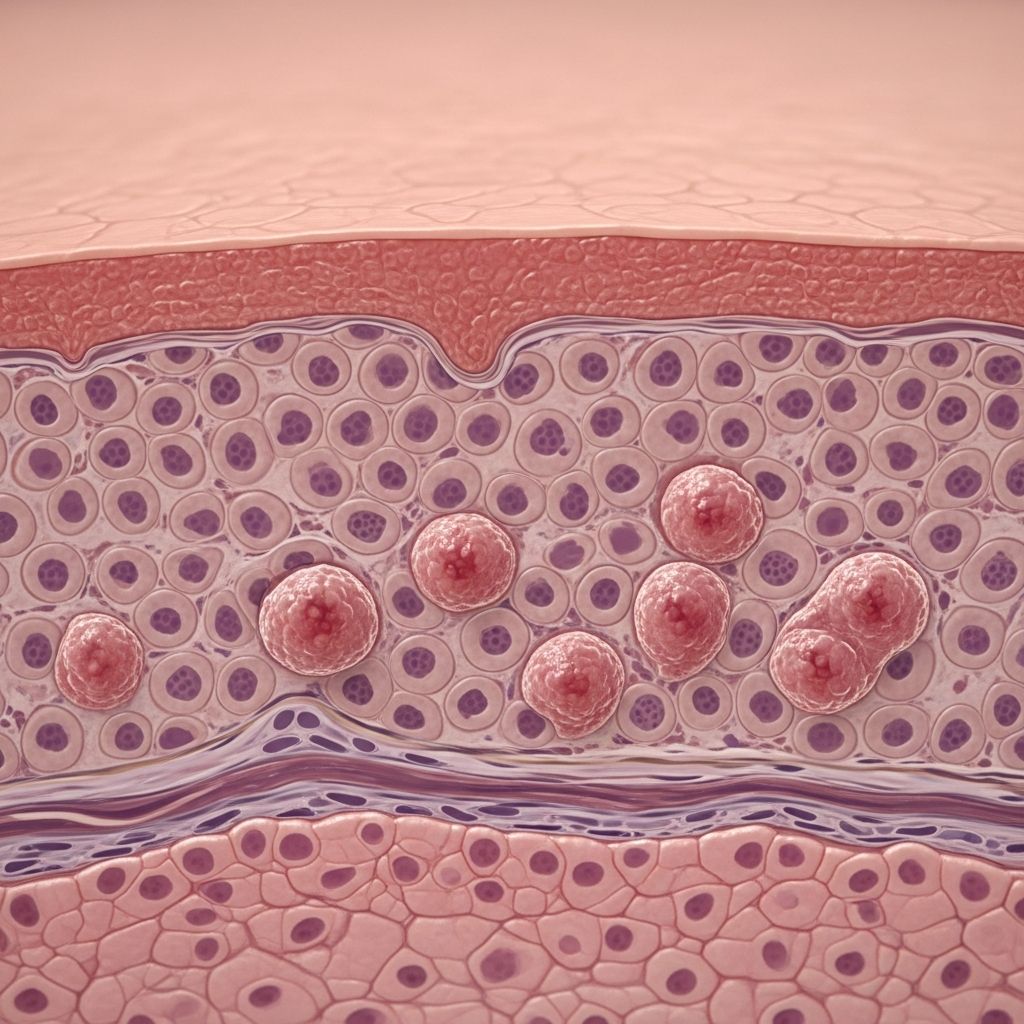
Melanoma
in situ
is the earliest form of primarymelanoma
in which the malignant cells are confined to the tissue of origin, theepidermis
.It is also known as
in-situ melanoma
andlevel 1 melanoma
.What is melanoma in situ?
Melanoma in situ represents the initial stage of melanoma development, where atypical melanocytes proliferate within the epidermal layer without breaching the basement membrane into the dermis. This containment eliminates any risk of metastasis, making it a highly curable condition when detected promptly. Early identification during this phase significantly enhances survival rates, reduces treatment-related morbidity, and lowers healthcare costs compared to advanced invasive melanomas. According to epidemiological data, as melanoma in situ has no associated mortality, timely intervention is crucial for preventing progression.
Genetic mutations in the DNA of melanocytes drive this condition, predominantly triggered by ultraviolet (UV) radiation exposure from sunlight or tanning beds. These mutations disrupt normal cell growth regulation, leading to uncontrolled proliferation confined to the epidermis. Chronic sun exposure is a primary risk factor, particularly for subtypes like lentigo maligna on sun-damaged skin.
Who gets melanoma in situ?
Melanoma in situ predominantly affects fair-skinned individuals with a history of significant UV exposure. Risk factors mirror those of invasive melanoma, including:
- Light skin, hair, and eye color (Fitzpatrick skin types I-II).
- History of sunburns, especially in childhood.
- Multiple dysplastic nevi or family history of melanoma.
- Immunosuppression, such as in organ transplant recipients.
- Older age, with peak incidence over 60 years.
Geographically, higher incidences occur in regions with intense sunlight, such as Australia and New Zealand, where rates are among the world’s highest due to UV exposure patterns.
What causes melanoma in situ?
The primary etiology is cumulative UV radiation damage to melanocyte DNA, inducing mutations in genes like BRAF, NRAS, and KIT. Unlike invasive forms, melanoma in situ remains in the radial growth phase, expanding horizontally across the epidermis. Subtypes arise from specific precursor lesions:
- Lentigo maligna: Evolves from lentigo maligna on chronically sun-exposed areas like the face.
- Melanoma in situ arising in a naevus: Develops within pre-existing moles.
- Acral lentiginous melanoma in situ: On palms, soles, or subungual sites, less UV-related.
Environmental factors, genetic predispositions (e.g., CDKN2A mutations), and phenotypic traits amplify risk.
What are the clinical features of melanoma in situ?
Typically, melanoma in situ presents as an irregular
pigmented patch
of skin, often following theABCDE criteria
:- Asymmetry: One half unlike the other.
- Border irregularity: Notched, scalloped, or fuzzy edges.
- Colour variation: Shades of brown, black, red, white, or blue.
- Diameter: Larger than 6 mm, though smaller lesions can be malignant.
- Evolving: Changes in size, shape, color, or symptoms like itching/bleeding.
The body site and features vary by subtype:
- Lentigo maligna: Large, slowly enlarging tan-brown patch on the face/cheeks of elderly patients, often >3 cm, with irregular borders and color variegation.
- Superficial spreading melanoma in situ: On trunk/legs, asymmetrical macule with irregular pigmentation.
- Acral: Parallel ridge pattern on acral sites.
Related Stories



In general, it is macular (flat), but 8% show thickening or scaling from epidermal hyperplasia. Untreated, it enlarges slowly; some develop invasive foci.
Images of melanoma in situ
Melanoma in situ often appears as subtle, irregular macules. Dermoscopy reveals atypical pigment networks, irregular globules, streaks, and structureless areas. Examples include:
- Dark macule on the back with irregular pigment distribution and peripheral structures.
- Banal-appearing lesion on the arm, histologically confirmed as in situ melanoma.
- Irregularly pigmented trunk lesion with blue-grey veil and featureless areas.
Macroscopic and dermoscopic pairs highlight asymmetry, color variation, and edge irregularity, aiding early suspicion.
How is melanoma in situ diagnosed?
Suspicion arises clinically or via dermoscopy showing melanoma-specific patterns. Definitive diagnosis requires
histological examination
of an excisional or incisional biopsy, confirming malignant melanocytes confined to the epidermis and adnexa. Breslow thickness is not applicable as invasion is absent. Multiple sections ensure no invasive foci. Immunohistochemistry (e.g., MITF, SOX10) assists in challenging cases.Differential diagnoses
Melanoma in situ must be distinguished from:
- Invasive melanoma: Deeper invasion on histology.
- Other skin cancers: Basal cell carcinoma, squamous cell carcinoma in situ.
- Benign lesions: Atypical nevus, solar lentigo, seborrheic keratosis, pigmented actinic keratosis.
- Dermal melanomas: Spitzoid, nevoid (no in-situ phase).
Dermoscopy and biopsy resolve ambiguities.
Complications of melanoma in situ
The primary risk is progression to invasive melanoma if untreated, though rates vary (5-20% for lentigo maligna). Psychological distress from diagnosis is common. Missed micro-invasion occurs rarely due to sampling limitations in large lesions.
Treatment of melanoma in situ
Standard treatment is
excision biopsy
with 5-10 mm margins, confirmed clear histologically. For large lesions (e.g., facial lentigo maligna), tissue-sparing options include:- Mohs micrographic surgery: Layer-by-layer excision with immediate margin control.
- Staged excision: Sequential removals over sessions.
If margins are narrow post-biopsy,
wide local excision
follows. Non-surgical alternatives for contraindicated cases (e.g., imiquimod cream off-label, radiation) have higher recurrence (up to 30%).| Treatment | Indications | Recurrence Rate |
|---|---|---|
| Wide excision | Standard | <1% |
| Mohs surgery | Large/ cosmetically sensitive | 1-5% |
| Imiquimod | Non-surgical candidates | 10-30% |
Follow-up for melanoma in situ
Patients require lifelong skin surveillance due to an 8-fold increased risk of subsequent melanomas. Guidelines recommend:
- Total body skin exams every 6-12 months initially, then annually.
- Self-examination education using ABCDE.
- Sun protection: SPF50+, clothing, shade.
No routine imaging or blood tests unless invasive disease suspected.
Outcome for melanoma in situ
Prognosis is excellent; life expectancy matches the general population as there is no metastatic potential. Cure rates exceed 99% post-excision. Rare issues stem from undetected invasion.
Frequently asked questions about melanoma in situ
Q: Is melanoma in situ life-threatening?
A: No, as it is confined to the epidermis without access to blood/lymphatics, it cannot metastasize.
Q: Can melanoma in situ spread?
A: Not in its pure form, but untreated lesions may progress to invasive melanoma.
Q: How is it different from invasive melanoma?
A: Invasive breaches the dermis (Breslow >0 mm), enabling spread; in situ does not.
Q: What are surgical margins?
A: 5-10 mm of normal skin around the lesion to ensure complete removal.
Q: Do I need regular check-ups?
A: Yes, due to elevated risk of new melanomas; follow specialist advice.
References
- Melanoma in situ – DermNet — DermNet NZ. 2024. https://dermnetnz.org/topics/melanoma-in-situ
- Melanoma in situ images – DermNet — DermNet NZ. 2024. https://dermnetnz.org/images/melanoma-in-situ-images
- Your Guide to Melanoma In-Situ — Melanoma Institute Australia. 2024-05. https://melanoma.org.au/wp-content/uploads/2024/05/MIA_Melanoma-In-Situ-Patient-Guide-2024.pdf
- Melanoma Skin Cancer: Images, Diagnosis, and Treatment — DermNet NZ. 2024. https://dermnetnz.org/topics/melanoma
- Melanoma Comprehensive Guide — Skintel NZ. 2024. https://skintel.co.nz/articles/melanoma/
- Stages of melanoma skin cancer — Cancer Society NZ. 2024. https://www.cancer.org.nz/cancer/types-of-cancer/melanoma-of-the-skin/stages-of-melanoma-skin-cancer/
Similar Articles








Read full bio of medha deb