Melanoma Of The Nail Unit: Everything You Need To Know
Comprehensive guide to nail unit melanoma: symptoms, diagnosis, treatment, and prognosis for early detection and management.
Melanoma of the nail unit is a rare but aggressive form of skin cancer, typically a variant of
acral lentiginous melanoma
arising from melanocytes in the nail matrix, bed, or surrounding skin. It most commonly affects the thumb or great toe and presents challenges in early diagnosis due to its resemblance to benign conditions.What is melanoma of the nail unit?
Melanoma of the nail unit (also called subungual melanoma) originates from the proliferation of atypical melanocytes primarily in the nail matrix. Unlike cutaneous melanomas linked to UV exposure, nail unit melanoma (NUM) occurs independently of sunlight, often in sun-protected areas like toes. It accounts for 0.7–3.5% of melanomas in white-skinned individuals but up to 75% in darker-skinned and Asian populations, making it the predominant melanoma type in these groups due to natural melanin protection against UV-induced cutaneous melanoma.
Rare subtypes include nodular or desmoplastic melanoma. NUM affects any nail but predominantly the great toe and thumbnail (75–90% of cases). It is diagnosed most frequently in individuals aged 60–70 years across all racial groups.
Who gets melanoma of the nail unit?
NUM occurs equally across racial groups but disproportionately represents total melanomas in pigmented skin: around 0.7–3.5% in whites versus up to 75% in dark-skinned and Asian people. Peak incidence is in the 60–70 age group. Trauma or injury may contribute, explaining higher rates on weight-bearing digits like the big toe and thumb.
What causes melanoma of the nail unit?
Unlike sun-exposed cutaneous melanomas, NUM arises from activation of nail matrix melanocytes without UV correlation. Studies confirm melanocytes reside mainly in the proximal nail matrix, not the bed, supported by stains like Tyrosinase, MITF, Melan-A, and Sox-10 showing absence in nail beds. UV-B is fully blocked by nail plates, and UV-A penetrates minimally (1.65% mean), shielding the matrix. Trauma is a potential trigger for the thumb and great toe predominance.
What are the clinical features of melanoma of the nail unit?
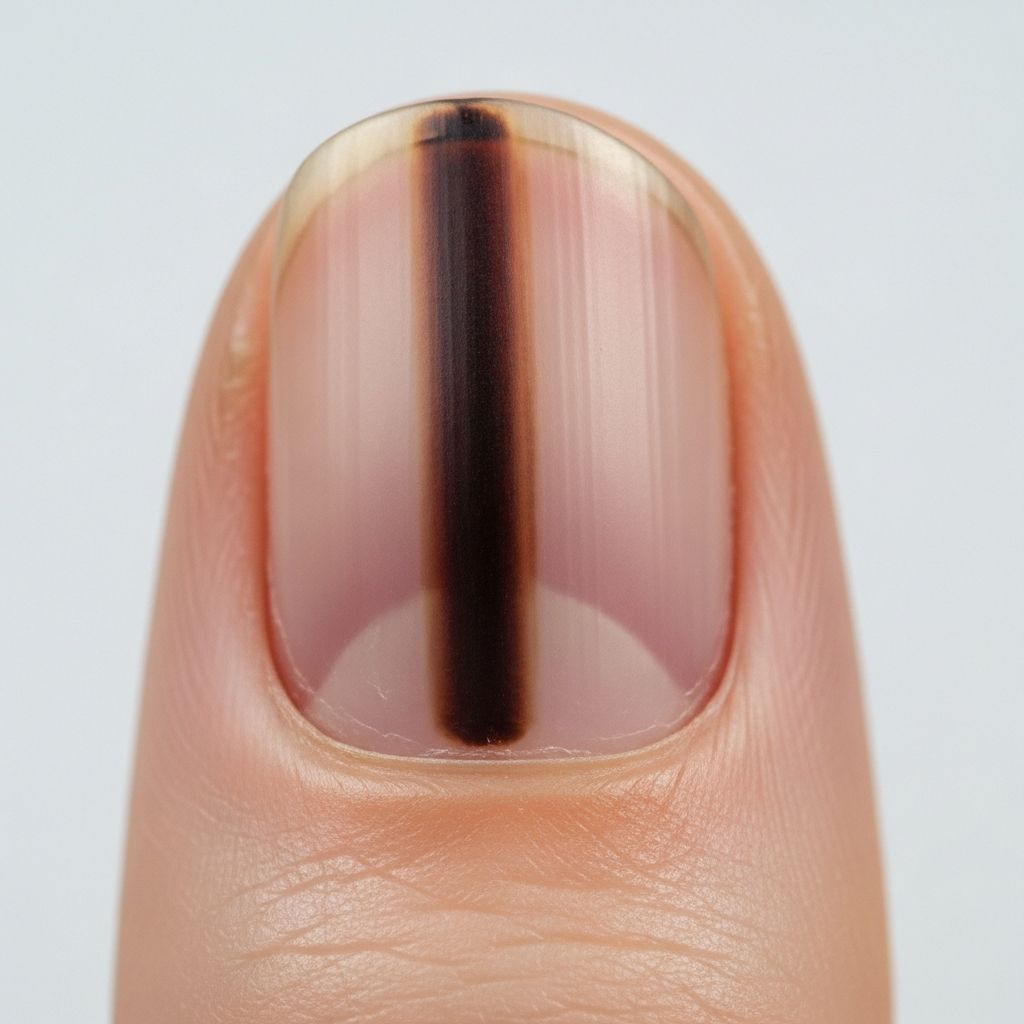
NUM often begins as
longitudinal melanonychia (LM)
—a narrow brown-to-black band along the nail plate length, most common on thumb or great toe nails. Early LM mimics benign lentigo or nevus, but progression over weeks to months shows:- Band widening
- Irregular borders
- Color variation (brown, black, grey, brown)
- Blurred margins
- Hutchinson sign: periungual pigmentation spreading to cuticle, hyponychium, or adjacent skin
Up to 25% are amelanotic, appearing as pink/red papules, longitudinal erythronychia, with onycholysis, notching, splitting, ulceration, or bleeding. Advanced features include nail dystrophy, ulceration, or granulation tissue.
Diagnosis of melanoma of the nail unit
Diagnosis combines history, examination, dermoscopy, and biopsy.
History and examination
Assess onset, progression, trauma, drugs, exposures. Examine all nails for:
- LM: width >3mm, irregular borders, color heterogeneity
- Band changes: widening, darkening, irregular pigmentation
- Nail dystrophy: splitting, onycholysis
- Periungual pigmentation (Hutchinson sign)
- Granulation, ulceration, nodularity
Related Stories



Dermoscopy
Dermoscopy aids early detection. Clues for NUM include:
- Irregular brown-black lines (60% of cases)
- Blurred borders (52%)
- Irregular nail plate (61%)
- Peripheral blood spots
- Irregular vessels (43%)
For amelanotic NUM: eroded nodules, whitish veils, yellow-brown scaling, vascular polymorphism.
ABCDEF rule
Use this mnemonic for pigmented nail lesions:
- A: Asymmetry
- B: Border irregularity
- C: Color variation
- D: Digit involvement (thumb/great toe)
- E: Evolution/change
- F: Family/personal melanoma history
Biopsy any suspicious features; avoid in children unless band enlarges/darkens.
Histopathology
Gold standard: biopsy nail matrix and bed. NUM shows poor circumscription, single melanocytes, pagetoid spread, junctional nesting, epithelioid/dendritic cells, nuclear atypia. Nail plate has diffuse melanin. In situ vs. invasive reported; acral lentiginous predominant. Distinguish from nevi by solitary melanocytes (96% vs. 64%), atypia (96% vs. 0%), lymphocytic infiltrate. Immunohistochemistry: PRAME >75% positive in 61% NUM (p<0.0001). Nail clippings may reveal melanin remnants prompting biopsy.
Differential diagnosis of melanoma of the nail unit
Key differentials for LM:
| Condition | Features |
|---|---|
| Benign racial/physiological melanonychia | Uniform, stable, multiple nails, children/adults |
| Lentigo | Stable, parallel lines, no Hutchinson sign |
| Acral nevus | Regular lines, symmetrical, children |
| Onychomycosis | Proximal/distal lines, mycology positive |
| Haemorrhage | Transverse, history of trauma |
| Drug-induced | Multiple nails, resolves on cessation |
Amelanotic differentials: warts, pyogenic granuloma, onychomycosis, squamous cell carcinoma.
Investigations for melanoma of the nail unit
Beyond biopsy:
- Skin checks for other primaries
- Sentinel lymph node biopsy (SLNB) for Breslow >0.8mm or ulceration
- Imaging (CT/MRI/PET) for staging if thick/invasive
- Bloods: LDH for metastasis
Refer to Australian Cancer Council guidelines for management.
What is the treatment for melanoma of the nail unit?
Treatment is surgical excision based on stage/thickness:
- In situ: Full-thickness excision matrix/nail bed to bone, 5mm margins
- Invasive (<1mm): Similar + SLNB
- Thick/ulcerated: Amputation (partial toe/finger), SLNB, node dissection if positive
- Metastatic: Immunotherapy (PD-1 inhibitors), targeted therapy (BRAF/MEK), clinical trials
Reconstruction post-excision/amputation as needed.
Complications of melanoma of the nail unit
- Late diagnosis leads to thicker tumors/metastases
- Local: nail loss, digital deformity
- Amputation morbidity (functional/cosmetic)
- Systemic metastasis (lymph nodes, lungs, liver)
Prevention of melanoma of the nail unit
No proven prevention; trauma minimization unconfirmed. Self-examine nails monthly for changes; seek prompt dermoscopy/biopsy for suspicious bands.
Outcome for melanoma of the nail unit
Prognosis worse than cutaneous melanoma due to late diagnosis (especially toes). Key prognosticator: Breslow thickness. 5-year survival ~77% (meta-analysis); stage-dependent 15–97%. Early detection improves outcomes.
Frequently Asked Questions
Is nail melanoma caused by sun exposure?
No, nail plates block UV; it’s unrelated to sunlight.
What does a melanoma nail band look like?
Longitudinal brown-black band widening, irregular, with possible Hutchinson sign.
Do I need a biopsy for every nail pigment change?
Low threshold for ABCDEF-positive lesions; dermoscopy guides.
Can children get nail melanoma?
Rare; monitor but biopsy only if progressing.
What is the survival rate?
~77% 5-year; better if thin/in situ.
References
- Adult and Pediatric Nail Unit Melanoma: Epidemiology, Diagnosis… — PMC/NCBI. 2023-03-15. https://pmc.ncbi.nlm.nih.gov/articles/PMC10047828/
- Melanoma of the nail unit — DermNet NZ. 2024-01-01. https://dermnetnz.org/topics/melanoma-of-the-nail-unit
- Subungual melanoma pathology — DermNet NZ. 2024-01-01. https://dermnetnz.org/topics/subungual-melanoma-pathology
Similar Articles








Read full bio of medha deb