Melanoma Skin Cancer: Diagnosis, Treatment & Prevention
Complete guide to melanoma: Understanding causes, symptoms, diagnosis, and evidence-based treatment options.
Melanoma Skin Cancer: A Comprehensive Overview
Melanoma, also referred to as malignant melanoma, is a potentially serious form of skin cancer characterized by uncontrolled growth of melanocytes (pigment cells). New Zealand has the highest rate of melanoma worldwide, with risk being greatest for non-Māori men aged over 50 years. Melanoma is the most common registered cancer and the fourth most common cause of cancer death among the 15-44 year age group. Understanding its features, risk factors, and treatment options is essential for early detection and improved patient outcomes.
Demographics and Epidemiology
Melanoma affects individuals across all age groups, though certain populations face elevated risk. In New Zealand, the most common site for melanomas in men is the back (approximately 40% of cases), while women most frequently develop melanomas on the leg (around 35% of cases). The disease presents differently across various skin types, with people of color tending to have distinct patterns of presentation and prognosis that warrant specialized consideration.
Causes and Risk Factors
Multiple factors contribute to melanoma development. Ultraviolet (UV) exposure from sun exposure and sunbeds represents a primary risk factor. Additional risk factors include:
- Light complexion and fair skin
- Family history of melanoma
- Age (particularly individuals over 50 years)
- Significant occupational or recreational sun exposure
- History of atypical moles or numerous nevi
- Immunosuppression
Classification of Melanoma
Melanoma is classified into distinct subtypes based on clinical and histopathological characteristics. There are four main clinical subtypes of melanoma, all of which have the potential to metastasize if they invade the dermis.
Superficial Spreading Melanoma: The most common type of melanoma, often featuring a prolonged pre-invasive in situ phase that grows slowly over months. These lesions typically present with irregular borders and variable pigmentation.
Melanoma In Situ: Characterized by atypical melanocytes confined to the basal layer and scattered higher in the epidermis (pagetoid spread). This represents early-stage disease with no dermal invasion.
Invasive Melanoma: Refers to neoplastic melanocytes found in the papillary dermis, either as nests or as single cells. Invasive disease carries greater risk for metastasis and systemic spread.
Other Subtypes: Additional forms include lentigo maligna melanoma, nodular melanoma, and desmoplastic melanoma, each with distinct clinical presentations and biological behaviors.
Clinical Features and Presentation
Melanoma may be suspected based on a lesion’s clinical features or a documented history of change. A thorough history and skin examination is performed using established clinical criteria to identify suspicious lesions.
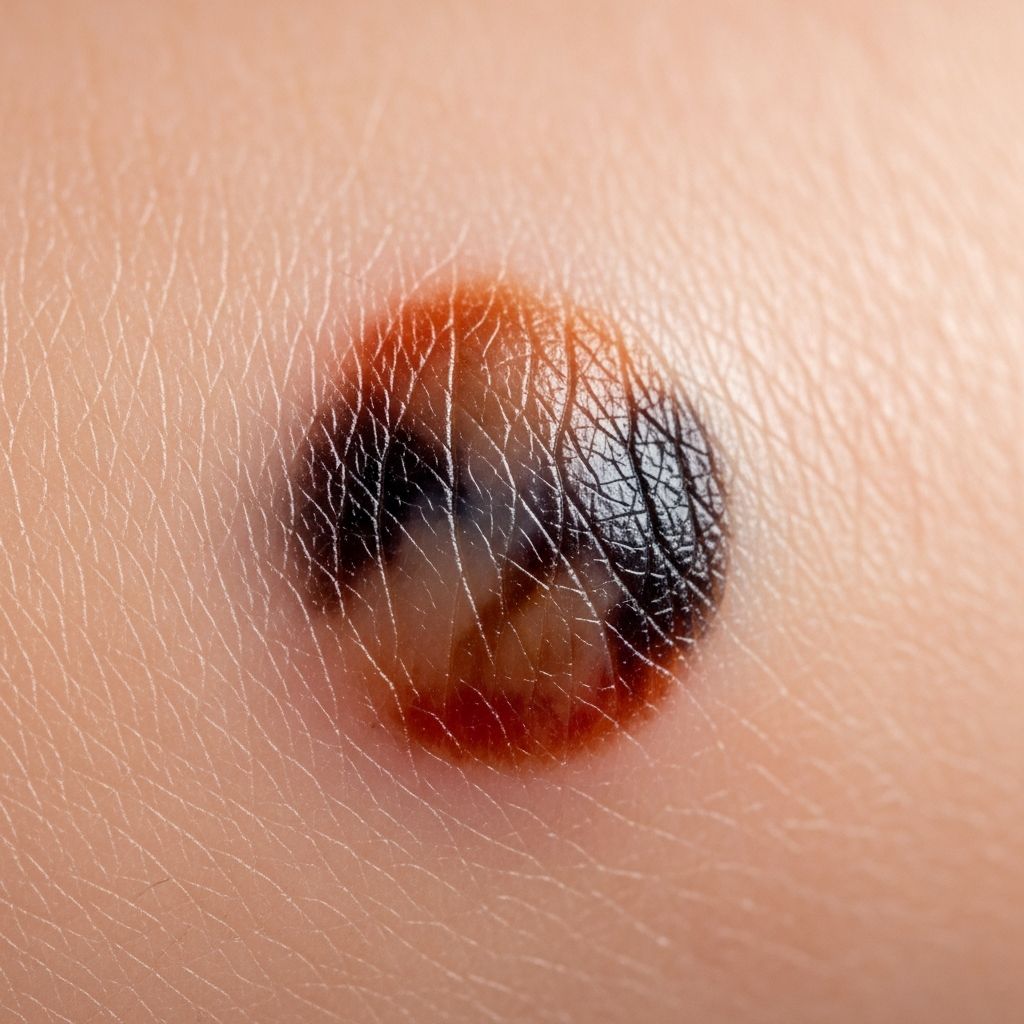
ABCDEFG Rule: The ‘ABCDE’ of melanoma is an acronym designed to help the public and clinicians identify features suggesting early or in situ melanoma:
- Asymmetry: One half of the lesion does not match the other half
- Border Irregularity: Edges are scalloped, notched, or poorly defined
- Color Variation: Multiple colors present including brown, black, grey, blue, pink, and white
- Diameter: Lesion larger than 6 millimeters (though smaller lesions can be melanoma)
- Evolving: Lesion changing in size, shape, or color over time
- F (Additional features): Bleeding, itching, or ulceration
- G (Gestalt): Overall appearance differs from other moles on the patient’s skin (“ugly duckling” sign)
Related Stories



Clinical Appearance: A thin melanoma typically begins as a flat, multicolored patch with a smooth surface.[10] Colors may include light brown, dark brown, black, grey, blue, pink, and white. As lesions progress, they may develop raised areas, irregular borders, and variable texture.
Variation in Skin Types
Melanoma presentation varies significantly across different skin types. People with skin of color tend to have distinct patterns of melanoma distribution and presentation that differ from Caucasian populations. Recognition of these variations is critical to prevent diagnostic delays and ensure equitable outcomes across all populations.
Diagnosis of Melanoma
Accurate and timely diagnosis is crucial for improving melanoma outcomes. Multiple diagnostic modalities support clinical assessment and confirm histopathological diagnosis.
Diagnostic Methods
Dermoscopy: Dermoscopy is a non-invasive examination technique that enhances visualization of skin lesions. The dermoscopy 3-point checklist for early detection of skin cancer is fairly easy to learn and has high sensitivity for melanoma. There is a high likelihood of malignancy (melanoma or basal cell carcinoma) if a pigmented skin lesion has any two of the dermoscopic criteria. Though not as specific as pattern analysis, the 3-point checklist allows non-experts to avoid missing melanomas.
Confocal Microscopy: Provides high-resolution imaging of skin lesions to assess cellular architecture and aid in discrimination between benign and malignant lesions.
Total Body Photography (Mole Mapping): Useful for detecting new lesions and assessing changes in pigmented lesions over time. Dedicated services like MoleMap NZ provide total body photography with review by accredited dermatologists, though cost may be a barrier for many people.
Adhesive Patch Genomic Analysis: Emerging technology that analyzes genetic material from lesions to support diagnostic decision-making.
Biopsy and Pathological Diagnosis
The gold standard for melanoma diagnosis is histopathological examination. The New Zealand Melanoma Quality Statements instruct that a narrow complete excisional biopsy with 2 mm margins and of sufficient depth to avoid transection at the base should be performed under local anesthesia on any pigmented lesion.
If invasive melanoma is present, the pathologist will comment on specific features including thickness (Breslow depth), level of invasion (Clark level), ulceration status, and mitotic rate. The report may also include comments about cell type, growth pattern, invasion of blood vessels or nerves, inflammatory response, regression, and any associated naevus.
Staging
Melanoma staging determines whether the melanoma has spread from its original site in the skin. Most melanoma specialists refer to the American Joint Committee on Cancer (AJCC) cutaneous melanoma staging guidelines (8th edition, 2017). The staging system categorizes disease into stages based on tumor thickness, ulceration, lymph node involvement, and distant metastases.
Patients with a confirmed diagnosis of melanoma are staged histopathologically, clinically, and radiologically in accordance with the latest AJCC Cancer Staging Manual. Melanoma lesion thickness is the strongest predictor of prognosis—in general, the thinner the lesion, the better the outcome for the patient.
Differential Diagnoses
Several benign and malignant skin lesions can mimic melanoma, necessitating careful clinical evaluation. Conditions to consider in the differential diagnosis include benign nevi, atypical moles, solar lentigines, seborrheic keratoses, basal cell carcinoma, squamous cell carcinoma, and other dermatological conditions. Dermoscopy and histopathological examination help distinguish melanoma from these mimics.
Treatment Options
Treatment of melanoma depends on stage, thickness, location, and patient factors. Multiple therapeutic approaches are available, ranging from surgical excision to systemic therapies.
Surgical Treatment
Following confirmation of diagnosis, wide local excision is carried out at the primary melanoma site. The extent of surgery depends on the thickness of the melanoma and its site. Margins recommended in New Zealand (2013) vary based on tumor thickness:
- In situ melanoma: 5 mm margins
- Melanomas 0.76-1.0 mm thick: 10 mm margins
- Melanomas 1.01-2.0 mm thick: 10-15 mm margins
- Melanomas >2.0 mm thick: 15-20 mm margins
Sentinel Node Biopsy
In Australia and New Zealand, it is recommended that lymphatic mapping with a sentinel node biopsy is performed for melanomas thicker than 1 mm or where the melanoma is greater than 0.75 mm with other high-risk pathological features. While the biopsy may help in staging cancer and directing the use of adjuvant therapies, it does not offer any survival advantage.
Systemic Therapies
For advanced melanoma, systemic treatments are employed. These include:
- Immunotherapy: Immune checkpoint inhibitors (ICI) represent a major advance in melanoma treatment, particularly for advanced disease
- Targeted Therapy: For melanomas harboring specific mutations (such as BRAF mutations), targeted kinase inhibitors provide treatment options
- Chemotherapy: Less commonly used in contemporary practice but may be considered in selected cases
- Adjuvant Systemic Treatment: Stage III patients should be considered for adjuvant systemic treatment (including enrollment in clinical trials) and adjuvant radiotherapy
Radiation Therapy
Radiation therapy should be considered in patients with a single or small number of brain metastases, painful bone metastases, problematic skin, soft tissue or nodal metastases that have not responded to systemic therapy. This may help relieve symptoms from the metastases.
Lymph Node Management
Lymph node involvement affects melanoma staging and treatment planning. Sentinel node biopsy reporting follows standardized criteria, and lymph node assessment is a critical component of melanoma staging per the AJCC guidelines.
Follow-up and Surveillance
Patients with melanoma require long-term follow-up to detect recurrence or metastatic disease. Surveillance intervals and imaging modality depend on stage of disease. Opportunistic skin checks are valuable; clinicians should be suspicious of lesions with atypical features or a history of change. Total body photography may be employed for surveillance in selected patients.
Prevention Strategies
Prevention of melanoma focuses on reducing UV exposure and promoting early detection:
- Sun protection with broad-spectrum sunscreen (SPF 30 or higher)
- Avoiding peak UV hours (10 AM to 4 PM)
- Wearing protective clothing, hats, and sunglasses
- Avoiding artificial tanning devices
- Regular skin self-examination using the ABCDEFG criteria
- Professional skin examinations, particularly for high-risk individuals
- Training of primary health care professionals to recognize skin lesions suspicious for melanoma
- Public education on risk factors and early detection of melanoma
Prognosis and Outcome
Melanoma prognosis depends primarily on tumor thickness at diagnosis. It is well documented that survival decreases with increasing thickness of the primary melanoma. Melanomas identified by health professionals are typically thinner and have a more favorable prognosis. Therefore, opportunistic skin checks are valuable and may identify lesions at earlier, more treatable stages.
Early detection with full-body skin checks, utilizing dermoscopy and digital dermatoscopy, is best practice. Patients with thin melanomas (less than 1 mm) generally have excellent prognosis with appropriate surgical management, while thicker lesions and those with lymph node involvement carry more guarded prognoses.
Multidisciplinary Care
Patients managed by a melanoma multidisciplinary team (MDT) have access to a clinical nurse specialist or other health professional who is a member of the MDM to help coordinate all aspects of their care. Cases that are not straightforward, stages III and IV cutaneous melanoma, desmoplastic melanoma, melanoma in people under 25 years of age, and non-cutaneous melanoma should be discussed at a melanoma MDM. Each treatment centre has a melanoma clinical lead to provide necessary leadership, guidance, and provision of melanoma care.
Frequently Asked Questions
Q: What is the primary risk factor for developing melanoma?
A: Ultraviolet (UV) exposure from sun exposure and sunbeds represents the primary modifiable risk factor for melanoma development. Light complexion, family history, age, and significant sun exposure also increase risk.
Q: How is melanoma diagnosed?
A: Melanoma is diagnosed through clinical examination using the ABCDEFG rule, dermoscopy, and histopathological examination via excisional biopsy. Imaging and staging studies help determine disease extent.
Q: What is Breslow thickness and why is it important?
A: Breslow thickness is the measurement of melanoma depth from the granular layer of the epidermis to the deepest point of tumor invasion. It is the strongest predictor of prognosis—thinner melanomas have better outcomes.
Q: Can melanoma be cured?
A: Early-stage melanomas (stages I and II) have excellent cure rates with surgical excision alone. Advanced melanomas are treated with multidisciplinary approaches including surgery, immunotherapy, targeted therapy, and radiation, which can achieve remission but may not cure all advanced cases.
Q: How often should I have skin checks?
A: Individuals at high risk should have regular professional skin examinations annually or more frequently as recommended by their dermatologist. Monthly self-examination using the ABCDEFG criteria is recommended for all individuals.
References
- New Zealand Melanoma Clinical Guidelines — Melanoma Network of New Zealand in partnership with Te Aho o Te Kahu – Cancer Control Agency. October 2025. https://melnet.org.nz/assets/DRAFT-Melanoma-Clinical-Guidelines-for-consultation.pdf
- Melanoma Skin Cancer: Images, Diagnosis, and Treatment — DermNet NZ. Reviewed by Dr Ian Coulson. https://dermnetnz.org/topics/melanoma
- Common Skin Lesions: Melanoma — DermNet NZ. https://dermnetnz.org/cme/lesions/melanoma
- Early Detection of Melanoma and Assessment of Asymptomatic Skin Lesions — Best Practice Advocacy Centre (bpac). 2021. https://bpac.org.nz/2021/melanoma-detection.aspx
- Dermoscopy: Three-Point Checklist — DermNet NZ. https://dermnetnz.org/cme/dermoscopy-course/three-point-checklist
- Melanoma Pathology — DermNet NZ. https://dermnetnz.org/topics/melanoma-pathology
- ABCDEFG of Melanoma — DermNet NZ. https://dermnetnz.org/topics/abcdes-of-melanoma
Similar Articles








Read full bio of medha deb