Meralgia Paraesthetica: Causes, Symptoms & Treatment Guide
Understanding the causes, symptoms, diagnosis, and effective treatments for meralgia paraesthetica, a common nerve entrapment condition.
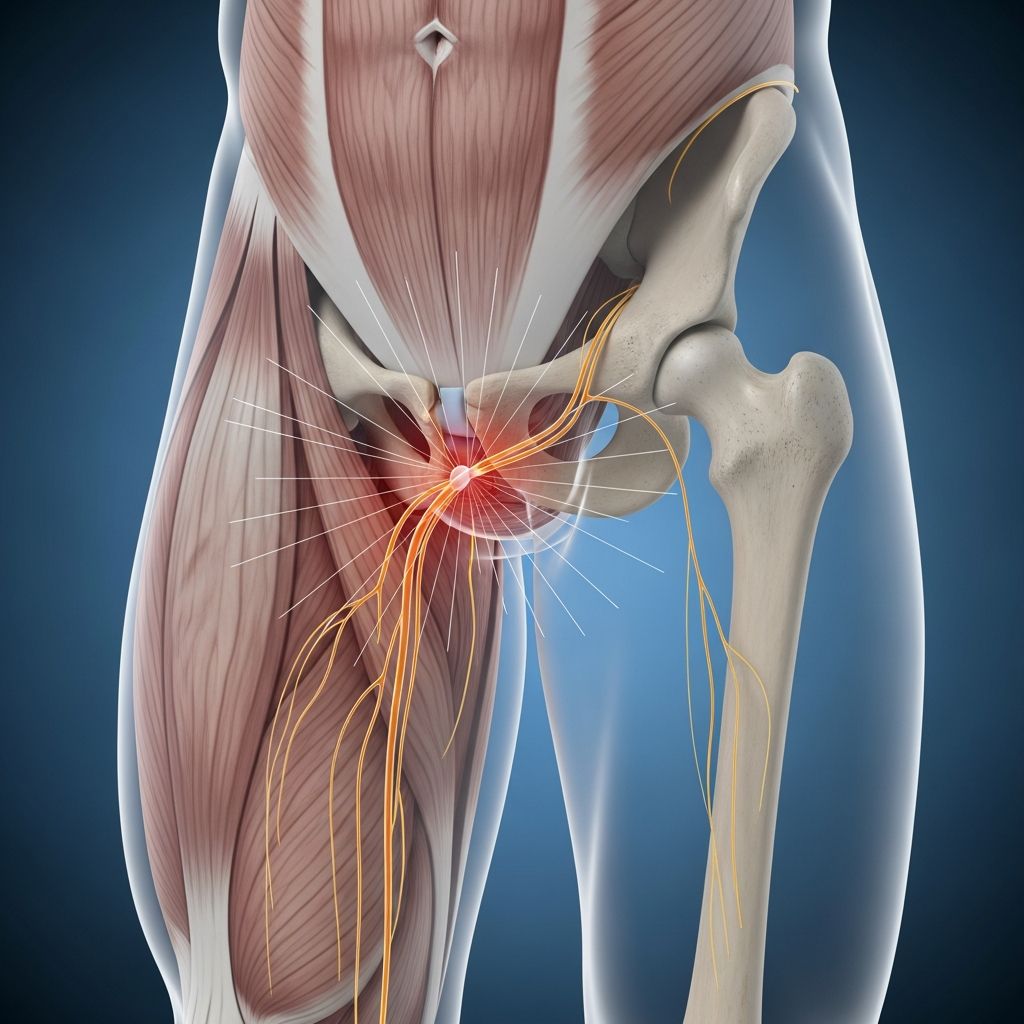
Meralgia paraesthetica, also known as lateral femoral cutaneous nerve entrapment, is a mononeuropathy characterised by tingling, numbness, and burning pain over the outer thigh. This condition arises from compression of the lateral femoral cutaneous nerve (LFCN), a purely sensory nerve that supplies the anterolateral thigh without affecting motor function. It typically affects adults aged 30-60 years, more commonly in men, and is usually unilateral.
What is the lateral femoral cutaneous nerve?
The
lateral femoral cutaneous nerve (LFCN)
originates from the L2-L3 spinal roots of the lumbar plexus. It emerges from the lateral border of the psoas muscle, crosses the iliacus muscle deep to the iliac fascia, and passes under or through the lateral attachment of theinguinal ligament
approximately 1-2 cm medial to the anterior superior iliac spine (ASIS). Beyond this point, it divides into anterior and posterior branches that innervate the skin of the anterolateral and lateral thigh down to the knee.The LFCN is susceptible to compression at the inguinal ligament due to its fixed course under the fascia and ligament, particularly when intra-abdominal or pelvic pressure increases. Anatomical variations occur in up to 25% of individuals, where the nerve pierces the ligament or fascia, heightening entrapment risk.
Who gets meralgia paraesthetica?
Meralgia paraesthetica affects individuals with predisposing factors that increase pressure on the LFCN.
Risk factors
include:- Obesity or recent weight gain: Excess abdominal fat compresses the nerve against the inguinal ligament.
- Tight clothing: Belts, corsets, or tight pants worn low on the hips irritate the nerve.
- Pregnancy: Uterine enlargement and weight gain elevate intra-abdominal pressure.
- Occupational factors: Prolonged standing, walking, or wearing heavy tool belts (e.g., firefighters, policemen).
- Trauma or surgery: Pelvic, hip, or abdominal procedures like appendectomy, hernia repair, or iliac crest bone grafting.
- Medical conditions: Diabetes mellitus (due to neuropathy), spinal stenosis, or scoliosis.
Incidence is higher in males (ratio 2-4:1) and peaks between ages 30-60 years.
What causes meralgia paraesthetica?
The primary mechanism is
compression or entrapment
of the LFCN at the inguinal ligament. Causes are classified as:Mechanical compression
- External: Tight belts, pants, or seatbelts.
- Internal: Obesity, pregnancy, ascites, or abdominal tumours.
Iatrogenic
- Post-surgical: Common after orthopaedic procedures like anterior iliac crest bone harvest (up to 44% incidence), pelvic osteotomies, or spinal fusions.
Other
- Trauma: Direct blow to the pelvis or hip.
- Neuropathic: Diabetes-induced nerve damage.
- Spinal: Lumbar disc herniation or foraminal stenosis referring pain.
In 20-30% of cases, no clear cause is identified (idiopathic).
What are the clinical features of meralgia paraesthetica?
Symptoms are confined to the LFCN distribution on the
anterolateral thigh
(above the knee):- Pain: Burning or aching, worsened by standing or walking, relieved by sitting.
- Sensory changes: Tingling (paraesthesia), numbness, or hypersensitivity.
- Other: Itching, formication (ants crawling sensation), or exaggerated knee jerk reflex rarely.
Symptoms are unilateral in 90% of cases and do not affect motor function (no weakness or atrophy). Pain may radiate slightly to the anterior thigh or knee but spares the medial thigh and below the knee.
Diagnosis of meralgia paraesthetica
Diagnosis is primarily
clinical
, based on history and examination:History
- Onset related to weight gain, tight clothing, or surgery.
- Pure sensory symptoms in LFCN territory.
Related Stories



Physical examination
Key tests:
- Tinel sign: Percussion over ASIS reproduces symptoms (positive in 70%).
- Femoral nerve stretch test: Hip extension with knee flexion exacerbates pain.
- Sensory mapping: Reduced pinprick or light touch in anterolateral thigh.
Diagnostic injections
Lidocaine injection at the entrapment site provides temporary relief, confirming diagnosis.
Investigations
Usually unnecessary, but to exclude mimics:
- Nerve conduction studies/EMG: May show LFCN sensory loss (not always abnormal).
- MRI pelvis/lumbar spine: For masses, pregnancy, or radiculopathy.
- Ultrasound: Identifies nerve compression site.
Differential diagnosis
| Condition | Distinguishing features |
|---|---|
| Lumbar radiculopathy (L2-L3) | Motor weakness, positive straight leg raise, back pain, affects multiple dermatomes. |
| Trochanteric bursitis | Lateral hip tenderness, pain on lying on side, normal sensation. |
| Iliotibial band syndrome | Runner’s pain at knee level, tenderness over ITB. |
| Polyneuropathy | Bilateral, stocking distribution, other nerves involved. |
| Proximal femoral tumour/fracture | Mass, systemic symptoms, imaging abnormalities. |
Treatment of meralgia paraesthetica
Most cases (85-91%) resolve with
conservative management
within 3-6 months.Conservative measures (first-line)
- Remove aggravating factors: Loose clothing, weight loss (5-10% body weight).
- Analgesics: NSAIDs (ibuprofen 400-600mg TDS), paracetamol.
- Activity modification: Avoid prolonged standing; use pelvic tilt brace.
Physical therapy
- Myofascial release: Iliopsoas, tensor fascia lata.
- Nerve gliding exercises, stretching.
- Kinesiology taping.
Pharmacotherapy (if persistent)
- Neuropathic agents: Gabapentin (300-900mg TDS), pregabalin, amitriptyline.
- Topical: Capsaicin, lidocaine patches.
Injections
- Corticosteroid +/- anaesthetic: 80% relief in 1-3 months; ultrasound-guided.
Surgery (rare, <5%)
For refractory cases >6-12 months:
- Neurolysis: Release of LFCN from fascia/ligament (90% success).
- Neurectomy: Nerve transection (if pure sensory).
Prevention
- Maintain healthy weight (BMI <25).
- Wear loose, high-waisted clothing.
- Ergonomic adjustments for prolonged standing.
- Pre-surgical precautions in at-risk procedures.
Prognosis
Excellent: 85-91% recover with conservatives; surgical success 80-90%. Pregnancy-related resolves postpartum. Untreated chronic cases may lead to persistent dysaesthesia.
Frequently Asked Questions
Q: Does meralgia paraesthetica go away on its own?
A: Yes, 85-91% of cases resolve spontaneously or with conservative treatment within 3-6 months.
Q: Is meralgia paraesthetica serious?
A: No, it is benign and sensory-only; no motor deficits or long-term damage.
Q: Can exercise help meralgia paraesthetica?
A: Yes, targeted physical therapy including nerve glides and stretches improves outcomes in most cases.
Q: When is surgery needed for meralgia paraesthetica?
A: Rarely, only after 6-12 months of failed conservative therapy.
Q: Can diabetes cause meralgia paraesthetica?
A: Yes, diabetic neuropathy can contribute via nerve damage.
References
- Meralgia paresthetica – Diagnosis and treatment — Mayo Clinic. 2023-10-15. https://www.mayoclinic.org/diseases-conditions/meralgia-paresthetica/diagnosis-treatment/drc-20355639
- Meralgia Paresthetica: A Commonly Overlooked Cause of Thigh Pain — ChiroUp. 2024-05-20. https://chiroup.com/blog/meralgia-paresthetica-a-commonly-overlooked-cause-of-thigh-pain
- What Is Meralgia Paresthetica? Symptoms and Treatment — Lone Star Neurology. 2024-08-10. https://lonestarneurology.net/neurological-disorders/what-is-meralgia-paresthetica/
- Meralgia paresthetica: diagnosis and treatment — PubMed (J Bone Joint Surg Am). 2001-09-01. https://pubmed.ncbi.nlm.nih.gov/11575913/
- Meralgia Paresthetica: Causes, Symptoms and Treatments — Joint Care London. 2023-11-05. https://jointcarelondon.com/conditions/meralgia-paresthetica
- Meralgia Paresthetica: Causes, Symptoms & Treatment — Cleveland Clinic. 2024-02-12. https://my.clevelandclinic.org/health/diseases/17959-meralgia-paresthetica
- Meralgia paresthetica – Symptoms and causes — Mayo Clinic. 2023-10-15. https://www.mayoclinic.org/diseases-conditions/meralgia-paresthetica/symptoms-causes/syc-20355635
Similar Articles








Read full bio of medha deb