Mohs Surgery For Eye Area Skin Cancers: 4-Step Guide
Discover how Mohs surgery precisely removes skin cancer near the eyes while preserving vision and appearance through advanced techniques.
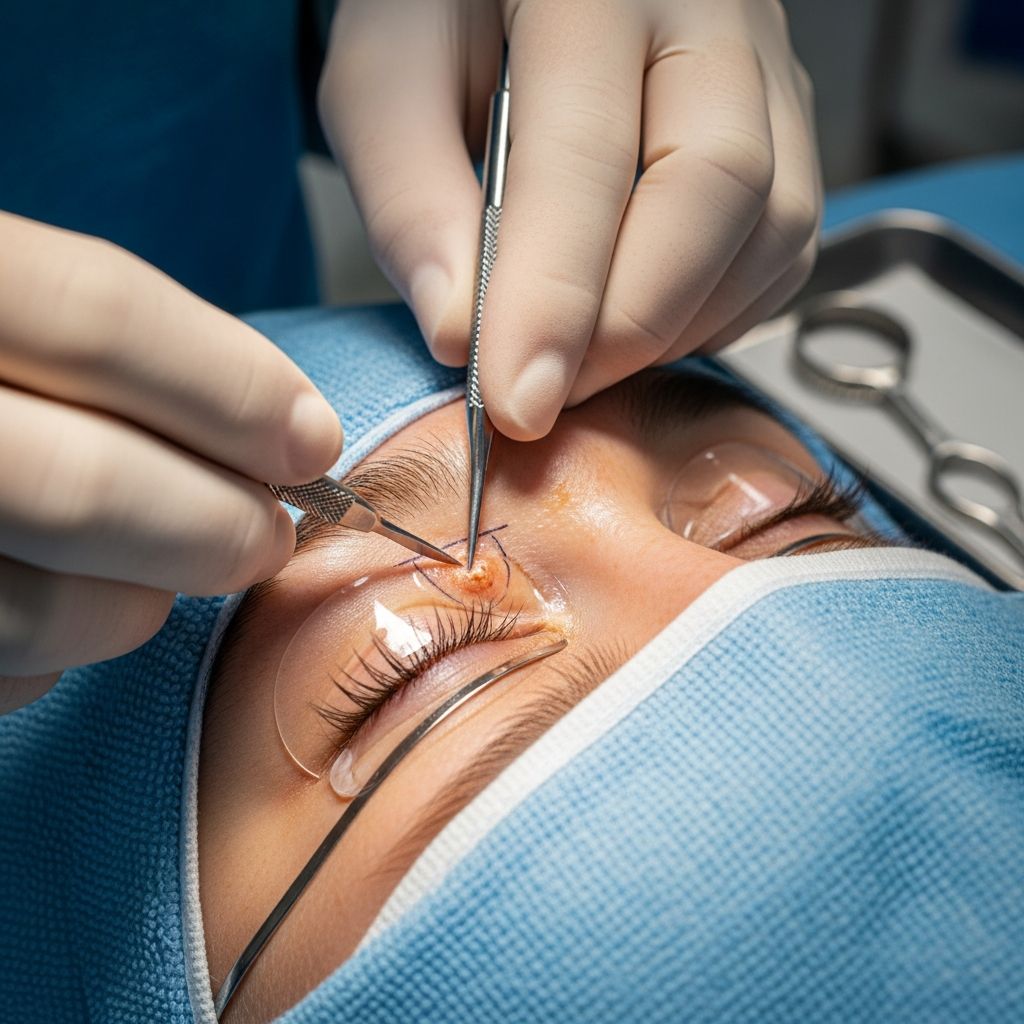
Mohs surgery represents a specialized, tissue-sparing approach to eliminating skin cancers in sensitive regions such as the eyelids, eyebrows, and surrounding orbital structures. This method combines precise excision with immediate microscopic examination to achieve cure rates exceeding 97% while safeguarding vital eye functions like blinking and tear production.
Understanding Skin Cancers Near the Eyes
Skin cancers affecting the periocular area primarily include basal cell carcinoma (BCC), the most prevalent type, and squamous cell carcinoma (SCC), which can be more aggressive. These malignancies often arise from chronic sun exposure and present as pearly nodules, ulcers, or scaly patches on the lower eyelids or medial canthus.
Early detection is crucial because proximity to the eye increases risks of local invasion, potentially impairing vision or globe integrity. Mohs surgery is particularly advantageous here due to its ability to delineate irregular tumor margins, which are common in 80-90% of recurrent or morpheaform BCC cases.
Why Choose Mohs for Ocular Region Tumors
Traditional excision may leave microscopic cancer extensions, necessitating wider margins that compromise eyelid function or aesthetics. Mohs, by contrast, examines 100% of excision margins in real-time, reducing recurrence to under 5% in high-risk sites.
- High cure rates: 97-99% for BCC, 94-98% for SCC.
- Tissue preservation: Essential for maintaining eyelid mobility and cosmetic outcomes.
- Ideal locations: Eyelids, nose, ears, and genitals where function trumps volume removal.
For eye-area lesions, collaboration between dermatologic surgeons and oculoplastic specialists ensures both oncologic clearance and reconstructive excellence.
Preparing for Your Mohs Procedure
Preoperative evaluation involves a detailed history, skin mapping, and imaging if deep invasion is suspected. Patients are advised to avoid blood thinners like aspirin for 7-10 days and arrange transportation, as the procedure lasts 4-8 hours.
| Preparation Step | Details |
|---|---|
| Medications Review | Discontinue anticoagulants; continue prescribed heart meds. |
| Skin Prep | Avoid lotions, makeup on the day of surgery. |
| Accompaniment | Bring a companion for post-op support. |
| Fasting | Not required; light breakfast recommended. |
The Step-by-Step Mohs Surgery Process
Performed under local anesthesia in an office setting, Mohs unfolds in stages:
- Initial Excision: Visible tumor scraped with a curette, followed by a thin layer removed via scalpel. Tissue is mapped, divided, color-coded, and frozen-sectioned.
- Laboratory Examination: Surgeon personally reviews slides for residual cancer at deep and peripheral margins. This takes 45-60 minutes per stage.
- Sequential Removal: Targeted re-excision of positive areas only. Average stages: 1-3 for primary tumors, up to 5 for aggressive types.
- Clearance Confirmation: Procedure ends when margins are tumor-free, often verified twice.
Areas near the eye demand extra caution to avoid corneal exposure or lacrimal disruption.
Related Stories



Reconstruction After Tumor Clearance
Once cancer-free, defects are repaired immediately or staged. Eyelid reconstruction prioritizes the “ladder of transposition”: primary closure for small gaps, flaps for moderate losses, and grafts for larger ones.
- Primary Closure: Undermining edges for tension-free suturing.
- Flaps: Rotation, advancement, or Tenzel for posterior lamella support.
- Grafts: Full-thickness from contralateral lid or ear for extensive losses.
Oculoplastic techniques restore canthal tendons and orbicularis function, preventing ectropion or lagophthalmos.
Recovery Timeline and Care Instructions
Post-op, a pressure dressing protects the site for 24-48 hours. Most resume normal activities in 1-2 weeks, with sutures removed at 5-7 days.
| Timeframe | Expectations |
|---|---|
| Day 1-2 | Swelling peaks; ice packs, head elevation, pain meds. |
| Week 1 | Suture removal; ointment application. |
| Month 1 | Scar maturation begins; avoid sun exposure. |
| 3-6 Months | Full healing; silicone sheets for optimization. |
Complications like infection (1-2%) or dehiscence are rare with meticulous care.
Risks and Potential Complications
While safe, risks include bleeding, infection, poor wound healing, and functional deficits like dry eyes. Eyelid-specific issues: ectropion (5%), ptosis, or epiphora.
Recurrence rates remain low, but lifelong sun protection and annual exams mitigate new primaries.
Long-Term Outcomes and Success Stories
Patients often report minimal scarring and restored confidence. Studies show 95% satisfaction in cosmesis for periocular Mohs. Regular follow-ups detect satellites early.
Frequently Asked Questions (FAQs)
Is Mohs surgery painful?
Local anesthesia ensures comfort during excision; post-op discomfort is mild, managed with acetaminophen.
How long does eyelid Mohs take?
Typically 4-7 hours, depending on stages needed.
Will I have a scar on my eyelid?
Scarring is minimized; fades significantly within a year with proper care.
Can Mohs treat melanoma near the eye?
Less common externally; suitable for select thin melanomas.
Who performs eye-area reconstruction?
Oculoplastic surgeons or fellowship-trained Mohs experts.
Preventing Future Skin Cancers
Daily SPF 50+, hats, and self-exams reduce risk by 50%. High-risk patients benefit from topical chemoprevention.
References
- Before and After Mohs Surgery Eye – Eyelid Reconstruction — Derm Skin Health. 2023. https://dermskinhealth.com/before-and-after-mohs-surgery-eye/
- What is Mohs Reconstructive Surgery? — North Georgia Eye Partners. 2024. https://northgeorgiaeye.com/what-is-mohs-reconstructive-surgery/
- Mohs Surgery Explanation for Skin Cancer Removal — Dermatology Consultants. 2023. https://dermatologyconsultants.com/mohs-surgery-explanation/
- Mohs surgery – Skin cancer surgery — Mayo Clinic. 2025-02-01. https://www.mayoclinic.org/tests-procedures/mohs-surgery/about/pac-20385222
- Everything You Should Expect from Mohs Surgery — Cascade Eye & Skin Centers. 2024. https://cascadeeyeskin.com/blog/everything-you-should-expect-from-mohs-surgery/
- 10 things to know about Mohs surgery — MD Anderson Cancer Center. 2020-04-07. https://www.mdanderson.org/cancerwise/mohs-surgery-for-some-skin-cancers.h00-158671845.html
- Mohs Reconstructive Surgery — Ophthalmic Associates. 2024. https://www.ophthalmicassociates.com/our-services/oculofacial-services/eyelid-and-orbital-reconstruction/eyelid-skin-cancer-growths/mohs-reconstructive-surgery/
Similar Articles








Read full bio of Sneha Tete