Molluscum Contagiosum: Causes, Symptoms & Treatment
Comprehensive guide to molluscum contagiosum: causes, symptoms, diagnosis, treatment, and prevention of this common viral skin infection.
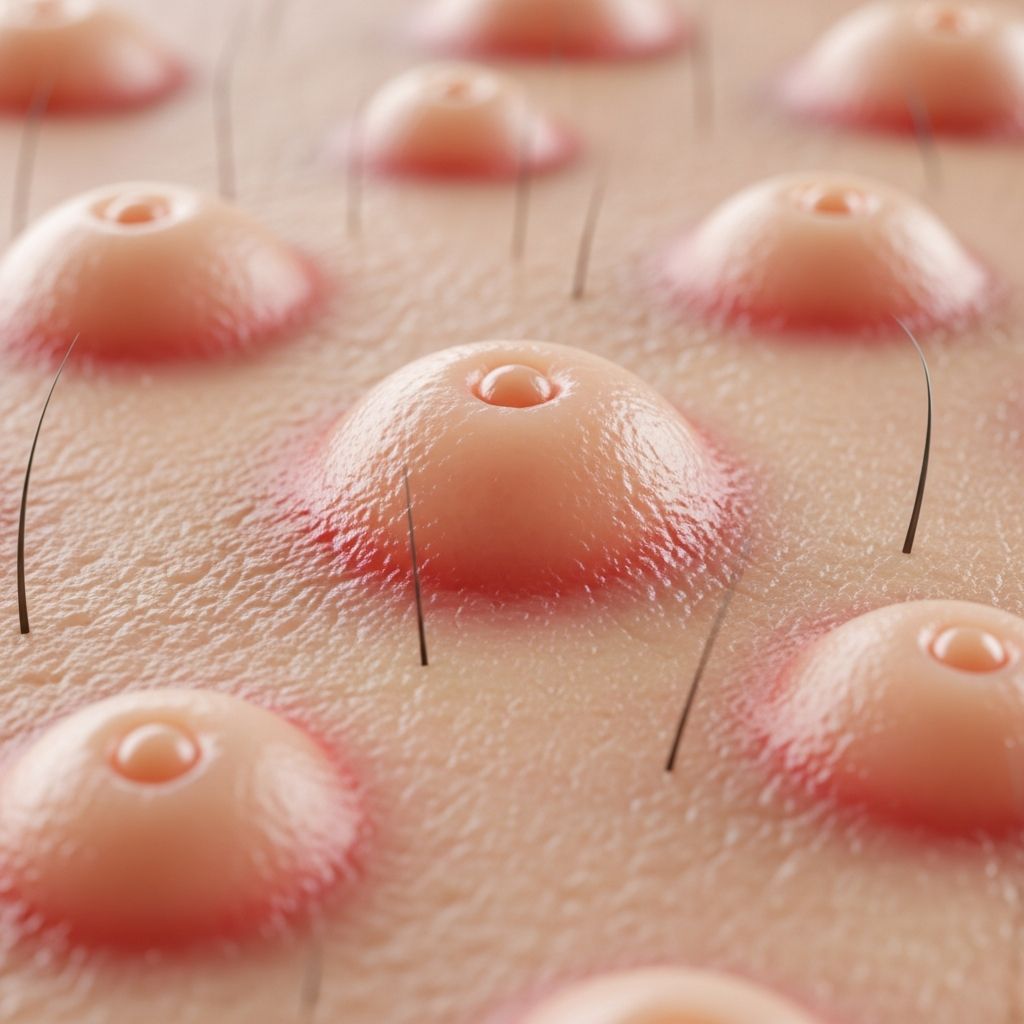
Molluscum contagiosum is a common benign viral infection of the skin and mucous membranes caused by a poxvirus. It typically presents as multiple small, dome-shaped, pearly papules with a central umbilication, affecting children, sexually active adults, and immunocompromised individuals. The infection is self-limited in healthy people, resolving spontaneously within months to years, but treatment may be sought to prevent spread or alleviate symptoms.
What is molluscum contagiosum?
Molluscum contagiosum is an epidermal eruption caused by the molluscum contagiosum virus (MCV), a double-stranded DNA virus from the Poxviridae family. MCV infects only keratinocytes in the epidermis, producing no systemic dissemination. The virus encodes proteins that inhibit human antiviral immunity, allowing lesions to persist. It is highly contagious, particularly in warm, humid environments, and more prevalent in tropical regions and low-income settings.
The condition is mildly contagious through direct contact and can affect any age, but peaks in children aged 1-10 years and adults via sexual transmission. In immunocompromised patients, such as those with HIV, lesions can be numerous, larger, and more persistent.
Who gets molluscum contagiosum?
Molluscum contagiosum primarily affects:
- Children: Most common in school-aged kids due to close contact in play, schools, or pools. Prevalence is rising, with 50% of cases resolving in 6-12 months.
- Sexually active adults: Genital lesions from sexual contact represent a significant transmission route.
- Immunocompromised individuals: Extensive, atypical lesions in HIV/AIDS or transplant patients.
- Athletes and others in shared facilities: Contact sports or communal baths increase risk.
Global incidence is higher in tropical climates and among those with atopic dermatitis, which facilitates spread.
What causes molluscum contagiosum?
The causative agent is the molluscum contagiosum virus (MCV), with four genotypes (MCV-1 to MCV-4). MCV-1 and MCV-2 are most common in children and adults, respectively, while MCV-1 predominates in HIV patients. The virus replicates in epidermal keratinocytes, forming intracytoplasmic inclusion bodies (Henderson-Paterson bodies) visible histologically.
How is molluscum contagiosum transmitted?
Transmission occurs via:
- Skin-to-skin contact: Direct touching of lesions.
- Autoinoculation: Spreading from one’s own lesions to other body areas, including the face.
- Sexual contact: Primary route in adults, affecting genitals, abdomen, thighs.
- Fomites: Contaminated towels, toys, clothing, razors.
- Shared wet environments: Pools, saunas (evidence limited).
- Rarely: Perinatal or in utero transmission.
Incubation period: 2 weeks to 6 months.
What are the clinical features of molluscum contagiosum?
Lesions are characteristic 2-5 mm, firm, umbilicated papules, flesh-colored, pink, or pearly white, with a central dimple expressing cheesy white material (viral core). They are usually asymptomatic but may itch, become inflamed, or superinfected.
- In children: Face, trunk, limbs, axillae; palms/soles spared.
- In adults: Genital/anogenital, inner thighs, abdomen; often fewer (<30).
- Immunocompromised: Larger (>5 mm), numerous, atypical sites.
Complications: Eczema (molluscum dermatitis), secondary bacterial infection, Gianotti-Crosti-like reaction.
Diagnosis
Clinical diagnosis is straightforward from the classic umbilicated papules. Differential includes warts, herpes, folliculitis, syphilis, sebaceous cysts.
| Condition | Key Features | Distinction from MC |
|---|---|---|
| Herpes | Vesicles, painful, clustered | MC painless, umbilicated, persistent |
| Syphilis | Chancre (painless ulcer) | MC papular, not ulcerative |
| Warts | Rough, hyperkeratotic | MC smooth, pearly, central core |
| Folliculitis | Pustular, follicular | MC non-follicular, dome-shaped |
| Sebaceous cyst | Larger, fluctuant | MC smaller, umbilicated |
Related Stories



Confirmatory tests: Dermoscopy (central yellow area, vessels), confocal microscopy, histopathology (Henderson-Paterson bodies), PCR.
Treatment of molluscum contagiosum
Self-limited (resolves in 6-12 months; up to 4 years). Treat to limit spread, especially in children/schools or immunocompromised. Options:
Physical destruction
- Curettage/scraping: Effective, minor bleeding.
- Cryotherapy: Liquid nitrogen, 1-3 sessions.
- Laser: CO2 or pulsed dye for recalcitrant cases.
Topical therapies
- Podophyllotoxin: Avoid in pregnancy.
- Potassium hydroxide (KOH) 5-10%: Home-applied.
- Salicylic acid ± povidone-iodine: Keratolytic.
- Benzoyl peroxide, tretinoin: Irritant-induced resolution.
- Berdazimer gel: FDA-approved for ages ≥1 year.
- Cantharidin (YCANTH™): FDA-approved topical blistering agent.
Systemic/Other
- Cimetidine (children), imiquimod (off-label).
- In HIV: Reduce immunosuppression, ritonavir, cidofovir.
No cure; focus on symptom relief and prevention of autoinoculation.
What is the outcome for molluscum contagiosum?
Spontaneous resolution: 50% in 6-12 months, 30% >18 months, 13% >24 months. Leaves hypopigmented/atrophic scars possible. Immunocompromised: Chronic, may disseminate.
How can molluscum contagiosum be prevented?
- Cover lesions with clothing/bandages.
- Avoid sharing towels/toys.
- Hand hygiene, no scratching.
- Safe sex (condoms reduce but don’t eliminate risk).
- Avoid pools/saunas until resolved.
Related topics
- Viral exanthems
- Sexually transmitted infections
- Atopic dermatitis
- HIV dermatology
Frequently Asked Questions
Q: Is molluscum contagiosum contagious?
A: Yes, highly contagious via skin contact, fomites, and autoinoculation until lesions resolve.
Q: How long does molluscum contagiosum last?
A: 6-12 months typically; up to 4 years. Treatment shortens duration.
Q: Does molluscum contagiosum need treatment?
A: Often not, but recommended to prevent spread, especially in children or public settings.
Q: Can adults get molluscum contagiosum?
A: Yes, usually genital via sexual contact.
Q: Is there a vaccine for molluscum contagiosum?
A: No licensed vaccine; research ongoing.
References
- Complete visual guide to molluscum contagiosum — STD Center NY. 2023. https://stdcenterny.com/articles/diagnosing-molluscum-contagiosum-visually.html
- Clinical Overview of Molluscum Contagiosum — Centers for Disease Control and Prevention (CDC). 2024-09-30. https://www.cdc.gov/molluscum-contagiosum/hcp/clinical-overview/index.html
- Molluscum Contagiosum — National Center for Biotechnology Information (NCBI), StatPearls. 2023-07-17. https://www.ncbi.nlm.nih.gov/books/NBK441898/
- Molluscum contagiosum — College of Optometrists. 2024. https://www.college-optometrists.org/clinical-guidance/clinical-management-guidelines/molluscumcontagiosum
- Comprehensive Management of Molluscum Contagiosum — Journal of Clinical and Aesthetic Dermatology. 2024. https://jcadonline.com/comprehensive-management-of-molluscum-contagiosum/
- A Dermatologist’s guide to Molluscum Contagiosum — Singer Dermatology. 2023. https://singerderm.com/dermatologist-guide-to-molluscum-contagiosum/
- Molluscum contagiosum: Diagnosis and treatment — American Academy of Dermatology (AAD). 2024. https://www.aad.org/public/diseases/a-z/molluscum-contagiosum-treatment
Similar Articles








Read full bio of medha deb