Morphoea En Coup De Sabre: Diagnosis, Causes & Treatment Guide
Understanding morphoea en coup de sabre: A rare linear scleroderma variant causing forehead scarring, alopecia, and potential neurological issues.
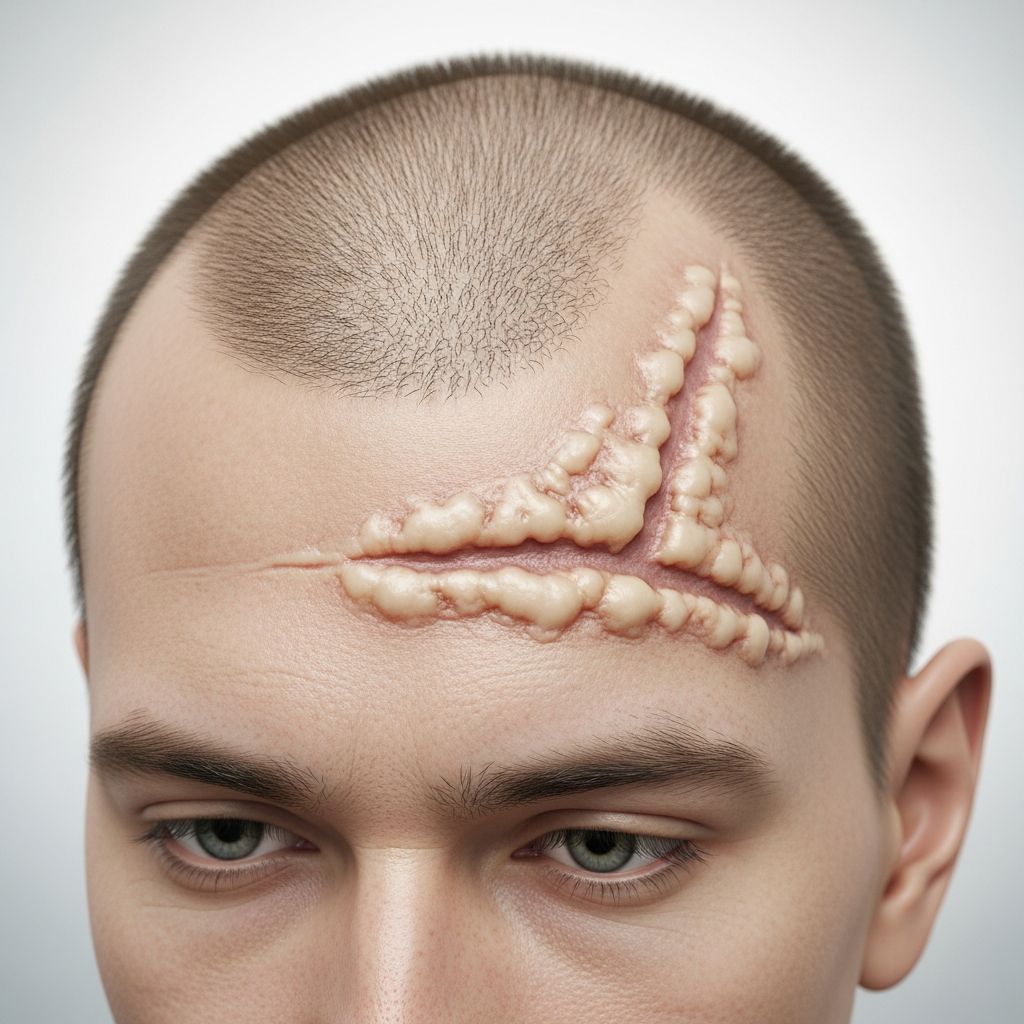
Morphoea en coup de sabre is a rare variant of linear morphoea, a localized form of scleroderma, primarily affecting the frontoparietal scalp and forehead, creating a characteristic sword-like scar that indents the skin and underlying tissues.
Introduction
Morphoea en coup de sabre, also known as linear scleroderma ‘en coup de sabre’ (French for ‘sword strike’), is an uncommon subtype of localized scleroderma. Unlike systemic sclerosis, it does not affect internal organs broadly but can extend deeply into subcutaneous tissues, bone, and rarely the brain. The name derives from the linear, depressed scar resembling a saber cut on the forehead. This condition leads to progressive fibrosis and atrophy, often resulting in cosmetic disfigurement, alopecia, and functional impairments. Early recognition is crucial to halt progression and mitigate complications.
The disease typically manifests in childhood or early adulthood, evolving over months to years. While primarily cutaneous, its paramedian location on the face raises concerns for ocular, neurological, and dental involvement. Recent studies emphasize its autoimmune etiology and the need for multidisciplinary management involving dermatologists, neurologists, and ophthalmologists.
Demographics
Morphoea en coup de sabre predominantly affects children and young adults, with onset commonly between 5 and 15 years of age. It is more frequent in females, with a female-to-male ratio of approximately 2-4:1, aligning with patterns in other linear morphoea forms. While most cases are sporadic, familial clustering suggests genetic susceptibility. The condition is rare globally, with incidence estimates below 1 per 100,000, though pediatric dermatology clinics report higher rates due to its prominence in this group.
- Peak age: 7-12 years
- Sex predominance: Females (60-80% of cases)
- Ethnicity: No strong predilection; reported across Caucasian, Asian, and Hispanic populations
- Risk factors: Family history of autoimmune diseases, preceding trauma or infection
Case reports highlight variability; for instance, adult-onset cases like a 23-year-old male with frontal lesions underscore its occurrence beyond pediatrics.
Causes
The precise etiology of morphoea en coup de sabre remains unknown, but it is widely regarded as an autoimmune inflammatory disorder. Genetic predisposition plays a role, with associations to HLA alleles and polymorphisms in genes regulating fibrosis, such as TGF-β pathways. Environmental triggers initiate aberrant immune responses leading to excessive collagen deposition by fibroblasts.
Reported triggers include:
- Mechanical trauma or friction to the scalp/forehead
- Herpes zoster ophthalmicus, with viral DNA detected in lesions suggesting persistent antigenic stimulation
- Radiotherapy or prior inflammatory dermatoses
- Infections (e.g., Borrelia burgdorferi in some regions, though serology often negative)
- Vaccinations, insect bites, or psychogenic stress
Pathophysiologically, Th2 cytokines like IL-4 and TGF-β drive fibroblast activation, causing sclerosis. Vascular endothelial damage and neuropeptide dysregulation post-herpes zoster may exacerbate local immune dysfunction.
Clinical features
The evolution of morphoea en coup de sabre spans months to years, starting subtly and progressing to overt scarring. Initial lesions appear as hyperpigmented or hypopigmented streaks on the forehead, often paramedian (more common on the left side). The streak widens, becomes indurated (ivory-colored with lilac borders), and indents, extending into the scalp causing linear alopecia. Facial asymmetry develops due to underlying bone atrophy.
Key features include:
- Skin changes: Linear plaque with shiny, bound-down skin; telangiectasias; loss of adnexa (hair follicles, sweat glands)
- Scalp involvement: Cicatricial alopecia along the lesion tract
- Facial extension: Possible involvement of nose, cheek, lip, or neck; rarely bilateral
- Deep tissue: Subcutaneous atrophy, muscle hypotrophy, mandibular hypoplasia
Oral manifestations are exceptional but reported, such as gingival recession, mucosal fibrosis, and alveolar resorption in a pediatric case. Dermoscopy reveals dilated vessels, fibrosis, and follicular dropout.
Complications
Beyond cosmetic issues, morphoea en coup de sabre can invade deeper structures, leading to significant morbidity:
- Neurological: Headaches (most common), seizures, epilepsy, hemiparesis, trigeminal neuralgia due to brain parenchyma involvement or meningeal inflammation
- Ocular: Iris atrophy, uveitis, glaucoma, retinal vasculitis; fundoscopy essential
- Dental/Oral: Delayed tooth eruption, root resorption, lingual atrophy
- Orthopedic: Facial hemiatrophy (Parry-Romberg syndrome overlap), limb length discrepancy if extremities involved
- Psychosocial: Anxiety, depression from disfigurement
Related Stories



Progression to underlying bone causes skull defects visible on imaging; rare CNS vasculitis reported.
Diagnosis
Diagnosis is primarily clinical, based on the pathognomonic linear forehead/scalp lesion. Dermoscopy aids by showing inflammatory and fibrotic changes. Biopsy, if needed, confirms scleroderma: dermal sclerosis, collagen homogenization, perivascular inflammation, eccrine gland atrophy.
Investigations include:
| Modality | Purpose |
|---|---|
| Skin biopsy | Histological confirmation (hyalinized collagen bundles) |
| MRI brain/orbits (with gadolinium) | Assess depth, brain involvement, white matter lesions |
| Ophthalmologic exam | Slit-lamp, fundoscopy for uveitis |
| Laboratory: | ANA (often positive, speckled/nucleolar), anti-single-stranded DNA; rule out Borrelia |
| Ultrasound | Lesion depth, vascularity |
Differential includes Parry-Romberg syndrome (progressive hemifacial atrophy without sclerosis), lupus profundus, or lymphoma.
Differential diagnoses
- Parry-Romberg syndrome: Hemifacial atrophy without induration; often coexists
- Linear lichen planus or lupus erythematosus: Itchy, less atrophic
- Herpes zoster scarring: History of vesicles; dermatomal
- Trauma or nevus lipomatosus: Non-progressive
- Malignancy: Lymphoma, metastases (biopsy differentiates)
Treatment
No cure exists; treatment aims to halt progression, reduce inflammation, and manage complications. Early intervention is key, especially in active (expanding, indurated) lesions. First-line: methotrexate (15-25 mg/week) ± systemic corticosteroids (prednisone 1 mg/kg taper). Response monitored via clinical scores (e.g., Localized Scleroderma Damage Index).
Therapeutic ladder:
- Topical: High-potency steroids, calcineurin inhibitors for superficial activity
- Systemic immunosuppressants: MTX, corticosteroids; alternatives: mycophenolate, cyclophosphamide for refractory cases
- Phototherapy: UVA1 for superficial lesions
- Biologics: Anti-TNF (etanercept), tocilizumab (IL-6 inhibitor) emerging
- Surgical: Fat grafting, fillers for atrophy; alopecia reconstruction post-stabilization
Multidisciplinary: Neurology for seizures (antiepileptics), ophthalmology. Case reports show good MTX response without side effects in children.
Outcome
With prompt treatment, 50-70% achieve stabilization within 2-5 years; untreated, progression continues 3-5 years. Residual atrophy, alopecia, and asymmetry persist, but neurological sequelae are preventable. Recurrence risk 20-30%; long-term monitoring needed. Parry-Romberg overlap worsens prognosis. Patient education on sun protection and psychosocial support vital.
Frequently Asked Questions (FAQs)
What is morphoea en coup de sabre?
A localized scleroderma variant causing a linear scar on the forehead/scalp, potentially affecting deeper tissues.
Who gets it and when?
Mostly children (5-15 years), females; starts as a streak, progresses over years.
Does it affect the brain?
Yes, rarely: headaches, seizures from extension; MRI screens for this.
How is it treated?
Methotrexate + steroids first-line; early treatment halts progression.
Is it curable?
No, but manageable; scars permanent, but activity controllable.
References
- Morphoea en coup de sabre — DermNet NZ. 2023. https://dermnetnz.org/topics/morphoea-en-coup-de-sabre
- [Linear morphea in saber coup: about a case] — Sánchez de MV et al. PubMed. 2022-04-01. https://pubmed.ncbi.nlm.nih.gov/35338820/
- Morphea «En Coup De Sabre» at the Site of Healed … — Actas Dermo. 2019. https://actasdermo.org/es-morphea-en-coup-de-sabre-articulo-S1578219019302392
- Esclerodermia localizada en Coup de Sabre — Sociedad Chilena de Reumatologia. 2021. https://sochire.cl/wp-content/uploads/2021/09/r-960-1-1628699142.pdf
- Morphea “en coup de sabre”: An unusual oral presentation — Niklander S et al. Journal of Clinical and Experimental Dentistry. 2017-02-01. https://researchers.unab.cl/es/publications/morphea-en-coup-de-sabre-an-unusual-oral-presentation/
- MORPHOEA LOCALISED SCLERODERMA — Scleroderma Australia. 2023-08. https://www.sclerodermaaustralia.com.au/wp-content/uploads/2023/08/Scleroderma-Aus-Morphoea-web.pdf
- Localized Scleroderma — Scleroderma Foundation. 2021-12. https://scleroderma.org/wp-content/uploads/2021/12/Localized-20211127.pdf
Similar Articles








Read full bio of Sneha Tete