Morphoea Images: Visual Atlas Of Key Subtypes & Stages
Comprehensive visual guide to morphoea skin lesions across all subtypes and stages of this localized scleroderma.
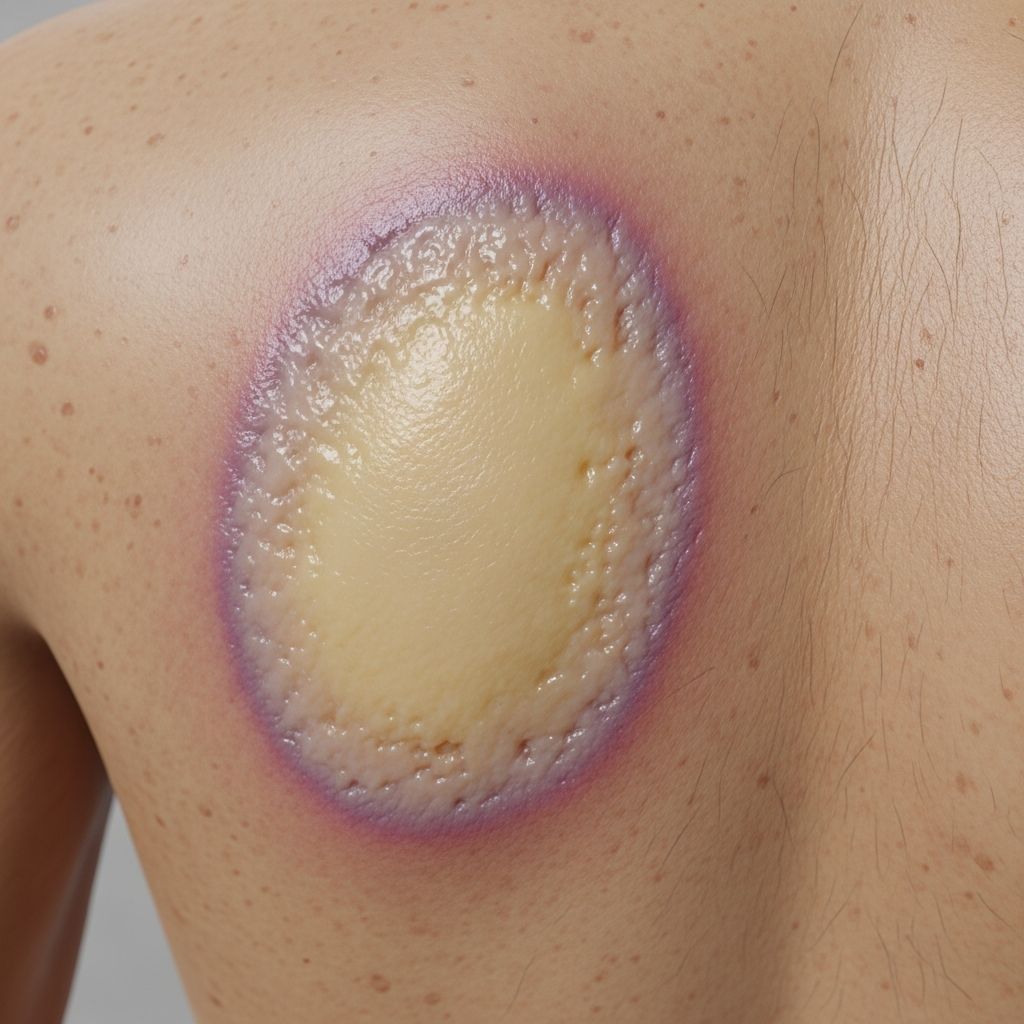
Morphoea, also known as localized scleroderma, is a rare autoimmune condition characterized by inflammation and fibrosis leading to thickened, hardened skin patches. Unlike systemic scleroderma, it does not affect internal organs but can cause significant cosmetic and functional issues. This article presents a comprehensive visual atlas of morphoea lesions across all major subtypes, stages, and anatomical sites, synthesized from clinical dermatology resources. Images illustrate the characteristic evolution from active inflammatory borders (lilac ring) to sclerotic centers and atrophic resolution phases.
What is morphoea?
Morphoea manifests as oval or linear patches of skin that undergo a predictable progression: initial erythema or violaceous discoloration, central ivory-white sclerosis with an active lilac ring, and eventual post-inflammatory hyperpigmentation or atrophy. Lesions primarily affect the trunk, limbs, and face, with subtypes determined by distribution, depth, and extent. It predominantly impacts children and adults under 40, with spontaneous resolution typically within 3–5 years, though sequelae like scarring or limb discrepancies may persist.
Types of morphoea
Morphoea is classified into superficial and deep forms, with superficial subtypes including circumscribed (plaque), guttate, generalized, linear, and bullous variants. Deep morphea involves subcutaneous tissues. Key types include:
- Circumscribed superficial morphoea (plaque morphea): Single or few oval plaques, most common in adults.
- Linear morphoea: Band-like lesions, prevalent in children, often on limbs or face (en coup de sabre).
- Generalized morphoea: Four or more plaques covering >30% body surface.
- Deep morphea (morphea profunda, pansclerotic): Involves fascia, muscle, bone; rare and severe.
Circumscribed superficial morphoea – Classical plaque morphoea
The hallmark of plaque morphoea is 1–3 well-defined, oval lesions 2–20 cm in diameter, typically on the trunk. Early lesions show peripheral lilac inflammation surrounding a waxy, hypopigmented center with reduced follicles and sweating. Over months, sclerosis peaks, followed by softening and atrophy.
- Early plaque with active lilac ring: Violaceous border on ivory sclerotic plaque on abdomen, showing perifollicular sparing.
- Evolving plaque: Central whitening with radial telangiectasia and surrounding erythema on chest.
- Mature sclerotic plaque: Shiny, bound-down skin on back with hair loss and hypohidrosis.
- Resolving plaque: Post-inflammatory hyperpigmentation on thigh after 2 years.
Multiple plaque morphoea
Multiple circumscribed plaques (>3 but <4 large lesions) indicate intermediate severity between solitary plaque and generalized forms. Lesions cluster on trunk or proximal limbs.
- Symmetrical plaques: Bilateral oval lesions on lower abdomen with matched lilac borders.
- Disseminated small plaques: Numerous 1–2 cm ivory patches on torso mimicking guttate morphea.
Generalised morphoea
Defined by >4 plaques or surface area >30%, generalized morphea carries higher risk of extracutaneous features like fatigue or arthralgias. Lesions spare flexures and face.
- Extensive truncal involvement: Confluent ivory plaques covering abdomen, chest, and back.
- Nodular generalized form: Kiesselbach-like nodules amid sclerotic sheets on thighs.
Related Stories



Linear morphoea
Linear lesions follow Blaschko lines or dermatomes, deepest on extremities or scalp. In children, ‘en coup de sabre’ mimics saber-cut on forehead, risking alopecia and ophthalmic complications.
- Limb linear morphea: Brown linear streak on leg with underlying muscle atrophy.
- En coup de sabre: Paramidian linear sclerosis from scalp to cheek, with brow loss.
- Progressive facial linear: Deepening groove on temple with ipsilateral uveitis risk.
Deep morphoea
Subcutaneous involvement (morphea profunda) spares epidermis, presenting as depressed plaques with overlying normal skin. Panniculitis-like on thighs.
- Plaque-like deep morphoea: Indurated subcutaneous plaque on flank.
- Pediatric deep form: Firm nodules on arms affecting growth plates.
Bullous morphoea
Rare variant with tense serous blisters atop sclerotic plaques, often linear subtype. Blisters arise from lymphatic obstruction.
- Bullae on plaque: Hemorrhagic vesicles on ivory sclerotic patch.
Atrophoderma of Pasini and Pierini
Controversial ‘abortive’ morphea with cliff-drop borders, hyperpigmented dermal atrophy sans sclerosis. Evolves over years.
- Classic atrophoderma: ‘Swiss cheese’ depressed plaques on back.
Guttate morphoea
Minute (<1 cm) raindrop-like plaques, often post-streptococcal in children. Benign course.
- Guttate lesions: Scattered white macules on trunk.
Disabling pansclerotic morphoea of children
Extremely rare, aggressive form engulfing >90% skin, fat, muscle, bone in childhood, leading to contractures and death.
- Pansclerotic involvement: Fibrotic sheets on extremities with joint ankylosis.
Morphoea – Progression
Lesions evolve through active (circumscribed), sclerotic (indurated), and burnt-out (atrophic) phases over 3–5 years.
- Active inflammatory: Lilac ring with expanding border.
- Sclerotic peak: Maximal induration, telangiectasia.
- Atrophic resolution: Softening with dyspigmentation.
Clinical variants and associations
Includes eosinophilic fasciitis (groove sign), lichen sclerosus overlap, and Parry-Romberg syndrome (hemiatrophy).
- Fasciitis: Paresthesia with rippling subcutaneous cords.
Frequently Asked Questions
What does early morphoea look like?
Early lesions present as reddish/purplish oval patches with central paling and perifollicular sparing, evolving to waxy sclerosis.
Is morphoea dangerous?
Usually self-limited, but linear/deep forms risk joint contracture, growth disturbance, or rare pansclerotic fatality.
Does morphoea itch or hurt?
Pruritus common in active phase; deep forms cause tightness or functional limitation.
Can morphoea recur?
20–50% experience new lesions post-resolution.
Treatment Overview
No cure; topical corticosteroids, calcipotriene, phototherapy (NB-UVB/PUVA), methotrexate for progressive disease. Early intervention limits sequelae.
| Subtype | First-Line Treatment | Indications |
|---|---|---|
| Circumscribed | Topical steroid + calcipotriene | Superficial, limited |
| Linear/Generalized | Methotrexate + phototherapy | Deep, progressive |
| Pansclerotic | Systemic immunosuppressants | Severe, disabling |
References
- Symptoms, Causes & Treatment | Types of Morphea — Healthgrades. 2024. https://resources.healthgrades.com/right-care/skin-hair-and-nails/morphea
- Morphea – Diagnosis and treatment — Mayo Clinic. 2025-01-15. https://www.mayoclinic.org/diseases-conditions/morphea/diagnosis-treatment/drc-20375290
- Localized Scleroderma (Juvenile) — American College of Rheumatology. 2024. https://rheumatology.org/patients/localized-scleroderma-juvenile
- Morphea — StatPearls, NCBI Bookshelf. 2024-07-01. https://www.ncbi.nlm.nih.gov/books/NBK559010/
Similar Articles








Read full bio of medha deb