Mucinous Carcinoma Pathology: 5 Key Insights For Diagnosis
Comprehensive pathology guide to primary cutaneous mucinous carcinoma: histology, diagnosis, and differentiation from metastases.
Primary cutaneous mucinous carcinoma is a rare but distinctive adnexal tumour of the skin, most commonly presenting as a slow-growing dermal nodule on the head and neck of older adults. It is characterized by clusters of epithelial cells floating in abundant extracellular mucin, mimicking colloid carcinoma from internal organs. This article delves into its clinical presentation, histological features, immunohistochemical profile, differential diagnosis, and management implications.
Introduction
Mucinous carcinoma of the skin, also known as colloid carcinoma, is an uncommon malignant neoplasm thought to originate from eccrine or apocrine glands. First described in the literature decades ago, it accounts for less than 1% of all cutaneous carcinomas. The tumour typically affects individuals over 60 years of age, with a slight male predominance, and preferentially involves the periorbital and centrofacial regions. Clinically, it manifests as a firm, gelatinous nodule or plaque that grows slowly over months to years. Due to its rarity and morphological overlap with metastatic disease, accurate pathological diagnosis is crucial to guide appropriate management and avoid unnecessary systemic workup.
Histologically, the defining feature is a dermal-based mass where epithelial elements appear suspended in copious pools of mucin, imparting a ‘floating islands’ appearance. This pattern distinguishes it from other adnexal carcinomas but necessitates careful exclusion of metastatic mucinous adenocarcinoma from breast, ovary, pancreas, or gastrointestinal tract. Recent studies emphasize the role of immunohistochemistry in confirming primary cutaneous origin, particularly markers like CK5/6 and p63 that highlight myoepithelial cells.
Clinical Features
Patients with primary cutaneous mucinous carcinoma typically present with a solitary, asymptomatic lesion. Key clinical characteristics include:
- Location: Head and neck (80-90% of cases), especially eyelids, periorbital area, nose, and cheeks.
- Appearance: Translucent, dome-shaped papule or nodule, 0.5-3 cm in diameter, with a smooth or slightly vascular surface.
- Growth pattern: Slow progression over 1-5 years; rarely ulcerates.
- Demographics: Predominantly elderly adults (mean age 63-73 years); male-to-female ratio approximately 1.5:1.
- Associations: Occasional link to sun-damaged skin; no strong predisposition to basal cell carcinoma or other skin cancers.
While clinically innocuous, the lesion’s location on the face raises cosmetic concerns and potential for local recurrence if incompletely excised. Recurrence rates range from 10-15%, with rare metastases to lymph nodes or distant sites.
Histology
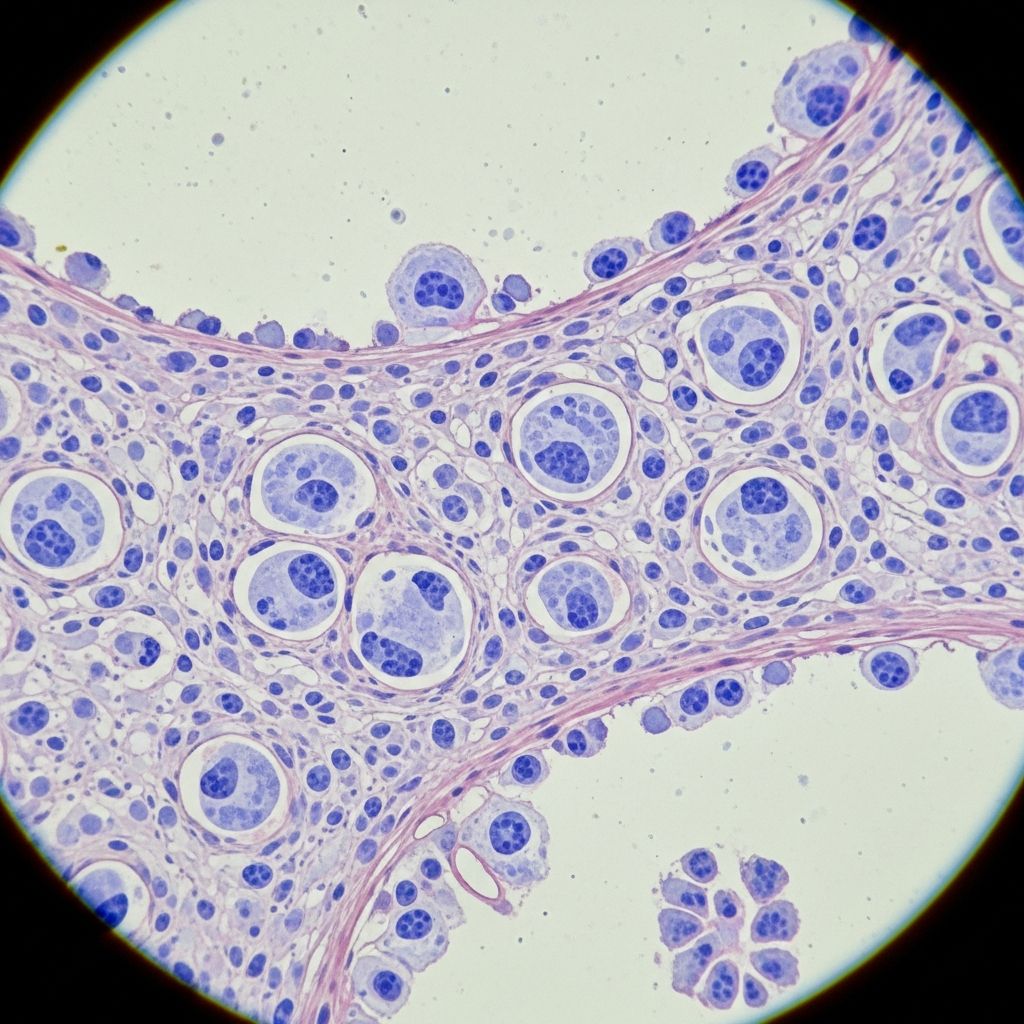
Microscopic examination reveals a well-circumscribed but unencapsulated dermal tumour composed of variably sized pools of abundant, basophilic mucin that distend the dermis. Within these mucin lakes, there are floating clusters, cords, and tubular glands of epithelial cells. The mucin is periodic acid-Schiff (PAS) positive and diastase resistant, confirming its epithelial origin.
At low power, the tumour appears as a lobulated mass centred in the mid-to-deep dermis, sparing the epidermis and often without grenz zone (figures 1-3 from DermNet archives). Higher magnification shows atypical epithelial cells with:
- Enlarged size and mild nuclear pleomorphism.
- Eosinophilic cytoplasm, occasionally vacuolated.
- Round to oval nuclei with small nucleoli; rare mitoses.
- Peripheral palisading in some nests, reminiscent of basal cell carcinoma but lacking retraction artifact.
Architectural patterns include solid nests, ductal structures with lumina, and cribriform arrangements. Peripheral tumour pools may infiltrate collagen, indicating subtle aggressiveness. No lymphovascular invasion is typically seen in pure mucinous variants, though mixed tumours with neuroendocrine features exist.
Related Stories



Cytology
Cytologically, the neoplastic cells exhibit bland to moderately atypical features. They are polygonal with abundant eosinophilic cytoplasm, distinct cell borders, and central nuclei showing fine chromatin and inconspicuous nucleoli. Intracytoplasmic mucin droplets are common, best highlighted by mucicarmine or Alcian blue stains. The background mucin is acellular and Alcian blue-positive at pH 2.5, confirming acid mucopolysaccharides. Fine-needle aspiration may yield diagnostic mucin pools with embedded epithelial clusters, aiding preoperative diagnosis.
Histopathology Images Description
Key histopathological images illustrate the classic features:
- Figure 1: Low-power view of dermal mucin pools with suspended epithelial islands.
- Figure 2: Medium power showing glandular structures within mucin.
- Figure 3: High power of atypical cells with eosinophilic cytoplasm and mild pleomorphism.
These images underscore the ‘Swiss cheese’ appearance due to mucin distension.
Immunohistochemistry
Immunohistochemical studies are pivotal for diagnosis and to exclude metastases. Primary cutaneous mucinous carcinoma typically shows:
| Marker | Expression | Significance |
|---|---|---|
| CK7 | Positive (diffuse) | Supports adnexal differentiation. |
| CK20 | Negative | Distinguishes from GI metastases. |
| ER/PR | Variably positive (30-50%) | Apocrine differentiation; therapeutic target. |
| CK5/6 | Positive (peripheral myoepithelial cells) | Favours primary cutaneous over metastasis. |
| p63 | Positive (myoepithelial layer) | Key discriminator for primary tumour. |
| GCDFP-15 | Often positive | Apocrine marker. |
| Synaptophysin/Chromogranin | Negative (unless mixed with EMPSGC) | Excludes neuroendocrine tumours. |
Myoepithelial markers (p63, calponin) around ducts strongly support in situ primary origin.
Differential Diagnosis
The main challenge is distinguishing primary cutaneous mucinous carcinoma from mimics:
- Cutaneous metastasis: Morphologically identical to breast colloid carcinoma (most common), ovarian, pancreatic, or colorectal mucinous adenocarcinoma. Clues: multifocal lesions, no myoepithelial cells (CK5/6/p63 negative), CK20+/CDX2+ for GI.
- Endocrine mucin-producing sweat gland carcinoma (EMPSGC): Precursor lesion, eyelid predilection, neuroendocrine differentiation (synaptophysin+), transitions to invasive mucinous areas. Cells have stippled chromatin.
- Mucinous basal cell carcinoma: Rare variant with peripheral palisading, BerEP4+, lacks abundant mucin pools.
- Adnexal mucinous tumours: Mucinous syringoma or hidradenoma lack atypia and infiltration.
- Metastatic adenocarcinoma (general): Glandular patterns without mucin dominance; site-specific IHC.
Clinical correlation (solitary facial nodule in elderly) plus IHC panel resolves most cases.
Electron Microscopy
Ultrastructural studies reveal apocrine differentiation: abundant rough endoplasmic reticulum, Golgi complexes, and intracytoplasmic lumina with microvilli. Mucin granules and decapitation secretion support apocrine over eccrine origin, though debate persists. Rarely used in modern practice due to IHC superiority.
Management and Prognosis
Complete surgical excision with 4-6 mm margins or Mohs micrographic surgery is curative in most cases, given the low metastatic potential (<10%). Sentinel lymph node biopsy is not routine but considered for eyelid tumours or recurrence. ER-positive cases may respond to tamoxifen. Local recurrence risk is 10-15%, higher with incomplete excision. Long-term follow-up is recommended due to late recurrences.
Frequently Asked Questions (FAQs)
What is the most common site for mucinous carcinoma?
The head and neck region, particularly periorbital area, accounts for over 80% of cases.
How do you differentiate primary cutaneous mucinous carcinoma from breast metastasis?
Presence of myoepithelial cells (p63+, CK5/6+) and solitary lesion favour primary; IHC panel and clinical history essential.
Is mucinous carcinoma aggressive?
Generally indolent with low metastasis rate, but local recurrence possible; wide excision recommended.
What is the relationship with EMPSGC?
EMPSGC is considered a precursor, especially in eyelid cases, with neuroendocrine features transitioning to mucinous carcinoma.
Are hormone receptors therapeutic targets?
Yes, ER/PR positivity in 30-50% allows anti-estrogen therapy in advanced or inoperable cases.
References
- Endocrine mucin–producing sweat gland carcinoma pathology — DermNet NZ. 2023. https://dermnetnz.org/topics/endocrine-mucinproducing-sweat-gland-carcinoma-pathology
- Mucinous carcinoma pathology — DermNet NZ, Assoc Prof Patrick Emanuel. 2014 (updated). https://dermnetnz.org/topics/mucinous-carcinoma-pathology
- Metastatic adenocarcinoma pathology — DermNet NZ. 2023. https://dermnetnz.org/topics/metastatic-adenocarcinoma-pathology
- Mucinous carcinoma pathology image — DermNet NZ. 2023. https://dermnetnz.org/imagedetail/18644-mucinous-carcinoma-pathology
- Basal Cell Carcinoma – StatPearls — NCBI Bookshelf, NIH. 2023-10-01. https://www.ncbi.nlm.nih.gov/books/NBK482439/
Similar Articles








Read full bio of medha deb