Multicentric Reticulohistiocytosis: Guide To Symptoms & Treatment
Rare systemic disease with skin nodules, destructive arthritis, and multi-organ involvement requiring early diagnosis.
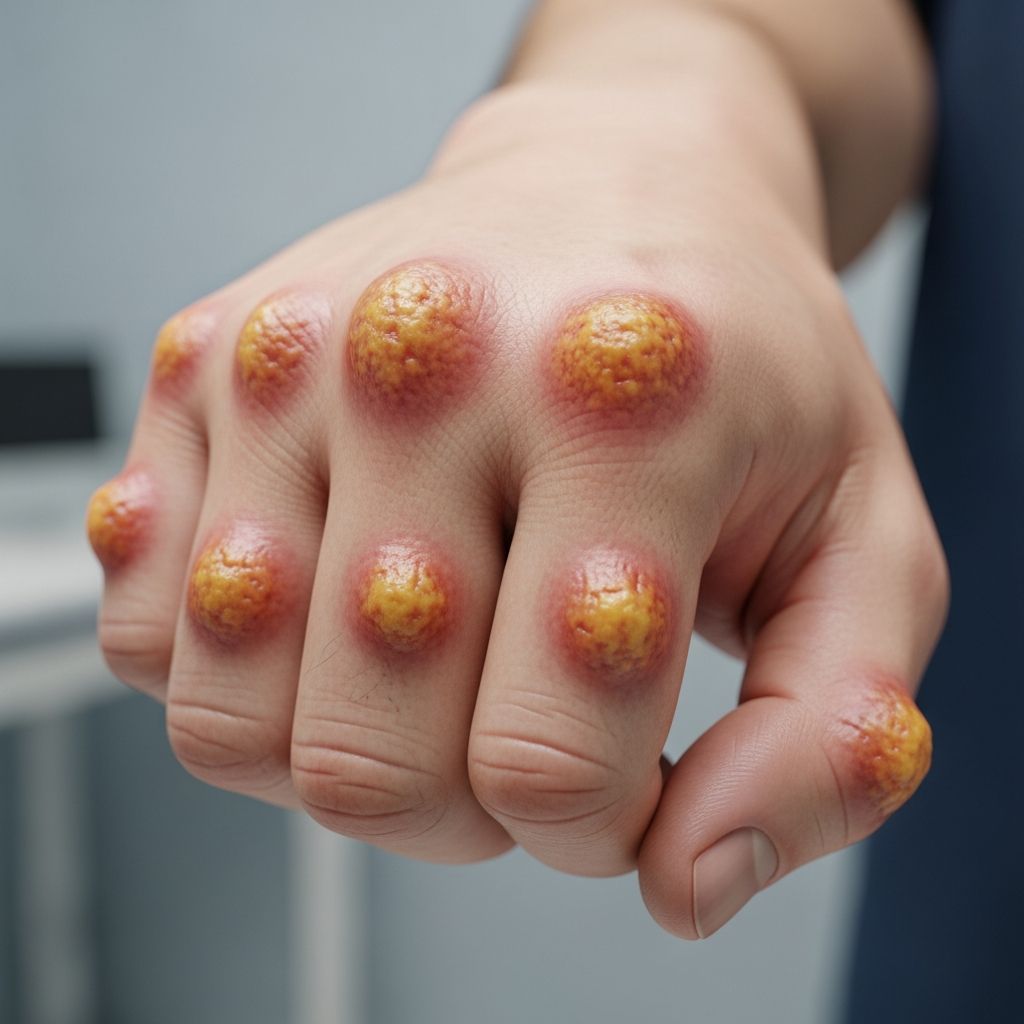
Multicentric reticulohistiocytosis
Author: Dermatologist reviewed
Multicentric reticulohistiocytosis is a very rare multisystem arthropathic form of reticulohistiocytosis. Reticulohistiocytoses are a type of non-Langerhans cell histiocytosis. It is characterised by skin and mucosal lesions, and arthritis.
What is multicentric reticulohistiocytosis?
Multicentric reticulohistiocytosis (MRH), also known as lipoid dermatoarthritis or reticulohistiocytic systemic granulomatosis, is an exceptionally rare systemic granulomatous disorder of unknown aetiology. It belongs to the spectrum of non-Langerhans cell histiocytoses, characterised by proliferation of true histiocytes (macrophages) leading to distinctive clinical and histopathological features. The disease predominantly affects the skin, mucous membranes, joints, and bones, but can involve nearly any organ including eyes, larynx, thyroid, salivary glands, bone marrow, heart, lungs, kidneys, liver, and gastrointestinal tract.
MRH typically presents with papulonodular cutaneous eruptions and a severe, destructive polyarthritis that can lead to arthritis mutilans in up to 50% of cases. The onset is usually in middle age, with women affected more frequently than men (approximately 3:1 ratio). Cutaneous manifestations often appear simultaneously or shortly before joint symptoms, and the disease follows a chronic, progressive course over 8–12 years, potentially entering spontaneous remission but often leaving permanent joint deformities.
Who gets multicentric reticulohistiocytosis?
MRH is extremely rare, with an estimated incidence of less than 1 case per million population annually. Over 200 cases have been documented in medical literature since its first description by Weber and Freudenthal in 1929. It typically manifests in the fourth to sixth decade of life, with a mean age at onset around 50 years. Females comprise about 65–75% of reported cases. There is no known ethnic or geographic predilection, though isolated case reports exist worldwide.
Risk factors remain unidentified due to the disease’s rarity and unclear pathogenesis. Approximately 25% of patients develop malignancy, most commonly solid tumours or lymphoproliferative disorders, within 2–3 years before or after MRH diagnosis, suggesting a possible paraneoplastic association. However, a direct causal link is unproven, and routine malignancy screening is recommended.
What causes multicentric reticulohistiocytosis?
The exact cause of MRH is unknown. It is classified as a non-Langerhans cell histiocytosis driven by aberrant activation and proliferation of monocyte-macrophage lineage cells (CD68-positive histiocytes). Potential triggers include:
- Autoimmune dysregulation with cytokine overexpression (e.g., TNF-α, IL-1, IL-6).
- Genetic factors, though no specific mutations are consistently identified.
- Paraneoplastic phenomenon in 10–25% of cases, linked to adenocarcinomas, lymphomas, or myelodysplastic syndromes.
- Infectious or environmental exposures, unsubstantiated.
Histogenesis involves accumulation of lipid-laden multinucleated giant cells with ground-glass cytoplasm, lacking Birbeck granules (distinguishing from Langerhans cell histiocytosis).
What are the clinical features of multicentric reticulohistiocytosis?
Clinical manifestations are protean, but hallmark features include dermatological, rheumatological, and systemic involvement.
Skin lesions
Skin lesions occur in 90% of cases and are often the presenting feature. They manifest as firm, reddish-brown to yellowish papules and nodules (1 mm–2 cm diameter), predominantly on the upper body:
- Hands: Characteristic coral bead papules along proximal nail folds (80% of cases), evoking a beaded appearance.
- Face: Scattered papules on nose, cheeks, ears, eyelids; confluence leads to verruucous plaques or leonine facies.
- Mucosa: Violaceous nodules on lips, tongue, gums, palate, nostrils (60% of cases).
- Other sites: Forearms, elbows, shoulders, back, scalp; rare lower body involvement.
Dermatoscopy reveals a ‘setting-sun sign’ (central yellow hue, pink-orange rim, brown reticular vessels, white scar-like centre).
Musculoskeletal features
Severe symmetric polyarthritis affects 95% of patients, starting insidiously in hands and progressing rapidly:
- Predilection for distal interphalangeal (DIP) joints (unique among arthritides).
- Proximal interphalangeal (PIP), metacarpophalangeal (MCP), wrists, knees, shoulders, temporomandibular joints.
- Radiographic ‘opera glass’ hands: marginal erosions, joint space narrowing, telescoping digits (arthritis mutilans in 50%).
- Tenosynovitis, muscle atrophy, osteopenia.
Systemic involvement
Up to 25% have extracutaneous disease:
- Cardiopulmonary: Pericarditis, pleuritis, pulmonary fibrosis.
- Neurological: Peripheral neuropathy, aseptic meningitis.
- Other: Lymphadenopathy, fever, weight loss, anaemia, elevated ESR, hyperlipidaemia (25%), thyroiditis.
How is multicentric reticulohistiocytosis diagnosed?
Diagnosis integrates clinical, radiological, and histopathological findings. No single test is pathognomonic.
Clinical suspicion
Triad of coral bead papules, DIP-predominant arthritis, and compatible histopathology.
Investigations
- Skin biopsy: Essential. Dermal infiltrate of large mononuclear and multinucleated histiocytes (30–50% multinucleated) with abundant eosinophilic ground-glass cytoplasm; PAS-positive diastase-resistant cytoplasmic granules; CD68+, CD163+, Factor XIIIa+, negative S100, CD1a.
- Radiology: Hand X-rays show symmetric erosions (‘gull-wing’ in DIP/PIP), acro-osteolysis. MRI detects early synovitis.
- Laboratory: Normocytic anaemia, thrombocytosis, high ESR/CRP; negative RF, ANA (usually); hypercholesterolaemia/xanthomata in 25–40%.
- Differentials exclusion: Rheumatoid arthritis, psoriatic arthritis, gout, sarcoidosis, Langerhans histiocytosis, dermatomyositis.
| Feature | MRH | Rheumatoid Arthritis | Psoriatic Arthritis |
|---|---|---|---|
| Joint predilection | DIP >> PIP | PIP >> DIP | DIP possible |
| Skin lesions | Coral beads, nodules | Rheumatoid nodules | Plaques, nail dystrophy |
| Histology | Ground-glass histiocytes | Palmsabnormal | Neutrophils |
| RF | Negative | Positive 70% | Negative |
Treatment of multicentric reticulohistiocytosis
No curative therapy exists; management is symptomatic and immunomodulatory to halt progression. Multidisciplinary approach (rheumatology, dermatology, oncology screening).
First-line
- NSAIDs for mild symptoms.
- Methotrexate (7.5–25 mg/week): Improves skin/joints in 60–70%.
Second-line
- Corticosteroids (prednisone 0.5–1 mg/kg): Rapid response, taper to avoid side effects.
- Hydroxychloroquine, ciclosporin, azathioprine.
- TNF inhibitors (etanercept, infliximab): Effective for refractory arthritis.
Other
- IL-1 blockers (anakinra), bisphosphonates for bone loss.
- Surgical synovectomy, joint replacement for mutilans.
- Treat hyperlipidaemia, screen for malignancy q6–12 months.
What is the outcome for multicentric reticulohistiocytosis?
MRH follows a self-limited course (mean 8 years), with spontaneous remission in 75–80%. However, joint destruction is often irreversible: 50% develop arthritis mutilans with crippled hands/feet; 20% facial disfigurement. Mortality is 10–25%, from infection, malignancy, or cardiopulmonary complications. Early aggressive therapy improves skin resolution (90%) and slows erosions.
FAQs
Is multicentric reticulohistiocytosis cancerous?
No, it is not malignant, but 25% of patients have associated malignancy requiring vigilant screening.
Can multicentric reticulohistiocytosis be cured?
No cure exists, but remission occurs in most after 8 years with treatment mitigating damage.
What does coral bead papules look like?
Linear arrangement of reddish-brown papules along nail folds resembling coral beads.
Is MRH hereditary?
No established genetic basis; sporadic occurrence.
How is MRH different from rheumatoid arthritis?
MRH targets DIP joints with histiocytic nodules; RA spares DIPs, has RF positivity.
References
- Multicentric reticulohistiocytosis – PMC – NIH — National Library of Medicine. 2012-10-01. https://pmc.ncbi.nlm.nih.gov/articles/PMC3481828/
- Multicentric reticulohistiocytosis – DermNet — DermNet NZ. 2024. https://dermnetnz.org/topics/multicentric-reticulohistiocytosis
- A case report of multicentric reticulohistiocytosis with atypical skin lesions as the first symptom — Frontiers in Immunology. 2024-04-15. https://www.frontiersin.org/journals/immunology/articles/10.3389/fimmu.2024.1344313/full
- Multicentric Reticulohistiocytosis–A rare and disabling disease — Wiley Online Library. 2024. https://onlinelibrary.wiley.com/doi/full/10.1002/ccr3.7846
- A Rare Case of Multicentric Reticulohistiocytosis — DermSquared. 2023. https://skin.dermsquared.com/skin/article/view/340
Similar Articles








Read full bio of medha deb