Multinucleate Cell Angiohistiocytoma Pathology
Comprehensive pathology guide to multinucleate cell angiohistiocytoma: clinical features, histopathology, and differential diagnosis.
Author: Dr. Harriet Cheng, Dermatopathologist
Revised: January 2026
Abstract
Multinucleate cell angiohistiocytoma (MCAH) represents a rare, benign cutaneous proliferation characterized by vascular and fibrohistiocytic elements. First described in 1985, it predominantly affects middle-aged women and manifests as asymptomatic papules on acral sites. Histologically, MCAH features dilated dermal vessels, superficial fibrosis, and distinctive multinucleated fibroblasts. This article synthesizes clinicopathological features, diagnostic criteria, immunohistochemistry, and management approaches based on peer-reviewed studies.
Introduction
Multinucleate cell angiohistiocytoma (MCAH) is an uncommon benign lesion of the skin, blending vascular proliferation with fibrohistiocytic changes. Initially reported by Smith and Wilson Jones in 1985, over 140 cases have been documented in indexed literature. It is likely underdiagnosed due to its resemblance to common entities like dermatofibroma. MCAH typically presents in women over 40 years, with lesions on the hands, fingers, or lower extremities. Lesions are small (2-15 mm), violaceous or reddish-brown papules that develop gradually without regression.
The etiology remains unknown, though fibrohistiocytic and vascular origins are proposed. Unlike malignant processes, MCAH shows no aggressive behavior, supporting conservative management. Accurate diagnosis relies on histopathology, distinguishing it from mimics like Kaposi sarcoma or granuloma annulare.
Clinical features
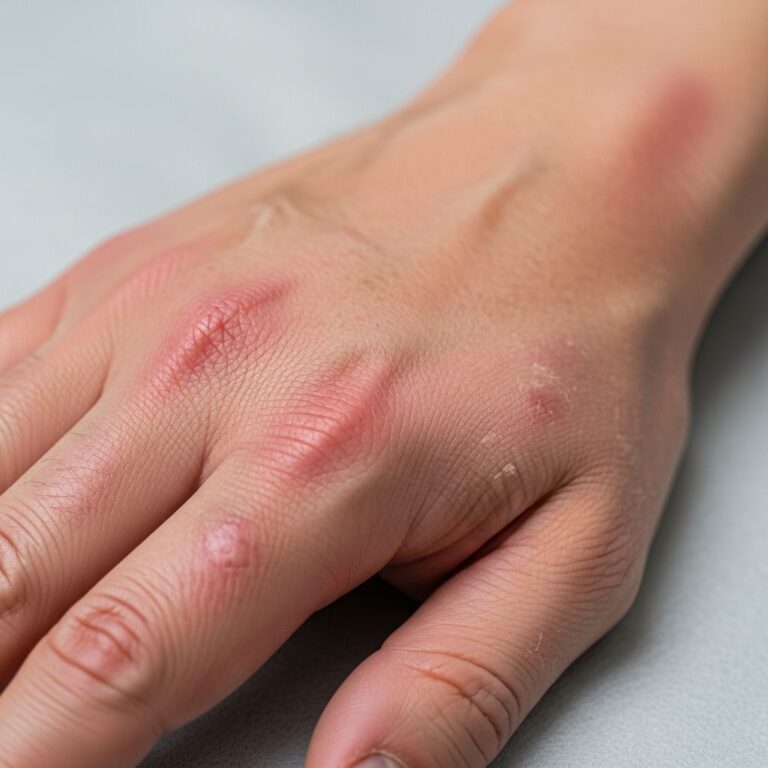
MCAH lesions are usually multiple, discrete, or grouped papules measuring 2-15 mm in diameter. They appear as firm, dome-shaped, reddish, pink, violaceous, or brown papules with smooth surfaces. Common sites include the dorsal hands, fingers, wrists, and lower extremities, though facial, trunk, and rare mucosal involvement occurs.
Patients report asymptomatic lesions, occasionally pruritic, developing over weeks to months without spontaneous resolution. Bilateral or generalized forms are exceptional. In one series, hands or fingers were affected in 51.6% of cases, equally across genders. Clinically, MCAH may mimic dermatofibroma, knuckle pads, or sarcoidosis, underscoring biopsy necessity.
Dermatoscopic findings
Dermatoscopy reveals polymorphous vessels, including comma-shaped, dotted, and linear forms in the papillary dermis. White areas correspond to fibrosis, with structureless violaceous or pink zones reflecting vascular proliferation. These patterns aid clinical suspicion but require histologic confirmation.
Pathology
Microscopic description
MCAH exhibits a normal epidermis overlying increased dermal cellularity. The papillary dermis shows parallel-oriented fibrosis, thickened collagen bundles, and proliferated, ectatic capillaries with prominent endothelial cells.
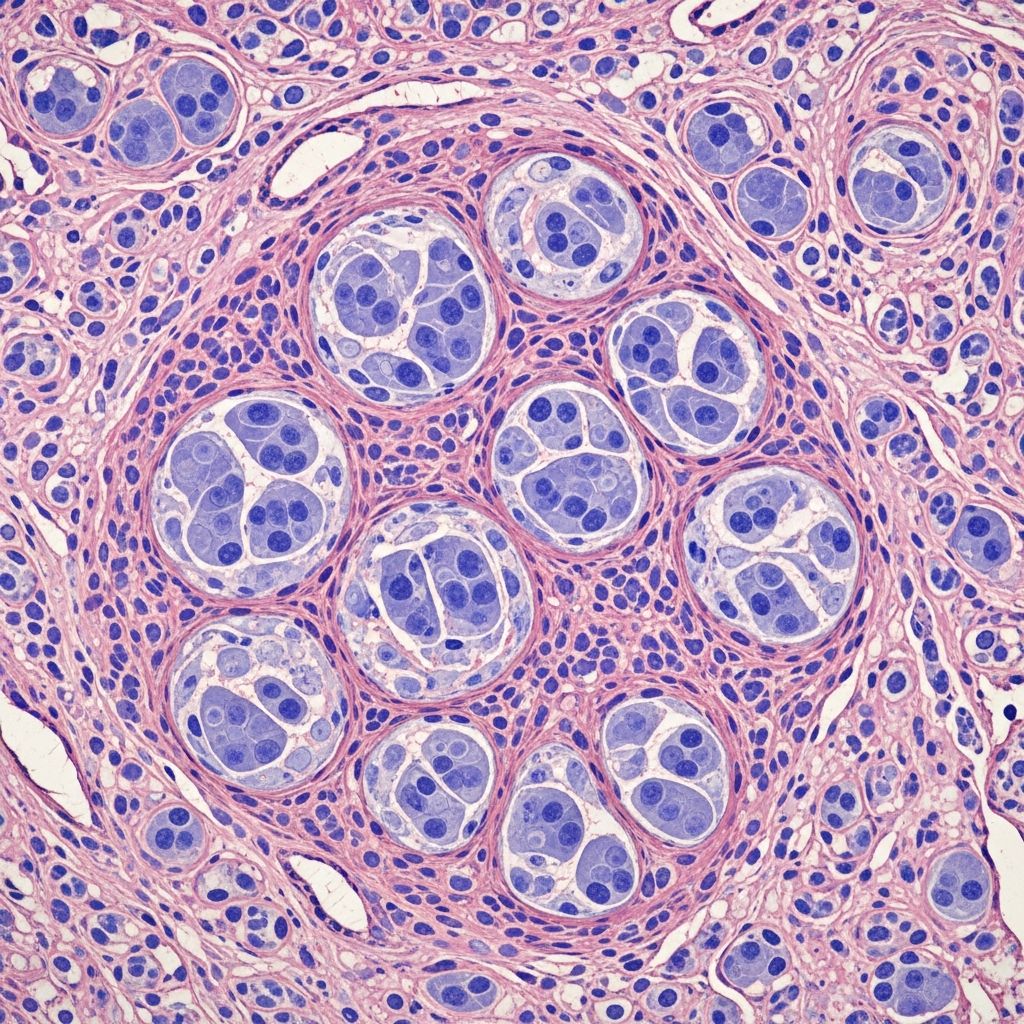
Key hallmark: bizarre multinucleated fibroblasts with angular contours, scalloped borders, and up to 10 hyperchromatic nuclei in basophilic cytoplasm. These reside amid lymphohistiocytic infiltrate, without granulomatous features. Mid-to-deep dermis displays venule proliferation in collagenous stroma, lacking perifollicular fibrosis.
Specific diagnostic criteria include: (a) odd multinucleated fibroblasts, (b) superficial parallel fibrosis, (c) thickened superficial papillary vessels, (d) absence of perifollicular fibrosis. No follicular induction or nuclear beta-catenin expression differentiates it from dermatofibromas.
Microscopic images
- Low-power view: Dilated vessels and fibrosis in papillary dermis (H&E).
- High-power: Multinucleated cells with irregular nuclei amid inflammatory infiltrate.
- Vascular detail: Ectatic capillaries with hypertrophic endothelium.
Histopathology images
Related Stories



Representative photomicrographs depict: (1) overall architecture with vascular ectasia and fibrosis; (2) characteristic multinucleate giant cells (H&E ×400); (3) thickened collagen and perivascular infiltrate.
Cytology descriptions
Cytology is rarely performed, but aspirates may show spindled fibroblasts, multinucleated cells, and endothelial fragments in a vascular matrix. Diagnosis favors biopsy over cytology due to architectural needs.
Histopathological variants
Standard MCAH predominates; rare variants include generalized or mucosal forms. No anaplastic or aggressive subtypes reported. Inflammation level varies, with immunohistochemistry aiding inflamed cases.
Immunohistochemistry findings
Multinucleated cells express vimentin, factor XIIIa (FXIIIa), and CD68, confirming fibrohistiocytic lineage. Endothelium stains for CD31, CD34, and factor VIII. Inflammatory infiltrate shows CD4+ lymphocytes, CD163+, CD117+, and CD138+ cells; S-100 negative.
No beta-catenin nuclear positivity excludes dermatofibroma with follicular induction. CD68 positivity in 60% of endothelial cells noted in reviews. IHC panel: FXIIIa+, CD68+, CD34/CD31+ (vessels), CD4+ (lymphocytes).
Electron microscopy description
Ultrastructurally, multinucleated cells display fibrohistiocytic features: rough endoplasmic reticulum, lysosomes, and intermediate filaments. Endothelial cells show Weibel-Palade bodies, supporting vascular component.
| Cell Type | Positive Markers | Negative Markers |
|---|---|---|
| Multinucleated cells | FXIIIa, CD68, vimentin | S-100 |
| Endothelium | CD31, CD34, factor VIII | – |
| Infiltrate | CD4, CD163, CD117, CD138 | – |
Differential diagnosis
MCAH mimics include:
- Dermatofibroma: Perifollicular fibrosis, beta-catenin+, epidermal hyperplasia absent in MCAH.
- Kaposi sarcoma: Prominent spindle cells, HHV-8+, lacks multinucleated giants.
- Granuloma annulare: Palisading granulomas, mucin; no ectatic vessels.
- Angiolymphoid hyperplasia: Eosinophils, epithelioid endothelium; MCAH lacks these.
- Sarcoidosis: Naked granulomas; no vascular proliferation.
Clinicopathologic correlation essential.
Treatment
Benign nature often precludes treatment. For cosmetics: intralesional steroids, excision, cryotherapy, vascular lasers (pulsed dye, Nd:YAG, CO2, argon, IPL). Nd:YAG laser showed dramatic improvement after 3 sessions. Observation preferred. No recurrence post-treatment reported.
Frequently Asked Questions
Q: What causes MCAH?
A: Etiology unknown; fibrohistiocytic/vascular proliferation suspected.
Q: Is MCAH cancerous?
A: No, entirely benign with no malignant potential.
Q: How is MCAH diagnosed?
A: Skin biopsy with histopathology and IHC confirming multinucleated cells, vascular ectasia.
Q: Does MCAH resolve spontaneously?
A: No tendency to regress; persists indefinitely.
Q: What are best treatments for MCAH?
A: Lasers (Nd:YAG, pulsed dye) or excision for aesthetics; often none needed.
Related topics
- Dermatofibroma pathology
- Benign vascular proliferations
- Fibrohistiocytic tumours
References
- Multinucleate cell angiohistiocytoma: A clinicopathologic… — PubMed (Yale study). 2019-04-10. https://pubmed.ncbi.nlm.nih.gov/30927287/
- Multinucleate Cell Angiohistiocytoma: Uncommon — Anais de Dermatologia. 2020-07-01. https://www.anaisdedermatologia.org.br/en-multinucleate-cell-angiohistiocytoma-an-uncommon-articulo-S0365059620301227
- Multinucleate Cell Angiohistiocytoma: A Case Report… — Derm Squared. 2023-01-01. https://skin.dermsquared.com/skin/article/view/1350
- Skin-Colored Nodules on the Knuckles —Diagnosis — JAMA Dermatology. 2010-06-01. https://jamanetwork.com/journals/jamadermatology/fullarticle/1105278
- Multinucleate cell angiohistiocytoma: an uncommon… — PubMed. 2020-05-01. https://pubmed.ncbi.nlm.nih.gov/32471758/
Similar Articles








Read full bio of medha deb