Muscles of the Body: Types, Anatomy & Functions
Complete guide to muscle types, structure, and how your body's 600+ muscles work.
Understanding Your Body’s Muscles: A Complete Anatomy Guide
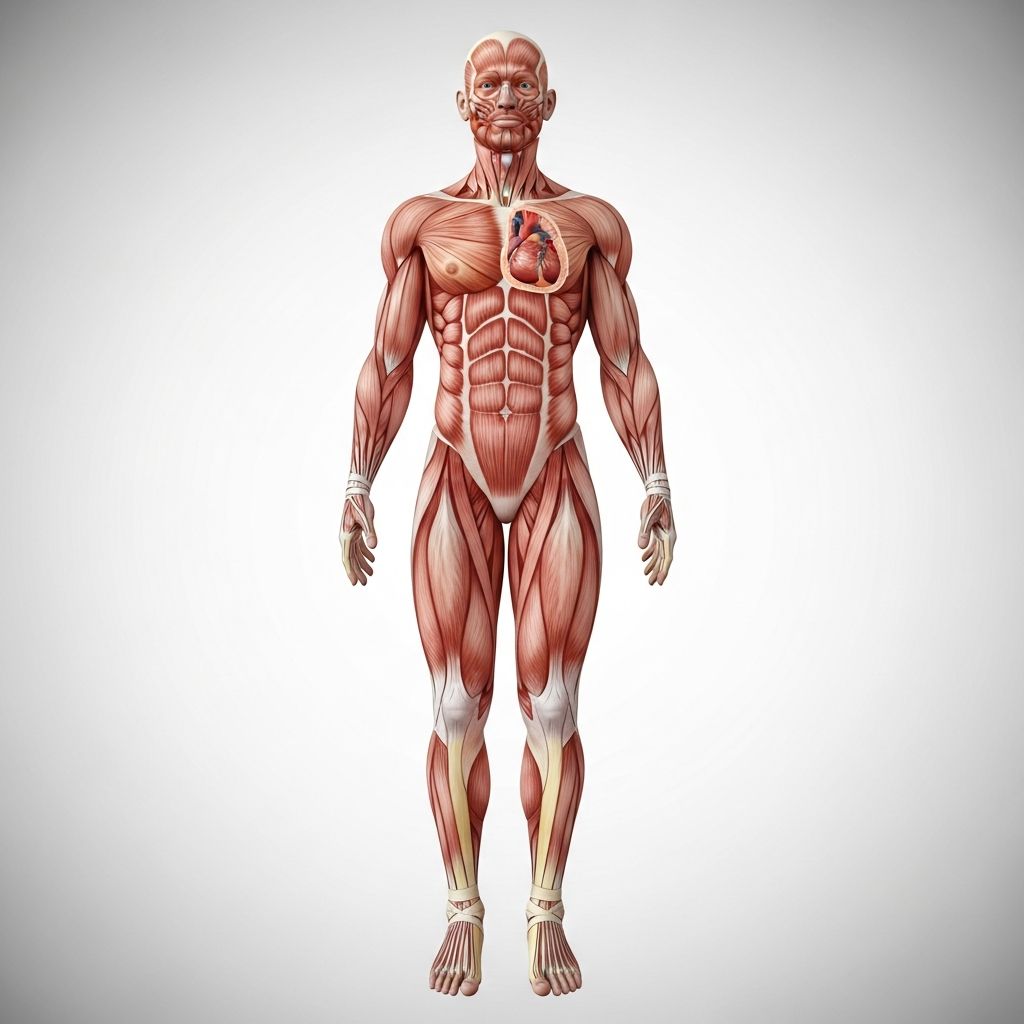
Your body contains more than 600 muscles that work almost constantly to keep you moving and functioning. Whether you’re running, speaking, blinking, or simply maintaining your posture, muscles are essential to virtually every action your body performs. Beyond movement, many muscles support your internal organs and keep you alive. Healthcare providers organize these muscles by tissue type into three distinct categories, each with unique characteristics and functions.
The Three Types of Muscle Tissue
Your body contains three primary types of muscle tissue, each designed for specific purposes and controlled in different ways. Understanding these differences helps explain how your body achieves such diverse functions through muscular activity.
Skeletal Muscle: Your Voluntary Movement System
Skeletal muscles make up approximately 30 to 40 percent of your total body mass and represent the most common type of muscle in your body. These muscles are part of your musculoskeletal system and work in conjunction with your bones, tendons, and ligaments to support your weight and enable movement. Skeletal muscles are voluntary muscles, meaning you consciously control how and when they contract. When you decide to reach for something, type on a keyboard, or go for a run, you’re using your skeletal muscles.
Skeletal muscle fibers display distinctive bands or striations when viewed under a microscope, which is why skeletal muscle is often called striated muscle. These fibers are long and tube-shaped, and in some cases can be as long as a foot. The fibers range from less than half an inch to just over 3 inches in diameter and usually span the length of the muscle. Each muscle can contain thousands of these fibers, which work together to create coordinated movement.
Tendons—tough bands of connective tissue—attach skeletal muscles to bones throughout your body. Your shoulder muscles, hamstring muscles, and abdominal muscles are all examples of skeletal muscles. These muscles are classified into two categories based on how quickly they contract: fast-twitch muscles that contract quickly and use short bursts of energy, and slow-twitch muscles that move slowly, such as your back muscles that help with posture.
Cardiac Muscle: Powering Your Heart
Cardiac muscle is unique because your heart is the only organ in your body that is also a muscle, and it’s made of a special type of muscle tissue called cardiac muscle. Like skeletal muscle, cardiac muscle is striated, displaying the same banded appearance under microscopic examination. However, cardiac muscle differs significantly from skeletal muscle in how it functions and is controlled.
Unlike skeletal muscle, cardiac muscle cannot be made to contract through conscious effort—you cannot voluntarily control your heartbeat. Instead, cardiac muscle has the remarkable ability to generate its own electrical impulses without requiring nerve stimulation for every contraction. An impulse begins in a specific location within the heart called the atrioventricular (A-V) node, which automatically triggers the coordinated contractions necessary for your heart to pump blood throughout your body. This autonomous function makes cardiac muscle uniquely suited to maintaining continuous circulation without requiring your conscious attention.
Smooth Muscle: Managing Involuntary Functions
Smooth muscle tissue lines some of your organs and performs functions you don’t consciously control. Unlike skeletal muscle cells, which are long and tube-shaped, smooth muscle cells are short and spindle-shaped. Additionally, smooth muscle cells lack the striations present in both skeletal and cardiac muscle, giving smooth muscle its name. Rather than being surrounded by tough connective tissue to form distinct muscles like skeletal muscle, smooth muscle cells are typically arranged in layers.
Related Stories



Smooth muscle is responsible for peristalsis—the wave-like movement of food through your gastrointestinal system—and helps regulate various involuntary bodily functions. Like cardiac muscle, smooth muscle cannot be controlled through conscious effort and relies on automatic nervous system regulation to function properly.
How Muscles Contract and Function
All three muscle types share one fundamental ability: the capacity to contract or shorten. However, the mechanisms by which this contraction occurs differ significantly among the three types.
Skeletal Muscle Contraction Mechanism
For skeletal muscles to contract, they must first receive electrical stimulation from nerves closely associated with the muscle fibers. Each muscle fiber has a branch of a nerve called an axon terminal that lies very close to it, separated only by a tiny space known as the synaptic cleft or synaptic gap.
When an electrical impulse travels down a nerve, it triggers the release of a chemical called a neurotransmitter into the synaptic cleft. The specific neurotransmitter for skeletal muscle is acetylcholine. This neurotransmitter crosses the synaptic cleft and binds to special receptor sites on the muscle fiber membrane. This binding causes an electrical impulse to travel down the muscle fiber, ultimately triggering the contraction of that fiber. When most or all of the muscle fibers within a muscle contract simultaneously, the entire muscle contracts, producing the movement you want to execute.
Joint Stability and Tendon Function
Beyond creating movement, skeletal muscles and their tendons play a crucial role in maintaining joint stability. Many tendons that connect muscles to bones cross movable joints such as the knee and shoulder. These tendons are kept taut through the constant contraction of the muscles to which they’re attached, essentially acting as structural supports that prevent joints from dislocating or shifting out of their normal positions.
Organizing Muscles by Location and Function
Healthcare providers and fitness professionals often organize muscles in practical ways to describe their location and function. Two common organizational systems help identify and understand specific muscles throughout your body.
Organizational Methods
Fitness trainers and physical therapists frequently reference specific muscle groups when discussing training or rehabilitation. These groups are usually organized in two primary ways:
Location-based grouping: Muscles are classified by their position on the body, such as chest muscles, leg muscles, back muscles, arm muscles, and abdominal muscles. This method makes it easy to identify which muscles you’re working when performing specific exercises or movements.
Function-based grouping: Muscles are classified by the type of movement they perform, such as abductors (muscles that move limbs away from the body), flexors (muscles that bend joints), and extensors (muscles that straighten joints). This classification system helps explain the specific roles muscles play in various movements.
The Musculoskeletal System
Skeletal muscles are part of your broader musculoskeletal system, a complex network of structures that work together to support your body’s weight, maintain your posture, and enable movement. In addition to muscles themselves, this system includes bones, tendons, ligaments, and cartilage. Your skeleton provides a framework for your muscles and other soft tissues to attach to and work with.
Healthcare providers sometimes refer to the muscular system as one anatomical group that includes all your muscles throughout your body. They might also include muscles as integral parts of other systems, such as the digestive system (smooth muscle in the gastrointestinal tract) or the circulatory system (cardiac muscle and smooth muscle in blood vessels).
The Functions of Your Muscles
Your muscles serve multiple critical functions that extend far beyond simply moving your limbs. Here are the primary roles your muscles perform:
Movement and Physical Activity
Nearly all body movement depends on skeletal muscle. Skeletal muscles enable you to perform obvious movements like running and jumping, but they also facilitate subtle activities like speaking, writing, and moving or blinking your eyes. These movements are achieved through the contraction or shortening of skeletal muscles, which pull on tendons connected to bones or other structures, creating the desired motion.
Maintaining Posture and Stability
Your muscles, particularly your back and core muscles, work continuously to maintain proper posture and body stability. Slow-twitch muscle fibers are especially important for these postural functions, as they provide sustained contractions without fatiguing quickly.
Supporting Vital Organ Functions
Beyond skeletal movement, your muscles perform essential functions to keep you alive. Cardiac muscle pumps blood throughout your body, enabling circulation. Smooth muscle moves food through your digestive system through peristalsis, facilitates breathing by controlling airways, and regulates blood pressure through vascular control.
Generating Heat
Muscle contractions generate heat as a byproduct of the energy conversion process. This thermogenic function helps maintain your core body temperature, especially during cold exposure or physical activity.
Muscle Structure and Composition
Understanding the physical structure of muscle tissue provides insight into how muscles function at a cellular and tissue level. Skeletal muscle fibers are composed of red and white fibers, which appear striated or striped under microscopic examination. Different types of sheaths or coverings surround these muscle fibers, providing protection and organization.
The color differences in muscle fibers relate to their function and composition. Red fibers contain more myoglobin (an oxygen-storing protein) and mitochondria, making them better suited for sustained aerobic activity. White fibers contain fewer of these components and are optimized for quick, powerful contractions but fatigue more readily.
Keeping Your Muscles Healthy
Since skeletal muscles comprise a significant portion of your body mass and are essential for virtually all your daily activities, maintaining muscle health is crucial. Keeping your skeletal muscles strong and healthy requires regular physical activity, proper nutrition, adequate rest, and injury prevention. Strong muscles support better posture, improve balance, enhance metabolic function, and reduce the risk of injury and chronic disease.
Frequently Asked Questions About Muscles
Q: How many muscles do humans have?
A: Humans have more than 600 muscles in their body, the vast majority of which are skeletal muscles that you control consciously.
Q: What percentage of body weight is muscle?
A: Skeletal muscles comprise 30 to 40 percent of your total body mass, making them a substantial portion of your body composition.
Q: Can you control your cardiac and smooth muscles?
A: No, cardiac and smooth muscles are involuntary muscles that function automatically without conscious control. Your nervous system regulates their activity.
Q: What do tendons do?
A: Tendons are tough bands of connective tissue that attach skeletal muscles to bones throughout your body. They transmit the force generated by muscle contractions to move bones and maintain joint stability.
Q: Why are skeletal muscles called striated muscles?
A: Skeletal muscle fibers display distinctive bands or striations when viewed under a microscope, which is why they’re called striated muscles. These stripes reflect the organized arrangement of contractile proteins within the muscle fibers.
Q: What is the difference between fast-twitch and slow-twitch muscle fibers?
A: Fast-twitch fibers contract quickly and use short bursts of energy, making them ideal for explosive movements. Slow-twitch fibers contract more slowly and are better suited for sustained activities like maintaining posture.
References
- Muscles | Research Starters — EBSCO Health. 2024. https://www.ebsco.com/research-starters/health-and-medicine/muscles
- Muscles of the Body: Types, Groups, Anatomy & Functions — Cleveland Clinic. 2024. https://my.clevelandclinic.org/health/body/21887-muscle
- Skeletal Muscle (Striated Muscle): What It Is & Function — Cleveland Clinic. 2024. https://my.clevelandclinic.org/health/body/21787-skeletal-muscle
- Leg Muscles: Anatomy and Function — Cleveland Clinic. 2024. https://my.clevelandclinic.org/health/body/22220-leg-muscles
- Musculoskeletal System: Arthritis, Lower Back Pain, Bones, Muscles — Cleveland Clinic. 2024. https://my.clevelandclinic.org/health/articles/12254-musculoskeletal-system-normal-structure–function
- Chapter 14 Muscular System Terminology — National Center for Biotechnology Information (NCBI). 2024. https://www.ncbi.nlm.nih.gov/books/NBK607446/
- Musculoskeletal ultrasonography has arrived — Cleveland Clinic Journal of Medicine. 2018. https://www.ccjm.org/content/85/4/301
Similar Articles








Read full bio of Sneha Tete