Mycosis Fungoides Pathology: Key Histology, Cytology & Variants
Detailed histopathological examination and diagnostic features of mycosis fungoides, the most common cutaneous T-cell lymphoma.
Author: Patrick Emanuel, Dermatopathologist, Auckland, New Zealand.
Mycosis fungoides is a primary cutaneous T-cell lymphoma characterised by epidermotropism of atypical small- to medium-sized T-lymphocytes. Mycosis fungoides usually progresses through patch, plaque and tumour stages over years with slow cutaneous spread. It is the most common type of cutaneous T-cell lymphoma, accounting for nearly 50% of cases.
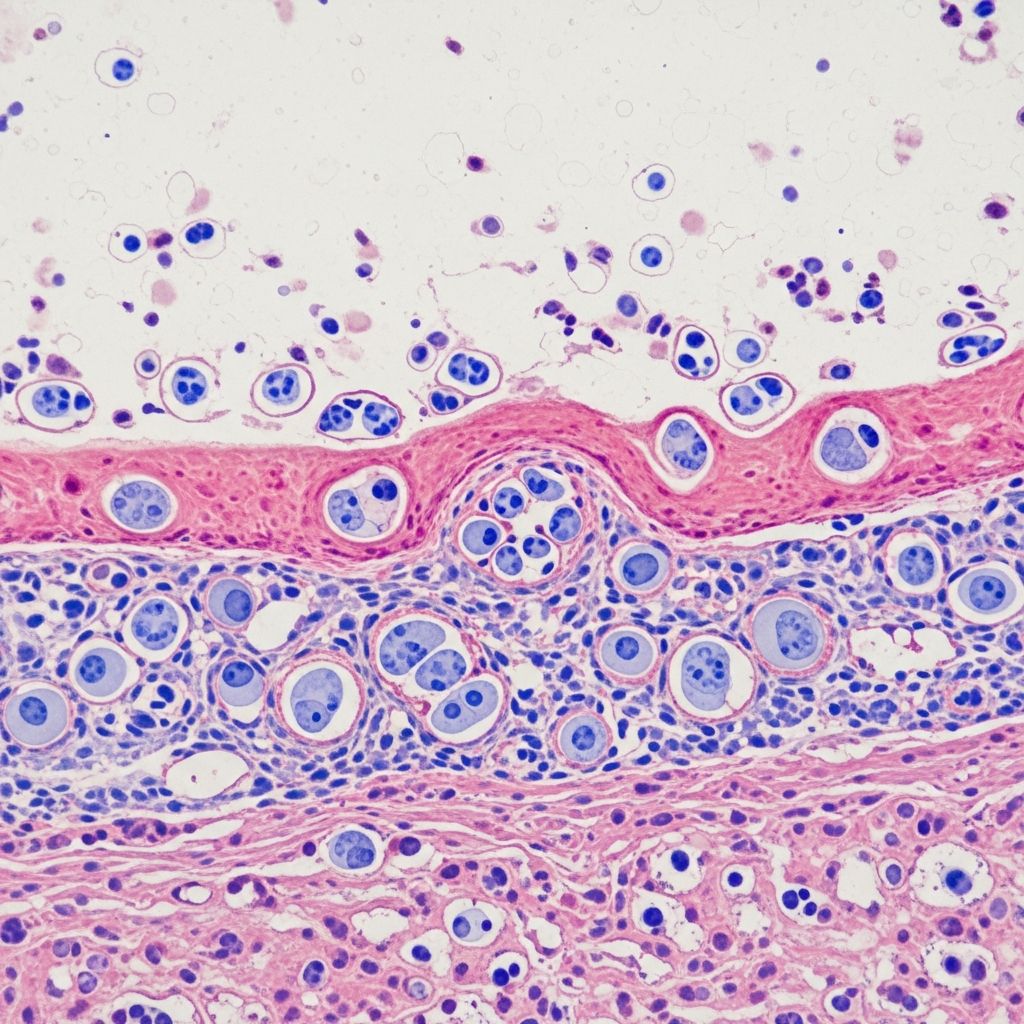
Histologically, mycosis fungoides is characterised by a band-like lymphocytic infiltrate with atypical cerebriform lymphocytes in a background of exocytosis and epidermotropism. Single-cell epidermotropism, lymphocytic infiltration of the epidermis, is an early feature. Aggregates of atypical lymphocytes within the epidermis form characteristic Pautrier microabscesses, which are a diagnostic hallmark.
Histology of mycosis fungoides
Early patch-stage lesions show superficial perivascular lymphocytic infiltrate with single-cell epidermotropism of mildly atypical cerebriform T-cells. There may be associated spongiosis and hyperplasia of the basal layer of the epidermis. Pautrier microabscesses are usually absent in early patches.
Patch-stage lesions can be subtle and mimic inflammatory dermatoses. Atypical lymphocytes may show hyperchromatic nuclei with irregular nuclear contours (‘cerebriform’). Careful assessment for disproportionate epidermotropism disproportionate to the degree of spongiosis is a clue to the diagnosis.
Thicker plaque-stage lesions demonstrate confluent sheets of atypical lymphocytes forming prominent Pautrier microabscesses. The dermal infiltrate becomes denser and extends deeper. Lymphoepithelial infiltration of adnexal structures may be seen. Larger, pleomorphic cells may appear in the infiltrate.
Tumour-stage lesions show a dense dermal infiltrate that obliterates normal structures. The epidermis may be effaced or hyperplastic. Tumours contain a mixture of small, medium and large atypical lymphocytes, sometimes with transformation to a high-grade lymphoma appearance. Pautrier microabscesses may be less prominent.
Patch stage
- Superficial perivascular lymphocytic infiltrate
- Mild cytological atypia
- Single-cell epidermotropism
- Lymphocytic exocytosis
- Spongiosis
- Hyperplasia of the basal layer
- Absence of Pautrier microabscesses
Plaque stage
- Dense band-like lymphocytic infiltrate
- Prominent epidermotropism
- Pautrier microabscesses
- Wart-like acanthosis
- Hypergranulosis
- Lymphoepithelial infiltration of adnexa
Tumour stage
- Dense nodular or diffuse dermal infiltrate
- Medium to large lymphocytes
- Loss of epidermotropism
- Possible large cell transformation
Cytology of mycosis fungoides
The hallmark cell of mycosis fungoides is the atypical cerebriform T-cell. These cells have highly convoluted nuclei with a ‘cerebriform’ appearance on electron microscopy. Nuclear diameters range from 4-10 microns. Small cerebriform cells predominate in early disease, while plaques and tumours show a mixture of small, medium and occasional anaplastic large cells.
- Small cerebriform cells: 4-6 microns, hyperchromatic irregular nuclei
- Medium cerebriform cells: 7-10 microns
- Large transformed cells: >10 microns, prominent nucleoli
Related Stories



Histological variants
Mycosis fungoides shows considerable histological variation depending on clinical stage, subtype and site. Awareness of these variants prevents misdiagnosis as benign or other malignant processes.
Folliculotropic mycosis fungoides
Folliculotropic mycosis fungoides (FMF) targets hair follicles with follicular mucinosis and perifollicular/periadnexal accentuation of the infiltrate. Follicles are filled and distorted by atypical cerebriform lymphocytes admixed with mucin. Pautrier microabscesses are usually absent.
Pagetoid reticulosis
Pagetoid reticulosis (Woringer-Kolopp disease) shows extreme pagetoid epidermotropism with atypical cerebriform cells filling the epidermis in a pagetoid pattern. The dermis is usually uninvolved.
Granulomatous slack skin
Granulomatous slack skin features granulomatous inflammation with numerous multinucleate giant cells, elastolysis and atypical cerebriform lymphocytes.
Hypopigmented mycosis fungoides
Common in darker skin types, showing prominent epidermotropism with minimal dermal infiltrate.
Cytogenetics description
Conventional cytogenetics in mycosis fungoides shows complex karyotypes in advanced disease. Common abnormalities include:
- Loss of 9p21 (CDKN2A)
- Loss of 10q and 17p (TP53)
- Gains of 8q (MYC)
- iso7q
- i(8)(q10)
Clonal chromosome abnormalities are detected in 20-50% of cases, more commonly in plaques and tumours.
Immunohistochemistry of mycosis fungoides
Mycosis fungoides shows a helper T-cell phenotype (CD4+). The atypical cerebriform cells are:
- CD3+, CD4+, CD8-
- CD7 loss (70%)
- CD62L loss
- CCR7 loss
- CXCR3 loss
- PD1+ (90%)
- CD30 variable (10-30%)
Loss of pan-T-cell antigens CD2, CD5, CD7 supports malignancy. CD4:CD8 ratio >6:1. CD8+ variants exist (<5%). CD30 expression predicts better response to brentuximab vedotin.
| Marker | Expression |
|---|---|
| CD3 | Positive |
| CD4 | Positive (95%) |
| CD8 | Negative (95%) |
| CD7 | Loss (70%) |
| CD30 | Variable (10-30%) |
| PD1 | Positive (90%) |
Molecular / cytogenetics of mycosis fungoides
T-cell receptor (TCR) gene rearrangement demonstrates clonality in 90% of plaques and 60% of patches. TCRβ preferred over TCRγ. PCR-based methods most sensitive.
High-throughput sequencing reveals dominant malignant clone amidst polyclonal background. Tracks disease progression.
Mutations and chromosomal aberrations
- 9p21.3 (CDKN2A): 20-30%, cell cycle regulation
- 10q25 (NFKB2)
- 17p13 (TP53): 40% advanced disease
- 8q24 (MYC) gains
- 7q and 17q isochromosomes
Prognostic factors of mycosis fungoides
Histological prognostic factors include:
- Thickness of infiltrate
- Folliculotropism (worse prognosis)
- Large cell transformation (>25% large cells)
- CD30 expression (variable)
- High Ki67 proliferation index
Molecular progression shows increasing clonal burden and additional mutations.
Differential diagnosis of mycosis fungoides pathology
The histological differential diagnosis is broad, particularly in early patch-stage disease.
| Diagnosis | Key distinguishing features |
|---|---|
| Lymphomatoid contact dermatitis | Spongiosis >> epidermotropism, CD8+ cells, clonal but resolves |
| Pityriasis lichenoides | Interface dermatitis, parakeratosis, CD30+ cells |
| Parapsoriasis | Mild epidermotropism, no/wrong atypia, persistent |
| Drug eruption | Eosinophils, vacuolar interface, resolves |
| Actinic reticuloid | CD8+ > CD4+, marked epidermotropism |
| Subacute cutaneous lupus erythematosus | Interface dermatitis, dermal mucin |
Key diagnostic criteria
- Clinical features suggestive of mycosis fungoides
- Histological features: epidermotropism + mild atypia
- Immunophenotypic abnormalities: CD4+/CD8-, CD7 loss
- Molecular clonality (TCR rearrangement)
All four criteria rarely present simultaneously in early disease. Clinicopathological correlation essential.
Oral and other pathology presentations of mycosis fungoides
Mycosis fungoides rarely involves oral mucosa (<1%). Shows similar epidermotropism and cerebriform cells. Important for staging.
Frequently asked questions in mycosis fungoides pathology
Q: How many biopsies are needed to diagnose early mycosis fungoides?
A: Multiple biopsies over time may be required. Early patch-stage lesions show subtle findings and up to 20-30% of initial biopsies may be non-diagnostic.
Q: What is the most specific histological feature?
A: Pautrier microabscesses composed of atypical cerebriform lymphocytes. However, absent in 30% early lesions and some variants.
Q: Can mycosis fungoides be CD8+?
A: Yes, rare CD8+ variant (~5%) with similar histology but CD8+/CD4-. Often more aggressive.
Q: What IHC panel is essential?
A: CD3, CD4, CD8, CD7, CD30, βF1, TCR clonality. PD1 and CD62L supportive.
Q: How does folliculotropic MF differ pathologically?
A: Follicular mucinosis, perifollicular accentuation, reduced/absent Pautrier abscesses. Worse prognosis.
References
- Mycosis fungoides: a review — Clinical and Experimental Dermatology, Oxford Academic. 2025. https://academic.oup.com/ced/article/50/12/2365/8215592
- Mycosis fungoides – DermNet — DermNet NZ. 2025. https://dermnetnz.org/topics/mycosis-fungoides
- Mycosis Fungoides — Journal of Brown Hospital Medicine. 2023. https://bhm.scholasticahq.com/article/85106-mycosis-fungoides
- Mycosis Fungoides and Other Cutaneous T-Cell Lymphomas Treatment (PDQ®) — National Cancer Institute (NCI). 2025. https://www.cancer.gov/types/lymphoma/hp/mycosis-fungoides-treatment-pdq
- Mycosis Fungoides — StatPearls, NCBI Bookshelf. 2023. https://www.ncbi.nlm.nih.gov/books/NBK519572/
- Mycosis Fungoides — Cutaneous Lymphoma Foundation. 2025. https://www.clfoundation.org/mycosis-fungoides
Similar Articles








Read full bio of Sneha Tete