Myofibroma Pathology: Essential Diagnostic Guide
Comprehensive guide to the pathology, clinical features, and diagnosis of myofibroma and myofibromatosis.
Myofibroma is a benign neoplasm composed of cells with both fibroblastic and myofibroblastic differentiation, representing the most common fibrous tumour of infancy. These lesions can present as solitary nodules or multiple lesions in infantile myofibromatosis, affecting skin, subcutaneous tissue, muscle, bone, and occasionally viscera. Understanding its pathology is crucial for distinguishing it from malignant mimics.
Introduction
Myofibromas are rare benign tumours that predominantly affect infants and young children, though adult forms exist. Solitary myofibroma accounts for approximately 75% of cases, typically presenting as a firm dermal or subcutaneous nodule on the head, neck, or trunk. Multicentric forms, more common in females, may involve multiple sites without or with visceral involvement, the latter carrying higher morbidity. Histologically, they are characterized by biphasic patterns of spindle cells and primitive-appearing round cells, reflecting their pericytic or myofibroblastic origin.
Clinical Features
Solitary myofibromas appear as firm, flesh-coloured to purple nodules, often 1-2 cm in diameter, freely movable in superficial locations. They are usually asymptomatic but may ulcerate or become indurated. In infantile myofibromatosis, lesions can be multiple, involving skin, muscle, bone, and viscera like lungs or gastrointestinal tract. The solitary form predominates in males, while multicentric forms are more frequent in females. Adult myofibromas are rarer, presenting as painless nodules on extremities.
- Location: Head and neck (most common), trunk, extremities; deeper lesions in muscle or bone.
- Size: Typically 0.5-3 cm, slow-growing.
- Symptoms: Usually painless; rare tenderness or ulceration.
Histology
Microscopically, myofibroma exhibits a distinctive biphasic pattern: areas of spindle cells arranged in short fascicles resembling smooth muscle, alternating with primitive round cell nests. The spindle cells have elongated nuclei, pale cytoplasm, and resemble myofibroblasts. Primitive areas feature small round cells with hyperchromatic nuclei and scant cytoplasm, mimicking small round blue cell tumours. Tumour cells infiltrate dermis and subcutis irregularly, with a pushing border. Necrosis and haemorrhage may be present, but mitoses are rare (<5 per 10 HPF).
The reticular dermis shows spindle cell proliferation parallel to the epidermis, sparing the papillary dermis. Elastic fibres are preserved or fragmented, aiding differentiation from scars.
Microscopic Features
- Biphasic pattern: Spindle cell fascicles + primitive round cell nodules.
- Stroma: Collagenous, hyalinized; thin-walled vessels prominent.
- Margin: Infiltrative but non-aggressive.
- Variants: Cellular, collagenous, epithelioid.
Cytology
Cytological smears reveal spindle cells with bipolar cytoplasmic processes and round/oval primitive cells with high N/C ratio. The matrix is metachromatic and fibrillary. This biphasic population is key for fine-needle aspiration diagnosis, distinguishing from neural or leiomyomatous lesions.
Histopathology Images
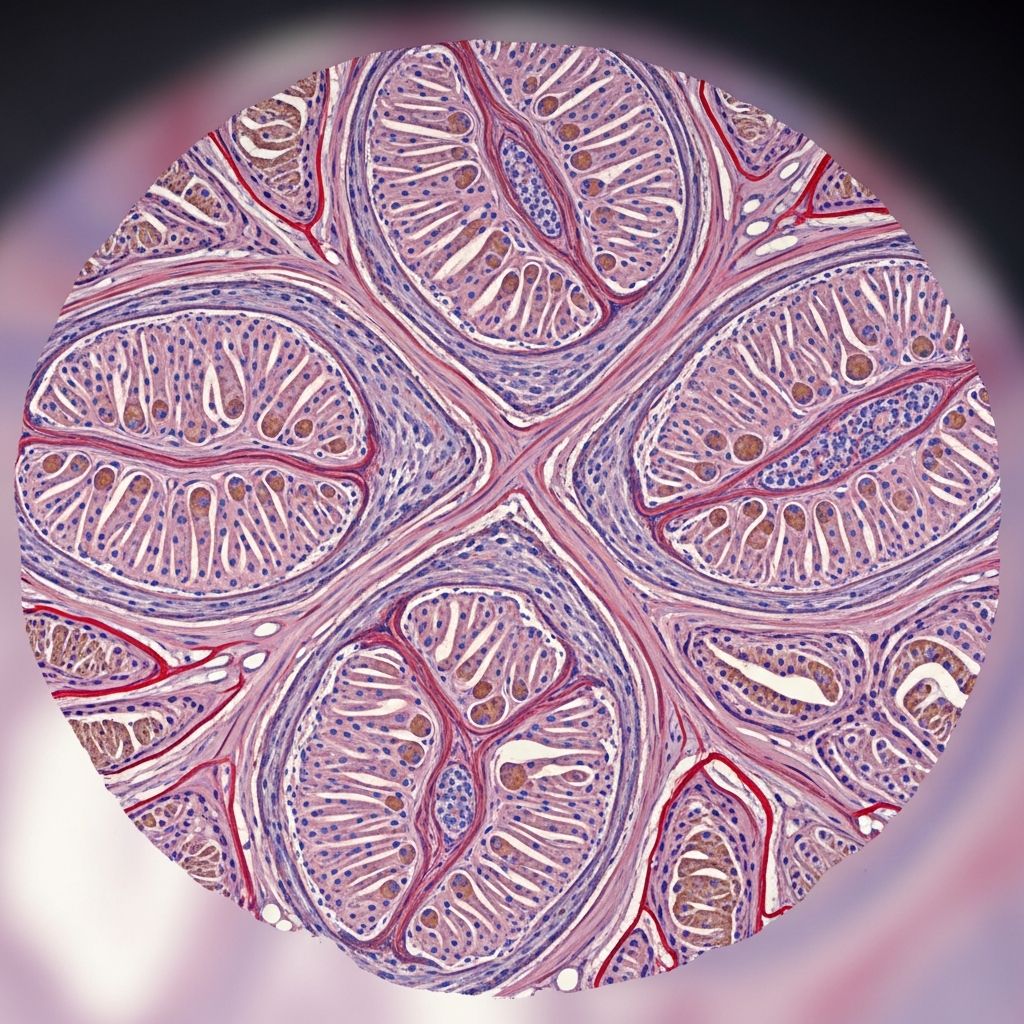
Typical low-power view shows nodular dermal proliferation with peripheral spindle cells and central primitive nests. High-power reveals interlacing fascicles of plump spindle cells with vesicular nuclei and eosinophilic cytoplasm, surrounding branching vessels. Reticulin highlights individual cell entrapment.
Related Stories



Immunohistochemistry
Myofibromas show SMA positivity in spindle cells, confirming myofibroblastic differentiation. Factor XIIIa is positive in histiocyte-like cells. CD34 highlights perivascular cells. Negative for desmin, h-caldesmon, S100, EMA, ALK, and cytokeratins. This profile distinguishes from leiomyoma (desmin+), DFSP (CD34+ diffusely), and melanoma (S100+).
| Marker | Result | Differential Utility |
|---|---|---|
| Smooth muscle actin (SMA) | Positive (spindle cells) | Supports myofibroblastic origin |
| Factor XIIIa | Focal positive | Histiocytic component |
| CD34 | Perivascular positive | Rules out DFSP |
| Desmin | Negative | Excludes leiomyoma |
| S100 | Negative | Excludes neural tumours |
Ultrastructure
Electron microscopy reveals myofibroblastic features: subplasmalemmal dense bodies, peripheral myofilaments, and fibronexus junctions attaching cells to collagen. Primitive cells show scant organelles, distinguishing from rhabdomyosarcoma or Ewing sarcoma.
Genetics
Most myofibromas harbour PDGFRB rearrangements or mutations, driving pericytic differentiation. Solitary lesions often show t(17;22)(p22;q13) creating PDGFRB-COL1A1 fusion. Multicentric forms may involve DDK3 or NOTCH pathway alterations. ALK fusions are rare, seen in some infantile cases.
Differential Diagnosis
Myofibroma mimics include:
- Leiomyoma: Uniform SMA/desmin positivity, no primitive cells.
- DFSP: CD34 diffuse+, storiform pattern, t(17;22) but different fusion.
- Cellular dermatofibroma: Monomorphic spindle cells, factor XIIIa+, no biphasic pattern.
- Infantile fibrosarcoma: ETV6-NTRK3 fusion, higher mitoses.
- Small round cell tumours: MIC2+, desmin+ (rhabdomyosarcoma).
Other Cutaneous Myofibroblastic Tumours
Dermatomyofibroma: Superficial plaque on shoulders of young adults, spindle cells parallel to epidermis, SMA+, no primitive areas.
Ischemic fasciitis: Pseudosarcomatous, granulation tissue-like, post-trauma.
Myofibroma-like haemangiopericytoma: Branching staghorn vessels, pericytic cells.
Frequently Asked Questions
What is the most common location for solitary myofibroma?
Head, neck, and trunk in infants; extremities in adults.
Is myofibromatosis malignant?
No, benign, but multicentric visceral form has 30-70% mortality due to organ dysfunction.
How is myofibroma diagnosed?
By biopsy showing biphasic histology and SMA immunohistochemistry.
Does myofibroma regress spontaneously?
Yes, up to 70% of infantile solitary lesions regress within 2 years.
What is the treatment for symptomatic myofibroma?
Surgical excision; observation for asymptomatic cases.
Management
Small asymptomatic lesions can be observed, as many regress. Surgical excision is curative for solitary persistent or symptomatic cases. Multicentric forms require imaging for visceral involvement; chemotherapy (vincristine/actinomycin) for life-threatening visceral disease.
References
- Infantile Myofibromatosis – Symptoms, Causes, Treatment — NORD (National Organization for Rare Disorders). 2023-05-15. https://rarediseases.org/rare-diseases/infantile-myofibromatosis/
- Dermatomyofibroma — PMC – NIH (National Institutes of Health). 2017-02-01. https://pmc.ncbi.nlm.nih.gov/articles/PMC5312187/
- What is Infantile Myofibromatosis? — News-Medical.Net. 2023-08-20. https://www.news-medical.net/health/What-is-Infantile-Myofibromatosis.aspx
- Solitary adult myofibroma — Wiley Online Library. 2006-12-01. https://onlinelibrary.wiley.com/doi/10.1111/j.1468-3083.2006.02057.x
- Cellular Dermatofibroma: Causes, Symptoms & Treatment — Cleveland Clinic. 2024-03-10. https://my.clevelandclinic.org/health/diseases/22668-cellular-dermatofibroma
Similar Articles








Read full bio of medha deb