Myositis Ossificans: Causes, Symptoms, Diagnosis, and Treatment
Comprehensive guide to understanding myositis ossificans, its causes, symptoms, diagnosis, and management options.
Understanding Myositis Ossificans
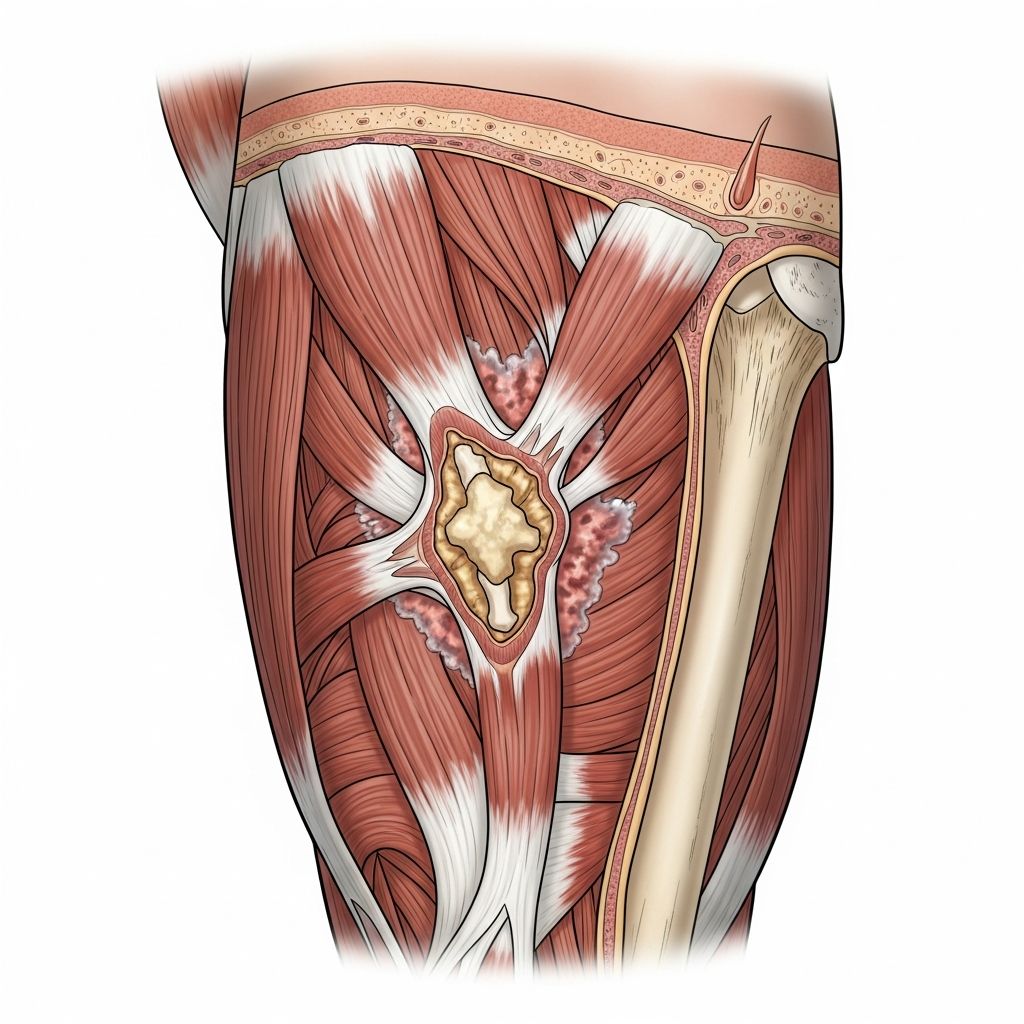
Myositis ossificans (MO) is a condition characterized by the formation of bone tissue in areas where bone normally should not exist, such as in muscles or other soft tissues. It usually develops following trauma but can sometimes occur due to rare hereditary causes.
This article provides a detailed exploration of MO, including its types, causes, symptoms, diagnostic process, treatment methods, and prognosis.
What Is Myositis Ossificans?
MO involves the abnormal development of bone (ossification) within muscles or soft tissues, often at sites of previous injury. This heterotopic ossification is typically self-limited and benign but may cause discomfort and impaired mobility depending on severity.
The term ‘myositis’ implies inflammation of muscle, although the actual role of inflammation in MO development varies.
Types of Myositis Ossificans
- Myositis Ossificans Traumatica: The most common form, occurring usually after trauma such as muscle contusions, strains, or fractures.
- Fibrodysplasia Ossificans Progressiva (FOP): A rare, inherited, and progressive disease causing widespread bone formation replacing muscles and connective tissues.
- Nontraumatic or Pseudomalignant MO: Occurs without clear injury and can mimic more serious conditions like tumors.
Causes and Risk Factors
Myositis ossificans occurs mainly as a response to trauma where the body mistakenly deposits bone tissue within muscle during healing.
- Injury Related Causes: Repeated trauma, muscle strains, contusions, or orthopedic surgery can lead to MO.
- Genetic Causes: Fibrodysplasia ossificans progressiva is a genetic disorder involving a mutation that causes extreme and progressive ossification.
- Other Causes: Rarely, MO is related to metabolic or bone disorders, or chronic inflammation, especially in pediatric populations or due to vitamin D deficiency and chronic kidney disease.
Signs and Symptoms
The most common symptoms of myositis ossificans include signs related to the abnormal bone formation within muscle:
- Pain and Tenderness: Muscle pain that develops weeks after injury and may worsen with movement.
- Swelling and Hard Lump: A firm, palpable mass may appear at the injury site as bone forms.
- Reduced Range of Motion: Muscle stiffness or contracture can limit normal movement of the affected limb or area.
- Deformity or Abnormal Posture: In cases affecting the neck muscles, such as the longus coli, abnormal head positioning (torticollis) can develop.
How Is Myositis Ossificans Diagnosed?
Diagnosing MO involves clinical evaluation and imaging studies to differentiate it from other conditions like tumors or infections.
Diagnostic Steps
- Medical History and Physical Exam: Assessment of recent trauma or symptoms onset.
- Imaging Tests:
- X-rays: May detect calcification several weeks after symptoms start.
- Computed Tomography (CT) Scan: Provides detailed images showing ossification patterns and helps exclude other pathologies.
- Magnetic Resonance Imaging (MRI): Useful in early stages to detect muscle inflammation and edema.
- Bone Scintigraphy: Can confirm active ossification processes in muscle tissue.
Characteristic findings in MO include peripheral ossification developing in a zonal pattern, distinct from bone malignancies.
Related Stories



Treatment Options for Myositis Ossificans
The treatment of MO depends on severity, location, and symptoms. Many cases resolve with conservative management, while others may require intervention.
Non-Surgical Treatments
- Rest and Physical Therapy: Avoiding further injury and gently maintaining mobility to prevent stiffness.
- Medications: Nonsteroidal anti-inflammatory drugs (NSAIDs) help reduce inflammation and pain. Muscle relaxants may alleviate spasms.
- Supportive Devices: Braces or collars can aid in reducing discomfort and supporting affected areas, especially in cases like cervical involvement.
- Heat and Stretching: Passive stretching exercises may improve flexibility and prevent contractures.
Surgical Treatment
Surgery is rarely necessary and is typically reserved for cases where significant functional impairment persists after several months or where ossification impinges nerves or joints. Surgical removal of heterotopic bone may be considered once the bone has matured to reduce recurrence risk.
Complications and Prognosis
- Functional Impairment: Severe ossification can limit motion or lead to deformities.
- Recurrence: Incomplete surgical excision may lead to re-ossification.
- Prognosis: Most cases of myositis ossificans resolve or significantly improve over weeks to months with conservative care, especially post-trauma. Hereditary forms like FOP have progressively worsening outcomes.
Case Example: Myositis Ossificans of the Longus Coli Muscle
A notable example involved a patient who developed MO in the longus coli muscle following a severe cervical spine fracture-dislocation. This MO caused torticollis (abnormal head rotation) due to muscle contracture caused by ossified tissue.
Treatment included NSAIDs, muscle relaxants, passive stretching, and wearing a cervical collar. Over several months, symptoms improved, highlighting the potential for conservative management in such rare locations.
Frequently Asked Questions (FAQs)
Q: Can myositis ossificans happen without an injury?
A: Yes, although most cases follow trauma, some forms like fibrodysplasia ossificans progressiva or nontraumatic MO can occur without obvious injury.
Q: How long does it take for myositis ossificans to heal?
A: Post-traumatic MO usually begins to improve within weeks and can resolve over several months. Treatment supports symptom control and function during recovery.
Q: Is surgery always needed to treat myositis ossificans?
A: No, most patients recover with nonsurgical treatments. Surgery is reserved for severe or persistent cases affecting function.
Q: How can I prevent myositis ossificans after a muscle injury?
A: Preventive strategies include appropriate care of muscle injuries, avoiding aggressive massage or heat early after trauma, gradual rehabilitation, and following medical advice closely.
Summary Table of Key Points on Myositis Ossificans
| Aspect | Details |
|---|---|
| Definition | Heterotopic bone formation within muscles or soft tissues, usually post-trauma. |
| Common Causes | Muscle injury, surgery, genetic mutation (FOP). |
| Symptoms | Pain, swelling, firm mass, limited motion. |
| Diagnosis | Physical exam, X-ray, CT, MRI, bone scan. |
| Treatment | NSAIDs, physical therapy, supportive care, surgery in select cases. |
| Prognosis | Generally good with conservative care; chronic or progressive in genetic cases. |
References
- Myositis ossificans of the longus coli muscle following cervical spine fracture: a case report — Orthopaedic Journal of Sports Medicine. 2017-05-22. https://pmc.ncbi.nlm.nih.gov/articles/PMC5472026/
- Myositis Ossificans: Diagnosis, Symptoms and Treatment — Cleveland Clinic. 2024-05. https://my.clevelandclinic.org/health/diseases/22419-myositis-ossificans
- A Case of Neonatal Myositis Ossificans Related to Chronic Kidney Disease — Case Reports in Pediatrics. 2023-04-10. https://pmc.ncbi.nlm.nih.gov/articles/PMC12580905/
- Fibrodysplasia Ossificans Progressiva: Causes, Symptoms, and Treatment — Cleveland Clinic. 2024-02. https://my.clevelandclinic.org/health/diseases/24476-fibrodysplasia-ossificans-progressiva
Similar Articles








Read full bio of Sneha Tete