Myxofibrosarcoma Pathology: 8 Essential Insights
Comprehensive pathology of myxofibrosarcoma: from clinical features to advanced molecular insights and management strategies.
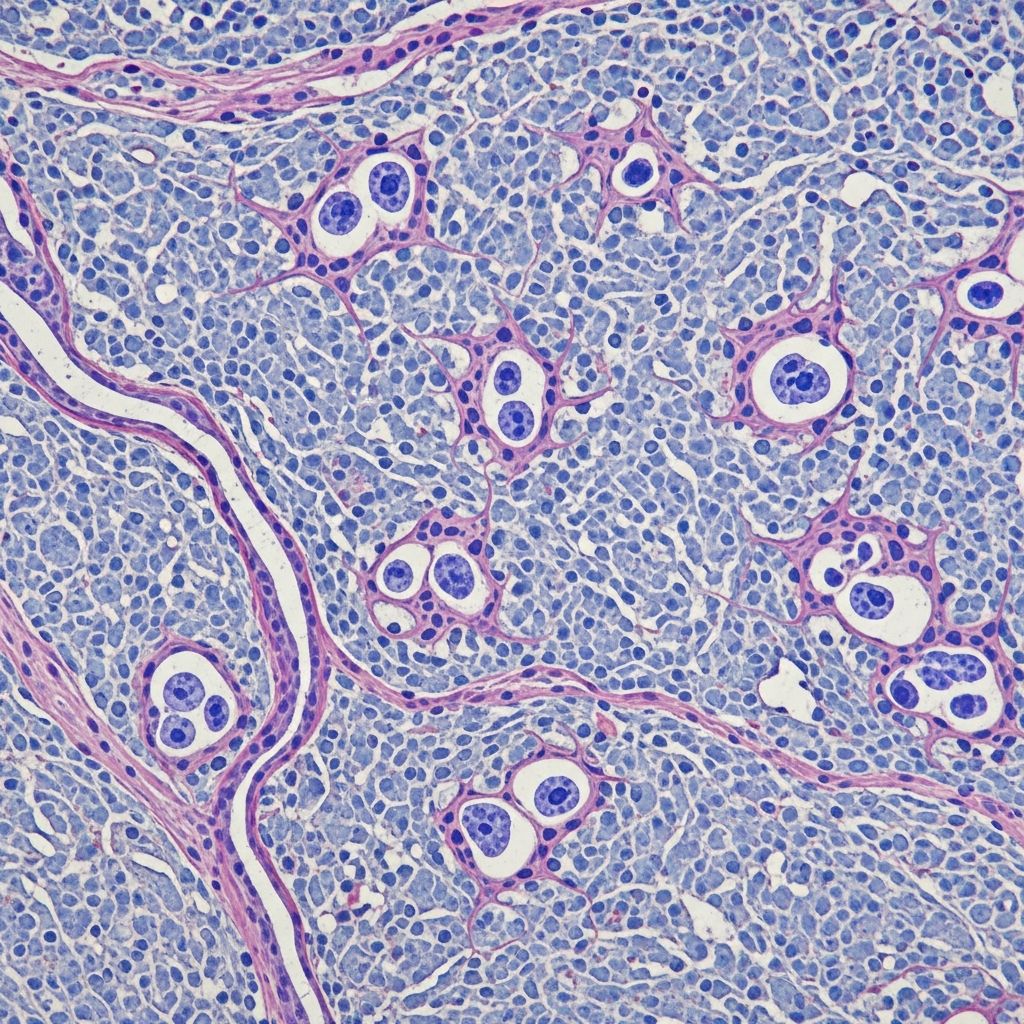
Myxofibrosarcoma (MFS), previously known as myxoid malignant fibrous histiocytoma, represents one of the most common sarcomas in elderly patients, particularly affecting the extremities with a predilection for dermal and subcutaneous tissues. This malignant fibroblastic neoplasm is characterized by a spectrum of histological grades ranging from low-grade myxoid lesions to high-grade pleomorphic sarcomas, featuring variably myxoid stroma, cellular pleomorphism, and distinctive curvilinear vasculature.
Clinical Features
Myxofibrosarcoma typically manifests in individuals over 60 years of age as a slowly enlarging, painless subcutaneous mass, most commonly in the limbs, with a higher frequency in the lower extremities compared to the upper limbs. More than half of cases arise in dermal or subcutaneous tissues rather than deeper fascia or muscle, contributing to its deceptive clinical boundaries that mimic benign lesions. Patients often present with multinodular, infiltrative growth that may extend to the dermis, appearing as cutaneous nodules prone to local recurrence due to incomplete surgical margins.
- Demographics: Predominantly affects older adults (>60 years); rare in children.
- Localization: Limbs (proximal > distal), limb girdles; rarely trunk, head/neck, hands/feet.
- Presentation: Painless, firm, gelatinous lump; may cause swelling or discomfort with growth.
- Behavior: High local recurrence rate (50-80%), especially superficial low-grade tumors; metastasis risk increases with grade and depth.
Histology
Microscopically, myxofibrosarcoma exhibits a wide morphological spectrum. Low-grade tumors are hypocellular with abundant myxoid stroma, spindled to stellate cells, and thin-walled curvilinear vessels forming a characteristic ‘chicken-wire’ pattern. Higher-grade lesions show increased cellularity, pleomorphism, multinucleated giant cells, and reduced myxoid matrix, transitioning to high-grade pleomorphic sarcoma.
Low-grade Myxofibrosarcoma
Hypocellular neoplasm with bland spindled/curvilinear fusiform cells in copious Alcian blue-positive myxoid stroma. Vessels are elongated, branching, and lined by flattened endothelium. Pseudo-lipoblasts (mucin-filled vacuolated cells) are common diagnostic clues.
Intermediate-grade Myxofibrosarcoma
Increased cellularity with mild atypia, fascicular growth, and hemorrhage. Myxoid areas persist but are interspersed with hypercellular zones.
High-grade Myxofibrosarcoma
Highly cellular with marked pleomorphism, high mitotic rate (>20/10 HPF), necrosis, and giant cells. Myxoid stroma is scant; resembles undifferentiated pleomorphic sarcoma but retains vascular pattern.
| Grade | Cellularity | Myxoid Stroma | Atypia/Mitoses | Vascular Pattern |
|---|---|---|---|---|
| Low | Hypocellular | Abundant | Mild/Low | Prominent curvilinear |
| Intermediate | Moderate | Moderate | Moderate | Present |
| High | Hypercellular | Scant | Marked/High | Focal |
Cytology
Fine-needle aspiration reveals myxoid fragments with spindled/stellate cells, pseudo-lipoblasts, and magenta matrix material. High-grade cases show pleomorphic cells in necrotic debris. Cytology is limited for grading due to sampling issues.
Genetic Profile
Myxofibrosarcoma demonstrates complex karyotypes without recurrent translocations, unlike other myxoid sarcomas. Common alterations include:
- Loss of 13q (RB1), 9p (CDKN2A/B), 10q (PTEN).
- Gains of 1p, 8q, 20q.
- TP53 mutations in ~70% high-grade cases.
- Amplification of MDM2/CDK4 rare, distinguishing from dedifferentiated liposarcoma.
Next-generation sequencing reveals high tumor mutational burden, supporting immunotherapy potential in advanced disease.
Immunohistochemistry
MFS shows nonspecific fibroblastic/myofibroblastic profile:
| Marker | Expression | Notes |
|---|---|---|
| Vimentin | Diffuse (+) | Consistent marker. |
| CD34 | Focal (30-50%) | Stromal/vascular. |
| SMA | Focal (+) | Myofibroblastic. |
| CD10 | Frequent (+) | Diagnostic aid. |
| STAT6 | Negative | Excludes SFT. |
| Desmin/S100 | Negative | Usually. |
Related Stories



High-grade cases may express p53 diffusely.
Electron Microscopy
Ultrastructurally, tumor cells display rough ER dilatation, cytoplasmic filaments, and extracellular myxoid material rich in glycosaminoglycans. No specific features; supports fibroblastic differentiation.
Diagnosis
Diagnosis relies on clinicopathologic correlation. MRI shows T2-hyperintense mass with ‘tail sign’ (infiltrative strands, 81% sensitivity). Biopsy essential; superficial shave biopsies risk underdiagnosis. Grading per FNCLCC system predicts behavior.
Differential Diagnosis
- Benign: Myxoma, nodular fasciitis (rapid growth, RET/USP6 fusions), neurothekeoma.
- Low-grade malignant: Myxoid liposarcoma (FUS-DDIT3), low-grade fibromyxoid sarcoma (FUS-CREB3L2), ossifying fibromyxoid tumor.
- High-grade: Undifferentiated pleomorphic sarcoma, dedifferentiated liposarcoma (MDM2+), leiomyosarcoma.
Key discriminators: curvilinear vessels, pseudo-lipoblasts, IHC, genetics.
Treatment and Prognosis
Wide surgical excision with 2-cm margins or R0 resection is standard, guided by MRI. Radiation for close margins/high-risk features; chemotherapy (doxorubicin/ifosfamide) for metastatic disease. Prognosis: 5-year survival 60-70%; local recurrence 30-50%, metastasis 20-30% (lungs).
Frequently Asked Questions
What is myxofibrosarcoma?
A rare soft tissue sarcoma of fibroblastic origin with myxoid stroma, common in elderly limb subcutaneous tissues.
How is myxofibrosarcoma graded?
Low (hypocellular myxoid), intermediate, high (pleomorphic/hypercellular) based on cellularity, atypia, mitoses, necrosis.
What causes local recurrence in MFS?
Infiltrative growth with ill-defined borders, often underestimated clinically.
Is myxofibrosarcoma hereditary?
No; sporadic with complex genetic changes, no known germline mutations.
What is the role of MRI in diagnosis?
Detects ‘tail sign’ of subcutaneous extension, aiding preoperative planning.
References
- Myxofibrosarcoma presenting in the skin — PubMed/NCBI. 2003-07-01. https://pubmed.ncbi.nlm.nih.gov/12876484/
- Myxofibrosarcoma — Orphanet. 2024. https://www.orpha.net/en/disease/detail/79105
- Myxofibrosarcoma | Clinical Keywords — Yale Medicine. 2024. https://www.yalemedicine.org/clinical-keywords/myxofibrosarcoma
- Myxofibrosarcoma: Symptoms, Prognosis & Treatment — Cleveland Clinic. 2024-10-01. https://my.clevelandclinic.org/health/diseases/22563-myxofibrosarcoma
- Myxofibrosarcoma – Symptoms and causes — Mayo Clinic. 2024. https://www.mayoclinic.org/diseases-conditions/myxofibrosarcoma/symptoms-causes/syc-20577507
- Myxofibrosarcoma — Wikipedia (sourced from primary refs). 2024. https://en.wikipedia.org/wiki/Myxofibrosarcoma
- Myxofibrosarcoma — Sarcoma Foundation of America/WHO. 2024-09-11. https://curesarcoma.org/sarcoma-subtypes/myxofibrosarcoma/
Similar Articles








Read full bio of Sneha Tete