Naevus Of Ota, Ito And Hori: Diagnosis, Risks & Treatment
Comprehensive guide to dermal melanocytosis: Naevus of Ota, Ito, and Hori – causes, diagnosis, and laser treatments.
What are they?
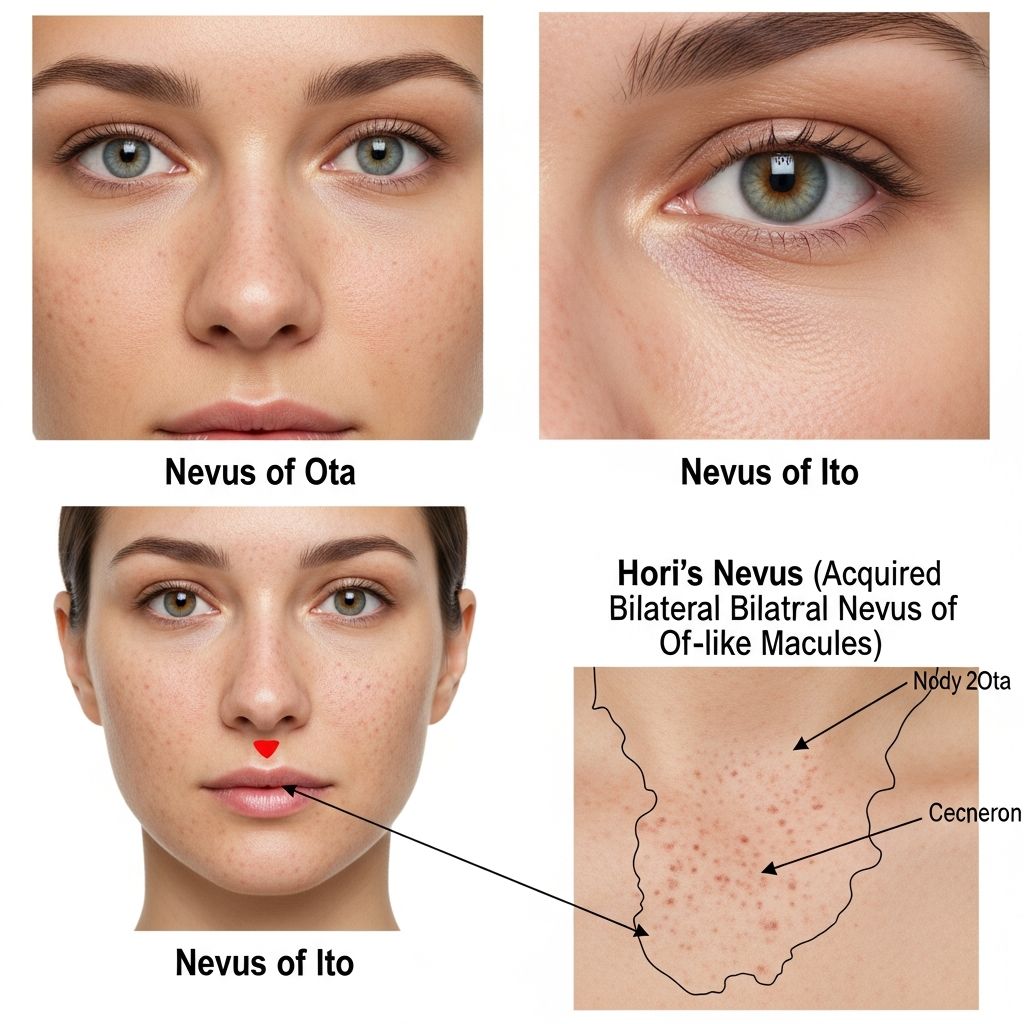
Naevus of Ota, naevus of Ito, and Hori naevus (naevus fusco-caeruleus zygomaticus) are uncommon dermal melanocytic naevi characterised by slate-brown or blue/grey colouring. These are forms of
dermal melanocytosis
in which naevus cells are located deep within the dermis (dermal melanocytes).Dermal melanocytosis can also occur elsewhere on the body, including inside the mouth (oral mucosa), on the sclera (whites of the eyes), cornea, retina, tympanic membrane, nasal mucosa and palate. Who gets them? Naevus of Ota is much more common than naevus of Ito. These naevi are present at birth in 50% of cases but may appear during adolescence or adult life. Naevus of Hori is not present at birth and is therefore a form of acquired melanocytosis.
Naevi of Ota and Ito are most commonly found in Asian populations; 0.2–0.6% of Japanese people have a naevus of Ota. They appear more frequently in females (ratio 5:1).[10] Both forms of naevi are uncommon in Caucasians.
What does naevus of Ota look like?
Naevus of Ota follows the distribution of the first two branches of the trigeminal nerve (V1 and V2 dermatomes: forehead, temple, malar area and nose, around the eye and on the sclera, and on the palate).
- Ocular: the sclera (whites of the eye) or conjunctiva (10–20% of cases).
- Periorbital area.
- Forehead.
- Temple.
- Malar (cheek).
- Nose.
- Lips.
- Palate (roof of mouth).
It is usually unilateral (one side) but can be bilateral. The colour is blue/grey to grey/brown. Size varies from a few millimetres to extensive. It is macular (flat) but the skin texture is normal.
Mishima’s classification describes the intensity and extent:
| Subtype | Intensity | Pigmentation | Area involved |
|---|---|---|---|
| Type I | Mild | Light brown | Upper and lower eyelids and zygomatic area |
| Type II | Moderate | Deep slate gray | Eyelids, zygomatic area, and base of nose |
| Type III | Intensive | Deep blue to brown | Affecting the first and second division of trigeminal nerve |
What does naevus of Ito look like?
Naevus of Ito is located on the shoulder, side of the neck, supraclavicular region, upper arm and scapula.
- Inframammary area (under the breast).
- Side of neck.
- Supraclavicular area (above the collar bone).
- Shoulder.
- Upper arm.
- Scapula (shoulder blade).
As with naevus of Ota it is blue/grey to grey/brown.
What does naevus of Hori look like?
Naevus of Hori is bilateral and localised to the zygomatic areas. It is brown/grey.
Dermoscopy
Dermoscopic findings include brown and gray structureless areas with patchy distribution, scattered brown-gray dots, terminal hairs, fine scales, white clods, perifollicular hypopigmentation, and occasional serpentine vessels. These features help differentiate from conditions like lentigo maligna or exogenous ochronosis.
Diagnosis
The diagnosis of naevus of Ota, Ito or Hori is made clinically. Dermoscopy aids confirmation. Histology reveals pigmented dendritic melanocytes and melanophages dissecting dermal collagen bundles in the reticular dermis.
Differential diagnosis
Differential diagnoses include Mongolian spot, blue naevus, complex II Hori naevus, melasma, lentigo maligna, and drug-induced hyperpigmentation. Mongolian spots resolve by age 3–6 and are lumbosacral; melasma is bilateral without palatal involvement.
Complications
If the eye is affected by naevus of Ota, regular eye examinations should be arranged to detect
glaucoma
. There is a low risk (<6%) ofuveal melanoma
. Any change in a naevus should be assessed by a dermatologist.Related Stories



Treatment of naevus of Ota, Ito and Hori
Treatment of a melanocytosis may include cosmetic camouflage to cover the disfiguring markings, and
laser treatment
(usually using 1064nm Q switched Nd:YAG, Alexandrite or QS ruby laser) or intense pulsed light (IPL).Laser treatment targets deeper dermal pigment with minimal epidermal damage. Multiple sessions (5–10) are required, spaced 8–12 weeks apart. Post-treatment redness, swelling, or crusting resolves in days. Significant fading occurs progressively.
Anesthetic cream minimizes discomfort. Q-switched Alexandrite is ideal; Fraxel may enhance results. Eye protection is mandatory if sclera is involved.
Frequently asked questions
What is naevus of Ota?
A blue-grey dermal melanocytic naevus along trigeminal nerve branches, often involving the eye.
Is naevus of Ota dangerous?
Usually benign, but ocular involvement risks glaucoma (<10%) or uveal melanoma (<6%). Regular eye checks needed.
Can naevus of Ota be treated?
Yes, Q-switched lasers (Nd:YAG, Alexandrite) effectively fade it over multiple sessions.
What is the difference between naevus of Ota and Ito?
Ota is facial/periorbital (V1/V2); Ito is shoulder/neck/upper arm.
Does naevus of Hori appear at birth?
No, it is acquired, bilateral on zygomatic areas.
How many laser sessions for naevus of Ota?
Typically 5–10 sessions for optimal fading.
References
- Naevus of Ota, Ito, Hori — DermNet NZ. 2023. https://dermnetnz.org/topics/naevus-of-ota-ito-hori
- Nevus of Ota Skin Condition — Dermatology & Laser Surgery Center. 2024. https://www.dermlasersurgery.com/skin-conditions/nevus-of-ota/
- Dermoscopic Findings of Nevus of Ota — Balkan Medical Journal. 2018-10-01. http://balkanmedicaljournal.org/text.php?lang=en&id=2169
- Nevus of Ota — MalaCards (aggregated from peer-reviewed sources). 2025. https://www.malacards.org/card/nevus_of_ota
- Nevus of Ota – A Rare Pigmentation Disorder with Intraoral Findings — PMC/NCBI (Journal of Clinical and Diagnostic Research). 2014-09-20. https://pmc.ncbi.nlm.nih.gov/articles/PMC4190813/
Similar Articles








Read full bio of medha deb