Nail Anatomy: 7 Key Parts, Functions, Growth, And Care
Understand the structure, function, growth, and common issues of fingernails and toenails for better nail health.
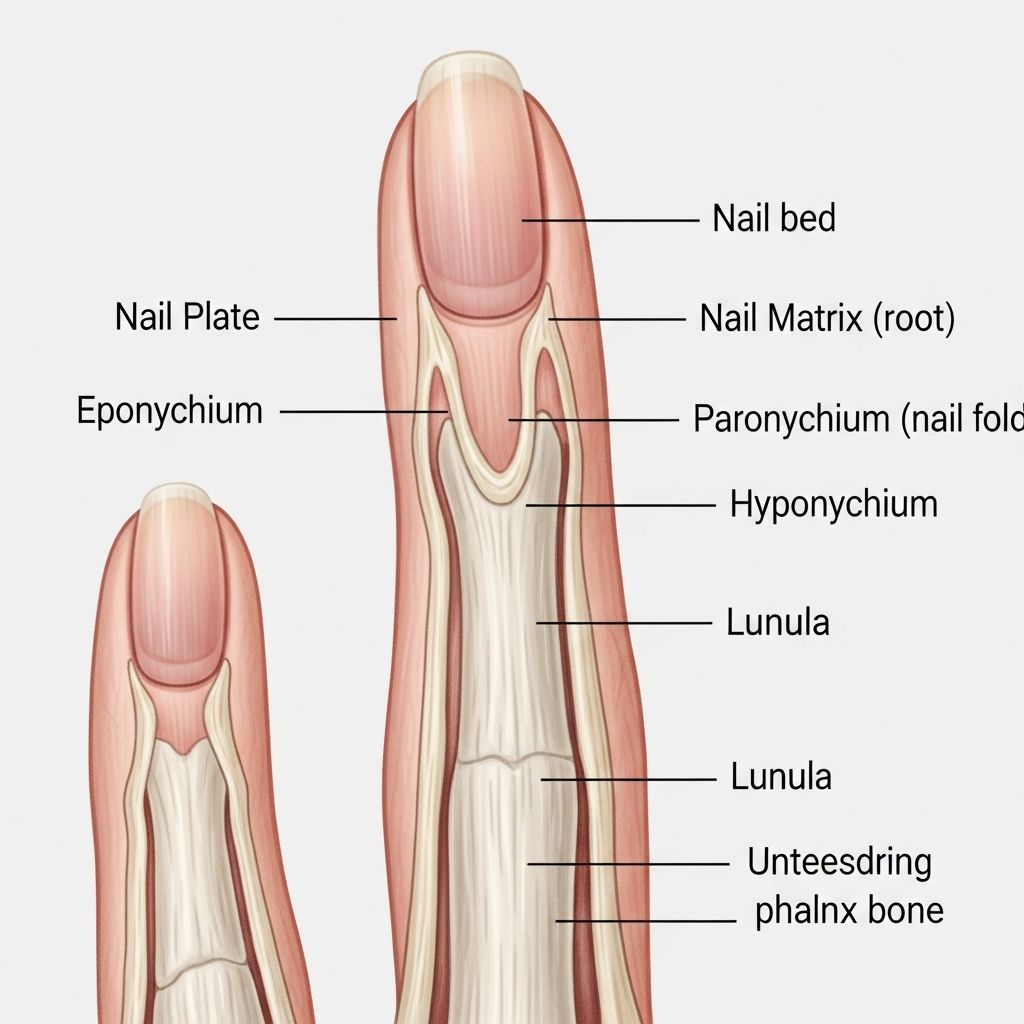
The human nail is a complex structure composed of multiple layers and tissues that serve essential protective and functional roles for the fingertips and toes. Comprising primarily keratinized cells, nails protect sensitive distal phalanges while aiding in tactile sensation and fine motor tasks. This article details the anatomy, functions, growth processes, common conditions, and care tips for nails, drawing from established medical knowledge.
What Are Nails?
Nails are durable, translucent plates formed from tightly packed keratin proteins, originating from specialized skin cells known as skin appendages, similar to hair. The visible
nail plate
—the hard, curved structure about 0.5 mm thick—rests atop the nail bed and is produced continuously by the underlying nail matrix. Nails frame the fingertips, enhancing grip and precision, and their health often reflects overall bodily well-being.Structurally, nails consist of dead, compacted epidermal cells without nerves or blood vessels in the plate itself, making them resilient yet flexible. The surrounding soft tissues, including folds and cuticles, safeguard the nail unit from trauma, infection, and environmental damage. Healthy nails appear smooth, pinkish (due to underlying capillaries), and uniformly shaped, with subtle variations like the whitish lunula at the base.
Nail Anatomy
The nail unit involves several interconnected parts: the nail plate, matrix, bed, folds, cuticle, hyponychium, and associated seals. Each component contributes to the nail’s integrity and growth.
Nail Plate
The
nail plate
(corpus unguis) is the opaque, hardened frontline visible from root to free edge. Composed of layered alpha-keratin proteins, it spans several millimeters in thickness when stacked but appears thin due to compression. Its translucency reveals the pink nail bed beneath, shaped by the distal phalanx bone—flat, arched, or hooked. The plate adheres firmly to the bed via grooves, providing a protective barrier without its own vascular supply.Nail Matrix
Hidden beneath the proximal nail fold, the
nail matrix
(matrix unguis) is the proliferative germinal zone generating new keratinized cells. This living tissue, rich in nerves, blood vessels, and lymphatics, determines nail plate width, thickness, and growth rate. As cells migrate distally, they flatten, harden, and are pushed forward by newer cells, creating continuous elongation. Damage here can cause permanent ridges or deformities.The visible portion, the
lunula
, appears as a pale, crescent-shaped half-moon at the matrix’s distal edge, more prominent on thumbs. Its whiteness stems from thick, nucleated cells obscuring underlying vasculature; absence in some nails is normal.Nail Bed
The
nail bed
is the epidermal-dermal interface directly under the nail plate, extending to the onychodermal band. Composed of dermis and epidermis linked by longitudinal matrix crests, it nourishes the plate via capillary loops visible as pink hue. Highly sensitive due to nerve endings, the bed separates only at the free edge, enabling nail use as a tool.Nail Folds
**Nail folds** (proximal and lateral) are skin folds encasing the nail’s sides and base. The proximal fold forms a pouch over the matrix, while lateral folds (nail walls or vallum unguis) embed the plate’s margins in sulci. These shield against trauma and UV exposure, with the perionyx extending over the lunula.
Related Stories



Other Structures
- Cuticle (Eponychium): Dead skin layer from the proximal fold sealing the matrix; proper care prevents infections like paronychia.
- Hyponychium: Thickened epithelium under the free edge, acting as a barrier; often called the ‘quick,’ prone to dirt buildup.
- Onychodermal Band: Grayish seal between plate and hyponychium, visible in light skin, preventing pathogen entry.
What Do Nails Do?
Nails fulfill multiple roles beyond aesthetics. Primarily, they
protect
distal phalanges and pulp from injury, distributing pressure during impacts. As acounterforce
, nails amplify fingertip sensitivity by enhancing pulp pressure against objects, crucial for touch discrimination despite lacking nerves themselves.Functionally, nails bolster
fine motor skills
: aiding grip on small objects, page-turning, scratching, and precision tasks like typing. Blood vessels maintain circulation under pressure, while the nail’s rigidity supports tool-like uses. In evolutionary terms, nails enhance dexterity in primates.Nail Growth
Nail growth originates exclusively at the matrix, averaging
3-4 mm per month
for fingernails (faster in dominant hands, summer, and longer fingers—index grows quickest). Toenails lag at ~1.5 mm/month, influenced by phalanx length. Full regrowth takes 4-6 months for fingers, 12-18 for toes.Factors affecting growth include age (peaks in 20s, slows later), nutrition (biotin, protein), hormones, and trauma. Matrices produce cells lifelong if nourished; injuries may cause temporary halts or beaus lines (transverse grooves).
| Nail Type | Average Growth Rate | Full Regrowth Time |
|---|---|---|
| Fingernails | 3-4 mm/month | 4-6 months |
| Toenails | 1-1.5 mm/month | 12-18 months |
Common Nail Problems
Nail irregularities often signal systemic issues. Monitor for changes in color, shape, or texture.
- Brittleness/ Splitting: Dryness, aging, or chemicals; moisturize and avoid overfiling.
- Ridges: Longitudinal (aging) or transverse (illness like beaus lines).
- Discoloration: White spots (trauma), yellow (fungal, smoking, syndrome), blue (cyanosis), clubs (heart/lung disease).
- Spoon Nails (Koilonychia): Iron deficiency, curving upward.
- Ingrown Nails: Improper trimming; soak and see a podiatrist.
Consult a doctor for persistent changes, as they may indicate psoriasis, thyroid issues, or infections.
How to Keep Nails Healthy
Maintain nail health through daily habits:
- Clip straight across, file gently; avoid cuticles.
- Moisturize hands/feet; use gloves for chores.
- Balanced diet rich in biotin, zinc, protein.
- Protect from trauma; treat injuries promptly.
- Avoid artificial nails if prone to allergies.
Healthy nails: smooth, even, pink with white lunula, no pain/swelling.
Frequently Asked Questions (FAQs)
What is the nail matrix?
The nail matrix is the living tissue under the proximal fold producing keratin cells for nail growth; damage causes permanent changes.
How fast do nails grow?
Fingernails grow 3-4 mm/month, toenails slower at 1-1.5 mm/month; varies by finger, age, health.
What does the lunula indicate?
The lunula is the visible matrix part; its size/color can hint at circulation or health, but small/absent is often normal.
Why do nails change color?
Colors signal issues: yellow (fungus), white spots (trauma), dark (melanoma risk)—see a dermatologist.
Can diet affect nails?
Yes; deficiencies in iron, biotin weaken nails, causing brittleness or ridges.
References
- Nail (anatomy) — Wikipedia. 2023-12-01. https://en.wikipedia.org/wiki/Nail_(anatomy)
- Structure of the nails — InformedHealth.org – NCBI Bookshelf (IQWiG). 2023-10-12. https://www.ncbi.nlm.nih.gov/books/NBK513133/
- Nail anatomy: Parts, structures, functions, and more — Medical News Today. 2024-05-15. https://www.medicalnewstoday.com/articles/nail-anatomy
- Nail Health Chart: Common Problems and Treatment — Healthline. 2023-11-20. https://www.healthline.com/health/beauty-skin-care/healthy-nails
Similar Articles








Read full bio of Sneha Tete