Nail Psoriasis: Causes, Symptoms, and Treatment
Complete guide to psoriatic nail dystrophy: Understanding symptoms, diagnosis, and effective treatment options.
Nail Psoriasis: A Comprehensive Guide
Nail psoriasis, medically known as psoriatic nail dystrophy, is a manifestation of psoriasis that affects the fingernails and toenails. This condition results from psoriasis involving the nail matrix or nail bed, producing distinctive changes in nail appearance and function. Unlike cutaneous psoriasis that affects the skin, nail psoriasis presents unique challenges in both diagnosis and treatment due to the slow growth rate of nails and the persistent nature of the condition. Understanding the underlying mechanisms, clinical presentations, and available treatment options is essential for managing this chronic dermatological condition effectively.
What is Nail Psoriasis?
Nail psoriasis is a subtype of the common chronic inflammatory skin condition psoriasis, but one that specifically targets the nail unit. This condition can be the first presentation of cutaneous psoriasis, occur as a consequence of existing skin psoriasis, or develop concurrently with systemic psoriasis involving the joints. The nail involvement serves as a visible indicator to predict concomitant or future inflammatory joint activity, particularly in the distal interphalangeal joint where psoriatic arthritis classically presents. Both fingernails and toenails can be affected, though certain patterns of involvement are more common in specific presentations.
Demographics and Prevalence
Nail psoriasis can affect individuals of all races, age groups, and both sexes, demonstrating a universal susceptibility to this condition. However, epidemiological data from large case series have reported a male predominance in nail psoriasis presentation. The condition varies significantly in severity among affected individuals, ranging from mild asymptomatic cases to severe disease that substantially impacts quality of life and functional capacity. Understanding the demographic distribution helps clinicians recognize that nail involvement can occur across diverse patient populations.
Causes of Nail Psoriasis
Nail psoriasis develops through the same fundamental pathological processes that affect other body sites in psoriasis. The underlying mechanism involves abnormally rapid skin cell growth, resulting in a layer of immature, poorly-functioning skin cells emerging on the outermost surface. The immune system plays a central role in this process, attacking healthy skin cells by mistake and triggering excessive cell division and growth.
Etiology and Contributing Factors
The exact etiology of nail psoriasis remains incompletely understood, but multiple factors contribute to its development:
- Genetic factors: Specific human leukocyte antigens (Cw6, B13, B17) are associated with nail psoriasis, and family history is often significant in affected individuals, suggesting inherited susceptibility
- Immunological factors: Dysregulation of innate immunity is putatively the strongest associated factor in nail psoriasis development
- Environmental factors: Various environmental triggers may exacerbate or initiate nail involvement in predisposed individuals
- Systemic factors: Psoriasis is recognized as a multifactorial systemic disease characterized by inflammation and epidermal hyperproliferation
Ultimately, nail matrix or nail bed inflammation serves as the central pathophysiological mechanism underlying nail psoriasis, with dysregulation of the immune system driving the disease process.
Pathophysiology and Nail Anatomy
Understanding how psoriasis affects different nail structures explains the varied clinical manifestations. The nail unit comprises several anatomical regions, each capable of being involved in psoriatic inflammation:
Nail Matrix Involvement
The nail matrix, located beneath the proximal nail fold, is primarily responsible for nail plate formation. The superficial portion of the nail plate develops from the proximal nail matrix, while the deep portion originates from the distal nail matrix. When psoriatic inflammation affects the nail matrix, specific clinical features emerge. Histopathological findings include focal parakeratosis, which is directly responsible for nail pitting—the characteristic punctate depressions seen clinically. Additional clinical features associated with matrix involvement include red spots in the lunula (the pale crescent at the nail base), leukonychia (white nails), and crumbling of the complete nail plate in severe cases.
Related Stories



Nail Bed Involvement
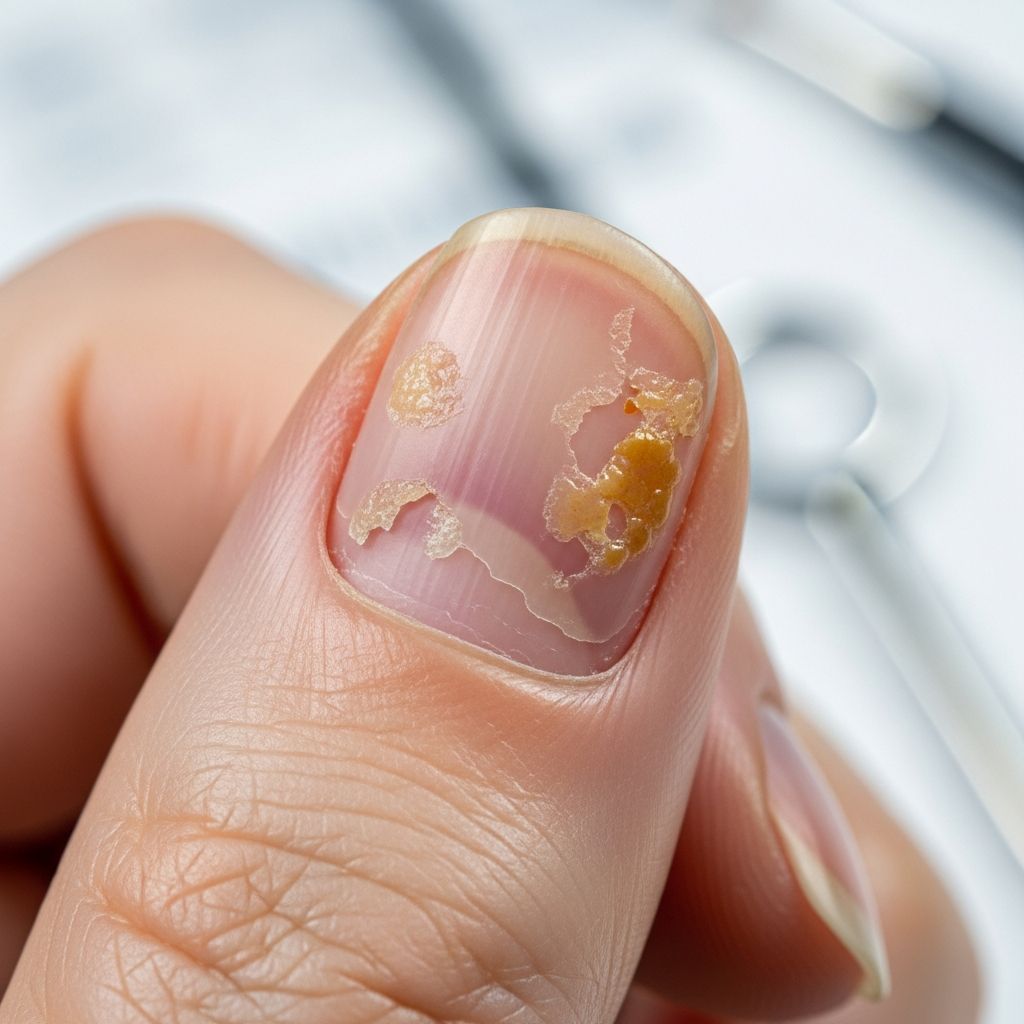
The nail bed lies directly beneath the nail plate and plays a significant role in maintaining the adherence of the nail plate to the underlying tissues. Psoriatic involvement of the nail bed manifests through distinctive clinical signs. These include onycholysis (distal nail plate separation from the nail bed), splinter hemorrhages (thin red lines under the nail), subungual hyperkeratosis (thickened skin under the nail), and oil-drop discoloration—a characteristic yellowish discoloration resembling a drop of oil beneath the nail plate.
Histopathological Features
The microscopic findings in nail psoriasis closely resemble those seen in cutaneous psoriasis. Key histopathological features include mild-to-moderate hyperkeratosis, focal parakeratosis, and spongiosis. Other prominent features include neutrophilic inflammatory infiltrate, hypergranulosis, and psoriasiform epidermal hyperplasia. The papillary dermis in affected skin contains dilated, tortuous capillaries, while the hyponychium demonstrates loss of the granular layer with hypergranulosis in the nail bed and matrix.
Clinical Features and Symptoms
The clinical presentation of nail psoriasis depends on which nail structure components are affected by the inflammatory process. The symptoms and visible changes vary significantly based on the site of involvement.
Common Signs and Symptoms
| Clinical Feature | Description | Associated Nail Structure |
|---|---|---|
| Nail pitting | Small punctate depressions or pits in the nail surface | Nail matrix |
| Oil-drop discoloration | Yellowish discoloration resembling a drop of oil beneath the nail | Nail bed |
| Onycholysis | Separation of the nail plate from the nail bed, typically at the distal end | Nail bed |
| Subungual hyperkeratosis | Thickened, scaling skin accumulating beneath the nail plate | Nail bed |
| Splinter hemorrhages | Linear red or brown streaks under the nail plate | Nail bed |
| Leukonychia | White discoloration or white spots on the nail plate | Nail matrix |
| Beau’s lines | Horizontal indentations or grooves across the nail plate | Nail matrix |
| Red spots in lunula | Red punctate spots in the crescent-shaped base area | Nail matrix |
Functional Impact
Beyond cosmetic concerns, nail psoriasis can significantly impact functional capacity. Psoriatic nail dystrophy may cause tenderness and pain in affected nails, particularly when pressure is applied. The condition can alter the sense of fine touch, making it difficult to perform precise manual tasks. Individuals may experience difficulty picking up small objects, manipulating items such as shoelaces or buttons, or performing other dexterous activities that require fine motor control. These functional impairments can substantially affect quality of life and daily activities.
Complications and Associated Conditions
Nail psoriasis carries several important clinical associations and potential complications. The condition may be a risk factor for the development of psoriatic arthritis and is often associated with prolonged severe cutaneous psoriasis. One significant complication arises when nails lift off the nail bed due to onycholysis—this separation creates a space where fungi can penetrate and establish infection, leading to secondary fungal nail infection. This coexistence of psoriasis and onychomycosis complicates diagnosis and treatment.
Diagnosis and Differential Diagnoses
Diagnosing nail psoriasis primarily relies on clinical assessment of characteristic nail features, as there is no specific diagnostic test for the condition. The presentation of multiple affected nails with similar findings strongly suggests psoriasis rather than fungal infection. A careful history regarding systemic psoriasis or family history of psoriasis supports the diagnosis. Dermoscopic examination can help identify specific features and distinguish nail psoriasis from other conditions.
Nail Psoriasis Index
To standardize and evaluate the severity of nail psoriasis, the nail psoriasis index was devised. This assessment tool evaluates the signs of nail psoriasis in each nail separately on a 1-3 scale. The index considers pitting, Beau’s lines, subungual hyperkeratosis, and onycholysis within the matrix, the subungual tissues distal to the lunula, or across the whole nail unit. This systematic approach enables consistent monitoring of disease progression and response to treatment.
Differential Diagnoses
Nail psoriasis is frequently mistaken for onychomycosis (fungal nail infection), with which it may coexist. Key distinguishing features include the pattern of nail involvement—psoriasis typically affects multiple nails simultaneously, while fungal infections usually begin with a single nail and slowly spread over time. Additionally, fungal infections more commonly affect toenails, whereas nail psoriasis more frequently involves fingernails. Fungal infections typically show gradual progression, whereas psoriatic changes can appear relatively suddenly across multiple nails.
Treatment Approaches
Treatment of nail psoriasis presents significant challenges due to the resistant nature of the condition and the slow growth rate of nails. A treatment response may take weeks or months to become visible, as new cells produced at the matrix require approximately one year to reach the distal edge of the nail plate. Treatment decisions depend on disease severity and functional impact.
Mild Disease Management
Mild nail disease that is not causing discomfort or functional impairment typically does not require active treatment. Many patients with minimal symptoms can conceal affected nails with nail varnish for cosmetic purposes. In these cases, observation and reassurance are appropriate management strategies, as the condition may resolve spontaneously or remain stable without intervention.
Topical Treatments
Topical treatments are typically employed for mild-to-moderate disease limited to one or two nails without functional impairment or systemic involvement. Available topical agents include:
- Topical steroids: Applied directly to affected nails and nail folds; when nails are lifting off, strong steroid scalp solutions can be carefully trickled under the nail
- Calcipotriol: A vitamin D analogue applied to nail folds and hyponychium; some patients may see results after 12 months of consistent application
- Salicylic acid: A keratolytic agent that helps reduce subungual hyperkeratosis
- Tazarotene: A retinoid compound applied topically to affected nails
- Fluorouracil solution: Applied to nail folds and hyponychium; requires patient compliance with twice-daily application for extended periods
Unfortunately, local topical treatments are often not very effective for treating nail psoriasis, though they are worth attempting before escalating to systemic therapy. The limited efficacy relates to the difficulty in maintaining adequate drug concentration in the nail matrix and bed through topical application alone.
Systemic Therapy
Moderate-to-severe disease involving more than two nails, disease with functional impairment, or disease associated with systemic involvement (such as psoriatic arthritis) may require systemic therapy. Systemic medications address the underlying inflammatory process throughout the body and have demonstrated greater efficacy for nail involvement than topical treatments.
Biologic Agents
Modern biologic therapies have significantly improved outcomes for severe nail psoriasis. A network meta-analysis of multiple biologic agents demonstrated that at 24 to 28 weeks, ixekizumab, followed by brodalumab and bimekizumab, showed the highest efficacy for complete resolution of nail psoriasis. At weeks 48 to 52, ixekizumab, followed by adalimumab and brodalumab, demonstrated the highest absolute probability of achieving complete resolution. These agents work by targeting specific inflammatory pathways central to psoriatic disease.
Other Considerations
Injected triamcinolone acetonide is rarely used for nail psoriasis because of the pain associated with injection and the potential to cause tissue atrophy. Systemic therapy is rarely warranted for nail disease alone in the absence of troublesome psoriasis affecting other body sites, as the risks and side effects of systemic medications must be justified by appropriate disease severity.
Prognosis and Long-term Outlook
The outlook for nail psoriasis is variable and depends on disease severity, treatment response, and individual factors. Nail psoriasis is typically difficult to treat, and there is currently no cure for the condition. Without treatment, nail psoriasis does not usually resolve spontaneously and can continue to cause problems indefinitely. However, the natural history of the disease can fluctuate in severity over time, and spontaneous resolution has been documented in some cases.
The appearance of affected nails can sometimes cause significant distress to patients, affecting self-esteem and quality of life. However, the treatment of severe psoriatic nail disease is improving with modern medicines, particularly biologic therapies that target underlying inflammatory mechanisms. With appropriate management, many patients can achieve substantial improvement or even complete resolution of nail involvement.
Frequently Asked Questions
Q: Can nail psoriasis be cured?
A: Currently, there is no cure for nail psoriasis. However, modern treatments can effectively manage symptoms and improve nail appearance. Some cases may resolve spontaneously, while others require long-term management with topical or systemic therapies.
Q: How long does treatment take to work on nails?
A: Treatment response for nail psoriasis is slow because nails grow gradually. It typically takes weeks to months to see visible improvement, as new nail cells produced at the matrix require approximately one year to reach the distal edge of the nail plate.
Q: Can nail psoriasis lead to arthritis?
A: Nail psoriasis may be a risk factor for developing psoriatic arthritis. Nail involvement serves as a visible indicator to predict concomitant or future inflammatory joint activity, particularly affecting the distal interphalangeal joints.
Q: Is nail psoriasis the same as a fungal infection?
A: No, nail psoriasis and fungal infections are different conditions, although they can coexist. Psoriasis typically affects multiple nails simultaneously and more commonly involves fingernails, while fungal infections usually begin with one nail and spread gradually, more commonly affecting toenails.
Q: Will my nails return to normal after treatment?
A: With effective treatment, many patients experience significant improvement in nail appearance and function. Complete resolution is possible with modern biologic therapies, though individual responses vary. Even without complete resolution, treatment can substantially improve symptoms and reduce functional impairment.
Q: Should I see a dermatologist for nail psoriasis?
A: If nail psoriasis is mild and not causing discomfort, specialist referral may not be necessary. However, if the condition is severe, causing functional impairment, or not responding to topical treatments, consultation with a dermatologist is recommended for specialized assessment and systemic therapy options.
References
- Nail Psoriasis — StatPearls, National Center for Biotechnology Information (NCBI), U.S. National Library of Medicine. 2024. https://www.ncbi.nlm.nih.gov/books/NBK559260/
- Nail Psoriasis: Symptoms and Treatment — Patient.info, Egton Medical Information Systems Limited. 2024. https://patient.info/skin-conditions/psoriasis-leaflet/psoriatic-nail-disease
- Nail Psoriasis — DermNet New Zealand, Department of Dermatology, University of Auckland. 2024. https://dermnetnz.org/topics/nail-psoriasis
- Palmoplantar and Nail Psoriasis: Scaly Skin Diseases — DermNet New Zealand, Department of Dermatology, University of Auckland. 2024. https://dermnetnz.org/cme/scaly-rashes/palmoplantar-and-nail-psoriasis-cme
- Nail Psoriasis vs. Nail Fungus: Photos and Differences — MyPsoriasisTeam. 2024. https://www.mypsoriasisteam.com/resources/nail-psoriasis-vs-nail-fungus-photos-and-differences
Similar Articles








Read full bio of Sneha Tete