Natal And Neonatal Teeth: What Parents Need To Know
Understanding teeth present at birth or erupting in the first month: causes, risks, and management strategies for newborns.
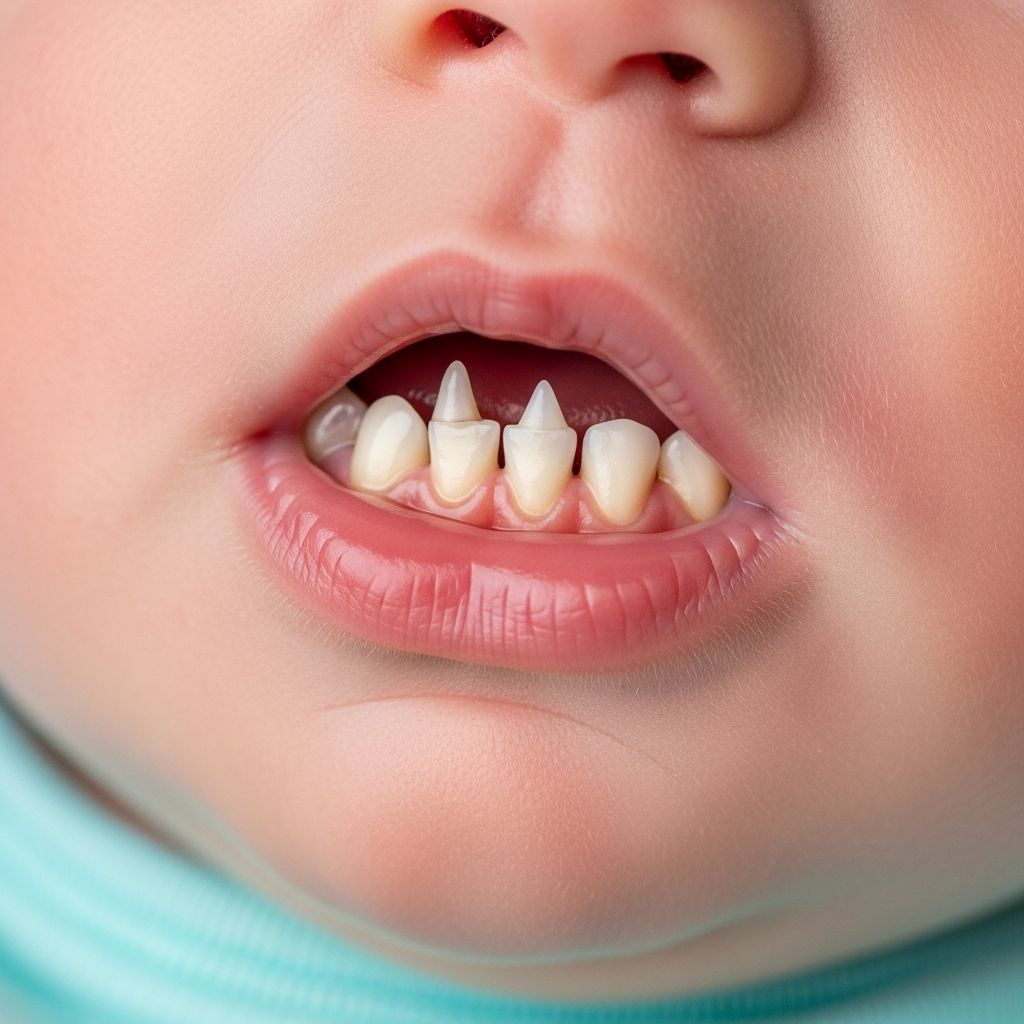
Natal teeth are present at birth, while neonatal teeth erupt within the first month of life. These rare occurrences affect approximately 1 in 2,000 to 3,500 newborns and require careful evaluation to prevent complications like feeding difficulties or aspiration.
What are natal and neonatal teeth?
Natal teeth are primary (deciduous) teeth visible in a newborn’s mouth at birth. Neonatal teeth emerge during the first 30 days of life. Both typically involve the lower central incisors and differ from normal primary teeth due to incomplete development, often featuring thin enamel, underdeveloped roots, and mobility.
These teeth arise from premature eruption of tooth germs rather than supernumerary (extra) teeth in most cases. Their early appearance can surprise parents but is generally harmless unless complications arise.
Who gets natal and neonatal teeth? (Epidemiology)
Natal teeth occur in about 1:2,000 live births, with neonatal teeth slightly less common. They are three times more frequent in males than females. Family history is reported in 8-62% of cases, suggesting a genetic component.
- Prevalence: 1 in 2,000-3,500 newborns for natal teeth.
- Most common in preterm infants or those with low birth weight.
- Predominantly affects mandibular central incisors (up to 85% of cases).
What causes natal and neonatal teeth? (Etiology)
The exact cause remains unknown, but multifactorial etiology is proposed, including genetic, endocrine, and environmental factors.
Genetic factors
Inherited as an autosomal dominant trait in some families. Associated with accelerated dental development or superficial tooth germ positioning. Genes controlling odontogenesis may mutate, leading to early eruption.
Systemic conditions and syndromes
Frequently linked to developmental disorders:
- Ellis-van Creveld syndrome (chondroectodermal dysplasia): High association with natal teeth.
- Sotos syndrome: Overgrowth disorder with premature dental eruption.
- Pachyonychia congenita: Nail and skin abnormalities.
- Hallermann-Streiff syndrome: Craniofacial dysmorphism.
- Other: Hypohidrotic ectodermal dysplasia, cleft lip/palate.
About 15-25% of cases occur in infants with these syndromes.
Environmental and maternal factors
Exposure to polychlorinated biphenyls (PCBs), dibenzo-p-dioxins (PCDDs), and dibenzofurans (PCDFs) strongly implicated, as they cross the placenta and correlate with natal teeth in affected children. Other proposed factors include maternal illness, fever, malnutrition, or endocrine disturbances during pregnancy, though evidence is weaker.
Clinical features
Natal/neonatal teeth are small, conical, discolored (yellow-brown), and mobile due to incomplete roots. Enamel is often hypoplastic or absent; dentin may show irregularities like atubular regions or calcospherites.
Classification by appearance:
- Shell-shaped crown poorly fixed to alveolus, no root.
- Solid crown poorly fixed, little/no root.
- Incisal margin erupted through gingiva.
- Edematous gingiva with palpable unerupted tooth.
They attach loosely to mucosa, increasing aspiration risk.
Complications
While often asymptomatic, risks include:
- Feeding difficulties: Painful suckling, laceration of mother’s nipple, refusal to breastfeed leading to dehydration or weight loss.
- Aspiration/ingestion: High mobility risks choking.
- Tongue injury: Ulceration or deformity from sharp edges.
- Infection: Riga-Fede disease (traumatic granuloma on tongue).
- Interference with adjacent tooth eruption or root development.
Related Stories



Diagnosis
Primarily clinical: Visual inspection at birth or shortly after. Radiographs confirm primary vs. supernumerary teeth, root development, and eruption status. Pulp vitality testing rarely needed in neonates. Differential includes gingival cysts (Bohn’s nodules, which resolve spontaneously).
Management
Decisions based on mobility, symptoms, and risks. Pediatric dentist consultation recommended.
| Stability | Recommendation |
|---|---|
| Firmly attached, no symptoms | Observe; smooth sharp edges if needed |
| Mobile, feeding issues, or aspiration risk | Extraction under local anesthesia |
| Associated with syndrome | Multidisciplinary care |
Extraction prevents complications; most cases show no long-term dental sequelae as they are primary predecessors. Bonding for stability rarely used in infants.
Prognosis and prevention
Excellent with prompt management. No prevention possible due to idiopathic nature, but screening family history and prenatal toxin exposure helps identify at-risk infants. Successors usually erupt normally.
Frequently Asked Questions
Can babies be born with teeth?
Yes, though rare (1:2,000). These natal teeth are usually lower incisors and may need removal if problematic.
Are natal teeth dangerous?
Potentially, due to aspiration risk or feeding interference. Consult a pediatrician or dentist immediately.
Do natal teeth mean a syndrome?
Not always; most are isolated. But linked to Ellis-van Creveld, Sotos, and others in 15-25% cases.
Should natal teeth be removed?
If mobile or causing issues, yes. Otherwise, monitor.
What’s the difference between natal and neonatal teeth?
Natal: present at birth. Neonatal: erupt within first month.
Historical and cultural notes
Ancient misconceptions linked natal teeth to misfortune or vampirism, leading to infanticide. Modern understanding emphasizes medical management.
References
- Natal and Neonatal Teeth: An Overview of the Literature — Mhaske S, et al. PMC/NCBI. 2013-08-15. https://pmc.ncbi.nlm.nih.gov/articles/PMC3759256/
- What causes natal teeth? — University of Rochester Medical Center (.edu). Accessed 2026. https://www.urmc.rochester.edu/encyclopedia/content?contenttypeid=90&contentid=p01862
- Natal Teeth: What Are They? Causes, Myths, and More — WebMD. Updated 2023. https://www.webmd.com/parenting/baby/what-are-natal-teeth
- Natal & Neonatal Teeth: What To Know — Cleveland Clinic. 2023-11-01. https://my.clevelandclinic.org/health/symptoms/natal-teeth
- Can Babies Be Born With Teeth? — Hurst Pediatric Dentistry. 2024. https://hurstpediatricdentistry.com/blog/can-babies-be-born-with-teeth/
Similar Articles








Read full bio of medha deb