Neck Muscles: Anatomy, Function & Health
Complete guide to neck muscle anatomy, function, and common conditions affecting your cervical spine.
Understanding Neck Muscles: Essential Support for Your Head and Neck
Your neck is a complex system of muscles, bones, and connective tissues that work together to support your head, enable movement, and protect vital structures. More than 20 muscles are actively working to keep your head supported, balanced, and mobile throughout the day. These muscles have far more responsibilities than you might realize—from helping you chew and swallow to keeping you breathing and enabling facial expressions. Understanding the anatomy and function of your neck muscles is essential for maintaining proper posture, preventing injury, and managing neck-related discomfort.
What Are Neck Muscles?
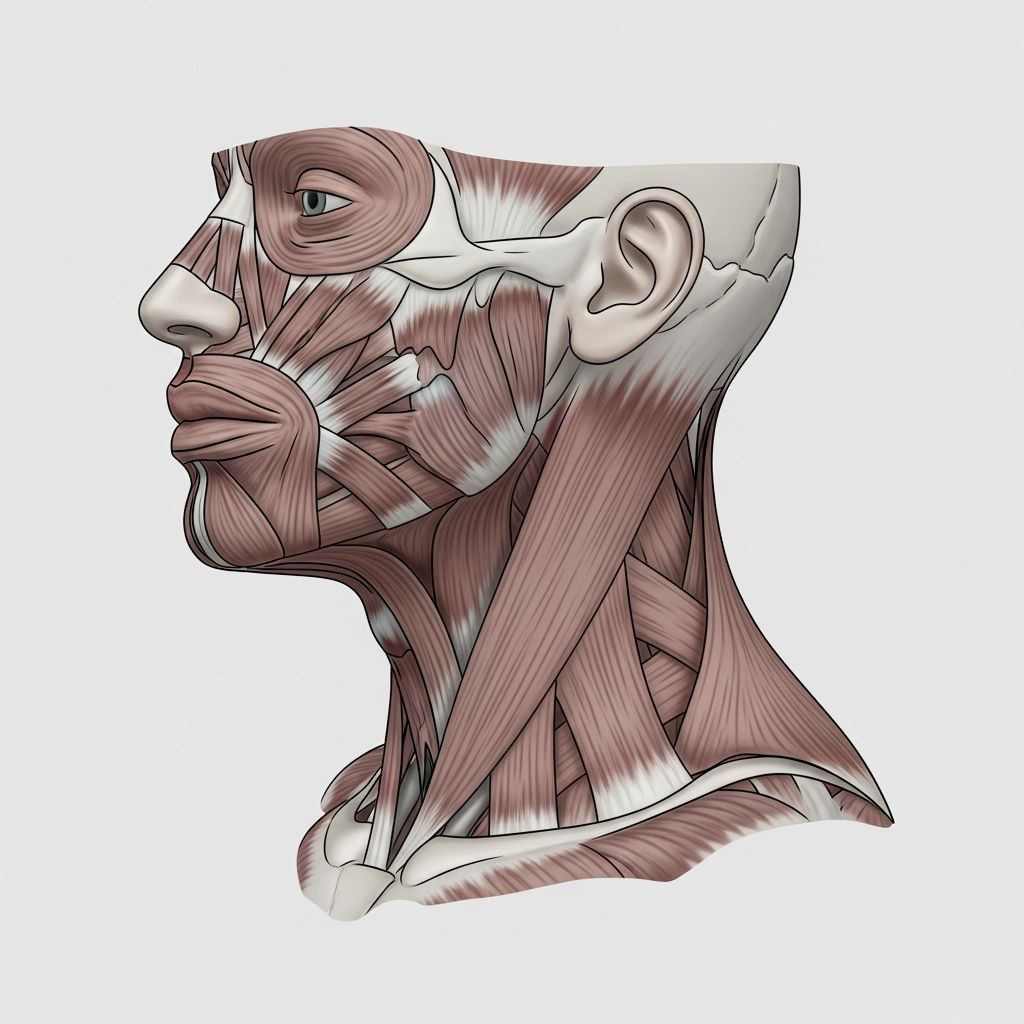
Neck muscles are a collection of skeletal muscles that surround your cervical vertebrae—the seven bones that make up your cervical spine. These muscles work in coordinated groups to provide stability, support, and controlled movement for your head and upper body. The primary function of neck muscles is to support and move your neck and head while maintaining proper alignment with your spine. Your neck muscle structure is remarkably sophisticated, with muscles arranged in three distinct categories based on their location and function: anterior (front), lateral (side), and posterior (back) muscles.
Types of Neck Muscles
Anterior (Front) Neck Muscles
The anterior neck muscles consist of superficial muscles located in the front of your neck. These muscles help you move your mouth, lower face, and the front of your neck. They also allow you to angle your neck downward and rotate your neck around. The anterior neck muscles include several important groups:
Suprahyoid Muscles: These muscles move your jaw and help you move the hyoid bone when swallowing or speaking. They work together to control precise movements of your jaw and mouth, enabling you to chew and speak clearly.
Infrahyoid Muscles: These muscles move the hyoid bone and your larynx downward, playing a crucial role in swallowing and voice production.
Scalenes: Located in the anterior neck, the scalene muscles help you rotate your neck and pull your head back. These muscles are particularly important for neck flexibility and movement in multiple directions.
Lateral Neck Muscles
The lateral neck muscles consist of five muscles that play an important role in moving your head around and contracting your neck. These muscles work together to enable side-to-side movements and help stabilize your head during complex movements. One of the most significant lateral neck muscles is the sternocleidomastoid.
The Sternocleidomastoid (SCM) Muscle
The sternocleidomastoid is the largest muscle in the front of your neck, located just below your skin where you can easily feel it by placing your fingers on both sides of your neck. This powerful muscle allows you to bend your neck and turn or tilt your head. The SCM extends from the base of your skull (mastoid process) down both sides of your neck until it ends at your sternum (sternal head) or clavicle (clavicular head).
The muscle gets its name from its attachment points and location. It’s a paired muscle with two parts—the sternal and clavicular heads—that work together to create various neck movements. The SCM is wider and thinner where it starts and ends, but narrow and thicker in the middle where the two heads merge.
Related Stories



Your sternocleidomastoid helps you bend your neck and turn and tilt your head by activating during flexion, rotation, and lateral movements. This muscle also assists in breathing by helping elevate your ribcage during inhalation. Healthcare providers often use the SCM muscle as a reference point to locate important structures in the neck, including nerves, blood vessels, lymph nodes, and glands.
Posterior (Back) Neck Muscles
The posterior neck muscles are grouped into three distinct categories based on their depth and function.
Superficial Posterior Muscles: The first group of posterior muscles helps bend your neck laterally (side to side) and bilaterally (forward and backward).
Suboccipital Muscles: Located deeper in the neck, the suboccipital muscles help rotate your head and bend your neck in various directions. These small but important muscles are crucial for fine motor control and precise head positioning.
Transversospinalis Muscles: The third group, the transversospinalis muscles, extends your head, cervical spine, and thoracic spine. They also bend your head, neck, and spine in different directions and help support and stabilize your spine.
The Trapezius Muscle
The trapezius is one of the two major neck muscles and is actually part of your upper back. You have one trapezius muscle on either side of your upper back, and they start at the base of your neck and extend across your shoulders and down to the middle of your back. Trapezius muscles get their name from their shape—when you look at them together, they form a trapezoid shape, like a kite.
Each trapezius muscle has three distinct sections: upper, middle, and lower. The upper section connects to your skull and neck (cervical spine), while the middle and lower sections attach to bones in your thoracic spine. The trapezius muscles are also connected to the back sides of your shoulder blade (scapula) and collarbone (clavicle). These muscles help you maintain your posture and move your upper back, neck, and head. Cranial nerve XI (the spinal accessory nerve) allows your trapezius muscles to move, while they receive sensory information from the C3 and C4 cervical nerves in your neck.
Functions of Neck Muscles
Your neck muscles have diverse and essential functions that go far beyond simple head movement. These muscles enable a remarkable range of activities and maintain critical bodily functions:
Head Movement and Support: Your neck muscles ensure your head is balanced and can move in multiple directions. The combination of muscles allows for flexion (forward bending), extension (backward bending), lateral flexion (side bending), and rotation (turning side to side).
Breathing: Neck muscles play an important role in respiration by helping to move your upper ribs up while inhaling, contributing to effective breathing mechanics.
Swallowing: The suprahyoid and infrahyoid muscles work together to control the complex movements required for swallowing food and liquids safely.
Speaking: Your neck muscles help control the position of your larynx and hyoid bone, enabling clear speech and proper voice production.
Chewing: Several neck muscles assist in mastication (chewing) by controlling jaw position and movement.
Facial Expression: Your neck muscles help make some facial expressions by enabling movement of surrounding tissues.
Posture and Stability: Working with your cervical spine, neck muscles maintain proper head alignment and spinal stability throughout daily activities.
Neck Anatomy and Cervical Spine Structure
Your cervical spine consists of seven stacked bones called vertebrae, labeled C1 through C7. These vertebrae are connected by small joints (facet joints) that work with your neck muscles to move your head in all directions. The first two vertebrae of your cervical spine are unique in shape and function.
The first vertebra (C1), called the atlas, is a ring-shaped bone that begins at the base of your skull and is named after Atlas from Greek mythology, who held the world on his shoulders. The atlas holds your head upright. The second vertebra (C2), called the axis, allows the atlas to pivot against it for the side-to-side “no” rotation of your head.
Between each pair of vertebrae are cervical disks—”shock absorber cushions” that cushion against stresses placed on your neck and allow you to flex and rotate your head more easily during activity. Eight pairs of spinal nerves exit through small openings between every pair of vertebrae, labeled C1 through C8, and they stimulate muscle movement in your neck, shoulder, arm, and hand.
Common Neck Muscle Conditions and Issues
Muscle Strain and Tension
Muscle strains are among the most common causes of neck pain, often resulting from poor posture, stress, or repetitive activities. Tension in neck muscles, particularly in the trapezius and sternocleidomastoid, can lead to stiffness and discomfort that may radiate to other areas.
Nerve Compression
A herniated disk in your neck vertebrae can press on nerves from your spinal cord, creating pinched nerves that cause neck pain and irritate your neck muscles, resulting in stiffness. This condition can be painful and may require medical intervention.
Disc Degeneration
Arthritis can narrow your spinal canal, causing muscle inflammation, strain, or trauma. This damage to your neck muscles can cause neck pain and may develop into more severe problems. Disc degeneration is often associated with age-related wear and tear on the cervical spine.
SCM-Related Conditions
Injuries and tension within your sternocleidomastoid can lead to pain and stiffness. These conditions can develop from trauma, repetitive strain, or prolonged muscle tension. Referred pain is common with SCM issues—although the pain originates in the SCM muscle, you may feel it in different areas of your head, face, or upper body.
Trapezius Injuries and Issues
Your trapezius muscles can feel several types of pain if they’re injured or irritated, including sharp, dull, or burning sensations. Other symptoms of trapezius injuries or issues can include weakness, limited range of motion, and postural problems.
Caring for Your Neck Muscles
Maintaining healthy neck muscles is essential for preventing pain and preserving mobility. Here are key strategies for neck muscle care:
Stretching: Regular neck stretching helps maintain flexibility and prevent muscle tightness. Gentle, controlled stretches should be performed daily.
Posture Management: Maintaining good posture throughout the day reduces unnecessary strain on your neck muscles. Ensure your screen is at eye level and your shoulders are relaxed.
Stress Management: Chronic stress often manifests as neck muscle tension. Implementing stress-reduction techniques can help prevent tension and strain.
Physical Therapy: Professional physical therapy can address muscle imbalances and provide targeted exercises to strengthen weak muscles.
Osteopathic Manipulation: This hands-on treatment approach can help relieve muscle tension and improve neck mobility.
Frequently Asked Questions
Q: How many neck muscles does the human body have?
A: The human body has more than 20 neck muscles working together to support and move your head and neck. These muscles are organized into three main categories: anterior (front), lateral (side), and posterior (back) muscles that coordinate to enable all neck movements and functions.
Q: What is the largest neck muscle?
A: The sternocleidomastoid (SCM) is the largest muscle in the front of your neck. It’s located just below your skin and can be easily felt on both sides of your neck. The trapezius, which extends from your neck across your upper back, is also a major neck muscle.
Q: What functions do neck muscles perform?
A: Neck muscles have multiple functions including supporting your head, enabling movement in all directions, facilitating breathing by lifting your ribs, assisting with swallowing and speaking, helping you chew, enabling facial expressions, and maintaining proper posture and spinal stability.
Q: What causes neck muscle pain?
A: Common causes of neck muscle pain include muscle strains from poor posture or repetitive activities, tension from stress, nerve compression from herniated disks, disc degeneration, and injuries. Referred pain may also occur where pain originates in the neck muscles but is felt in other areas.
Q: How can I prevent neck muscle problems?
A: You can prevent neck muscle problems by maintaining good posture, stretching regularly, managing stress effectively, taking frequent breaks from screens, strengthening neck muscles through appropriate exercises, and avoiding prolonged static positions that strain your neck.
Q: What are the three categories of neck muscles?
A: The three categories are anterior (front) neck muscles that help move your mouth and lower face, lateral (side) neck muscles that enable head movement and neck contraction, and posterior (back) neck muscles that include superficial, suboccipital, and transversospinalis muscles for various movements and support.
References
- Neck Muscles: What to Know — WebMD. 2024. https://www.webmd.com/a-to-z-guides/neck-muscles-what-to-know
- What Is the Sternocleidomastoid (SCM Muscle)? — Cleveland Clinic. 2024. https://my.clevelandclinic.org/health/body/24939-sternocleidomastoid-scm-muscle
- Trapezius Muscle: What It Is, Anatomy & Function — Cleveland Clinic. 2024. https://my.clevelandclinic.org/health/body/21563-trapezius-muscle
- Cervical Spine (Neck): What It Is, Anatomy & Disorders — Cleveland Clinic. 2024. https://my.clevelandclinic.org/health/articles/22278-cervical-spine
- Neck pain: Causes, Treatments, and Myths — Spine Health. 2024. https://spinehealth.org/article/neck-pain-causes-treatments-myths/
Similar Articles








Read full bio of medha deb