Necrotizing Fasciitis Pathology: Key Histologic Findings
Detailed histopathological analysis of necrotising fasciitis, a life-threatening bacterial infection of fascia and soft tissues.
Necrotising fasciitis is a
life-threatening, rapidly progressive form of necrotising cellulitis
that primarily affects the deep fascia and subcutaneous tissues, leading to extensive tissue destruction if not promptly diagnosed and treated.Author Information
Assoc Prof Patrick Emanuel, Dermatopathologist, Auckland, New Zealand. Updated 2013, with ongoing relevance due to consistent histopathological features across studies.
Clinical Context and Introduction
Necrotising fasciitis (NF) represents a severe bacterial infection characterised by rapid progression along fascial planes, often sparing overlying skin initially but leading to necrosis of subcutaneous fat, fascia, and deeper structures.
Group A beta-haemolytic streptococci (Streptococcus pyogenes)
are the most common causative organisms, particularly in Type II NF, though polymicrobial (Type I) and other monomicrobial forms (Type III, e.g., Vibrio or Clostridium) also occur. The pathology is marked by overwhelming bacterial colonisation, suppuration, thrombosis, and necrosis, necessitating urgent surgical intervention.Histopathological examination is crucial for definitive diagnosis, often requiring deep biopsies that extend into subcutaneous fat and fascia. Intraoperative frozen sections or touch preparations may expedite diagnosis during surgery. Early recognition is vital, as NF can progress to systemic toxicity, multiorgan failure, and mortality rates up to 25%.
Microscopic (Histopathologic) Description
A deep biopsy is essential for accurate diagnosis, revealing hallmark features at low and high magnification.
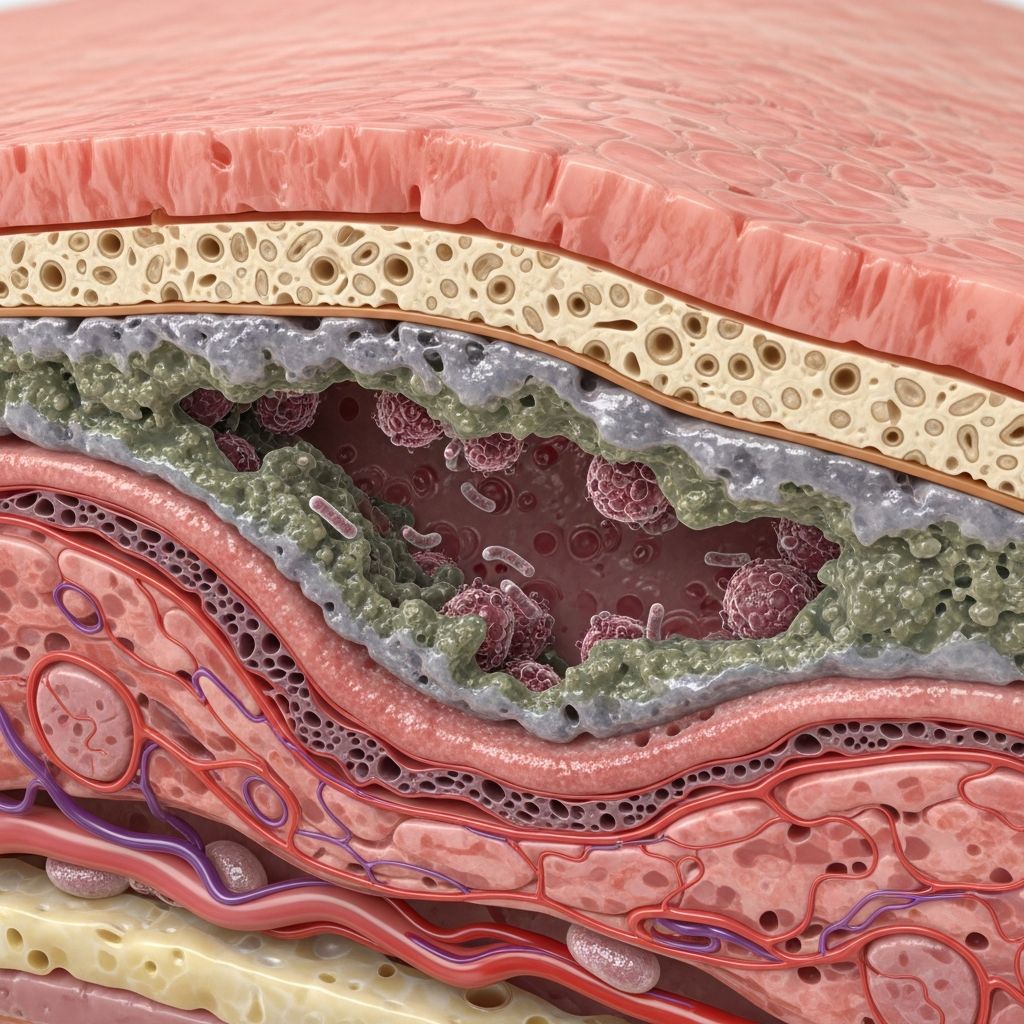
- Low-power view (Figure 1 equivalent): Extensive acute inflammatory reaction involving subcutaneous fat and fascia, with possible superficial ulceration or deep extension into skeletal muscle.
- Subcutaneous involvement (Figure 2): Panniculitis-like changes with neutrophils permeating fat lobules and septa.
- Higher power (Figure 3): Impressive suppuration with dense neutrophilic infiltrates forming microabscesses.
- Tissue necrosis (Figure 4): Ghost-like outlines of adipocytes and fibroblasts amid amorphous necrotic debris, accompanied by overwhelming bacterial colonisation visible even on H&E stains.
- Vascular changes (Figure 5): Intravascular thrombosis and vessel wall invasion by microorganisms, contributing to ischaemic necrosis.
- Gram stain (Figure 6): Confirms bacterial morphology; gram-positive cocci in chains (streptococci) or clusters (staphylococci), depending on the pathogen.
Tissue culture is mandatory to identify the specific causative organism, guiding targeted antibiotic therapy.
Pathophysiology in Histological Terms
The histopathological progression mirrors the clinical pathophysiology: bacteria (e.g., S. pyogenes) release exotoxins (SPE A, B, C), enzymes (hyaluronidase, streptokinase), and superantigens that trigger massive cytokine release, thrombosis, and tissue destruction. Aerobic and anaerobic bacteria produce gases (hydrogen, nitrogen, H2S) that degrade hyaluronic acid, facilitating horizontal spread along fascial planes without early skin changes.
| Histological Feature | Description | Pathogenic Mechanism |
|---|---|---|
| Acute inflammation | Dense neutrophilic infiltrate in fat and fascia | Bacterial toxins recruit neutrophils |
| Suppuration | Microabscesses and pus formation | Neutrophil degranulation and bacterial lysis |
| Necrosis | Coagulative and liquefactive necrosis of tissues | Ischaemia from thrombosis + direct enzymatic digestion |
| Bacterial overgrowth | Sheets of organisms on H&E and Gram | Polymicrobial synergy or virulent monopathogens |
| Thrombosis | Fibrin thrombi in vessels | Toxin-induced endothelial damage |
This table summarises key correlates between microscopy and disease process.
Differential Diagnosis
Histological mimics must be excluded through clinical correlation and microbiology:
- Alpha-1-antitrypsin deficiency panniculitis: Septal panniculitis with suppuration but no bacteria; serum levels confirmatory.
- Pancreatic panniculitis: Fat necrosis with ghost cells, saponification; elevated amylase/lipase.
- Bacterial overgrowth in autopsy/unfixed tissue: Postmortem artefact; clinical context distinguishes.
- Ery s ipelas/cellulitis: Superficial dermal inflammation without fascial involvement.
- Gas gangrene (clostridial myonecrosis): Predominantly muscle necrosis with gram-positive rods and gas bubbles.
Intraoperative touch preps highlight organisms rapidly, aiding distinction from sterile necrotising processes.
Diagnostic Approach
Diagnosis integrates:
- Clinical suspicion: Disproportionate pain, crepitus, bullae, rapid progression post-minor trauma.
- Imaging: CT/MRI shows fascial thickening, gas, fluid collections.
- LRINEC score: Lab parameters (CRP, WBC, Hb, Na, creatinine, glucose) for risk stratification.
- Biopsy/Frozen section: Gold standard for confirmation.
Related Stories



Management Implications from Pathology
Pathological confirmation mandates:
- Emergent surgical debridement of all necrotic tissue.
- Broad-spectrum IV antibiotics (e.g., vancomycin, piperacillin-tazobactam, clindamycin).
- IV immunoglobulin for toxin-mediated cases.
- Supportive care in ICU.
Repeat debridements guided by pathology until healthy tissue margins.
Frequently Asked Questions (FAQs)
Q: What is the most critical histopathological finding in necrotising fasciitis?
A: Overwhelming bacterial colonisation with suppuration, necrosis, and thrombosis in fascia/subcutis.
Q: Is a superficial biopsy sufficient for diagnosis?
A: No, deep biopsy to fascia is required, as early changes may spare dermis.
Q: How does Type I differ histologically from Type II NF?
A: Type I (polymicrobial) shows mixed flora; Type II (streptococcal) gram-positive cocci. Both share necrosis/thrombosis.
Q: Can frozen sections reliably diagnose NF?
A: Yes, especially with touch preps demonstrating organisms; critical for intraoperative decisions.
Q: What distinguishes NF pathology from cellulitis?
A: NF involves fascia with bacteria/necrosis; cellulitis is dermal/subdermal without deep extension.
Q: Is fungal NF histologically distinct?
A: Yes, shows broad septate hyphae in immunocompromised hosts; GMS/PAS stains highlight.
(Word count: 1678, excluding metadata and references)
References
- Necrotising fasciitis — DermNet NZ. 2023. https://dermnetnz.org/topics/necrotising-fasciitis
- Necrotising fasciitis pathology — DermNet NZ. 2013. https://dermnetnz.org/topics/necrotising-fasciitis-pathology
- Necrotising fasciitis – Bacterial skin infections — DermNet NZ. 2008. https://dermnetnz.org/cme/bacterial-infections/necrotising-fasciitis-cme
- Fulminant necrotizing fasciitis to the hand in a patient on high-dose steroids — PMC (NCBI). 2020-09-25. https://pmc.ncbi.nlm.nih.gov/articles/PMC7509890/
- Necrotizing Fasciitis (Flesh-Eating Disease) — Cleveland Clinic. 2023. https://my.clevelandclinic.org/health/diseases/23103-necrotizing-fasciitis
- An Overview of Necrotizing Fasciitis — Cambridge Media Journals. 2014. https://journals.cambridgemedia.com.au/download_file/3526/2262
Similar Articles








Read full bio of Sneha Tete