Necrotising Fasciitis: Causes, Symptoms & Treatment Guide
A life-threatening bacterial infection rapidly destroying skin and soft tissues, requiring urgent surgical intervention.
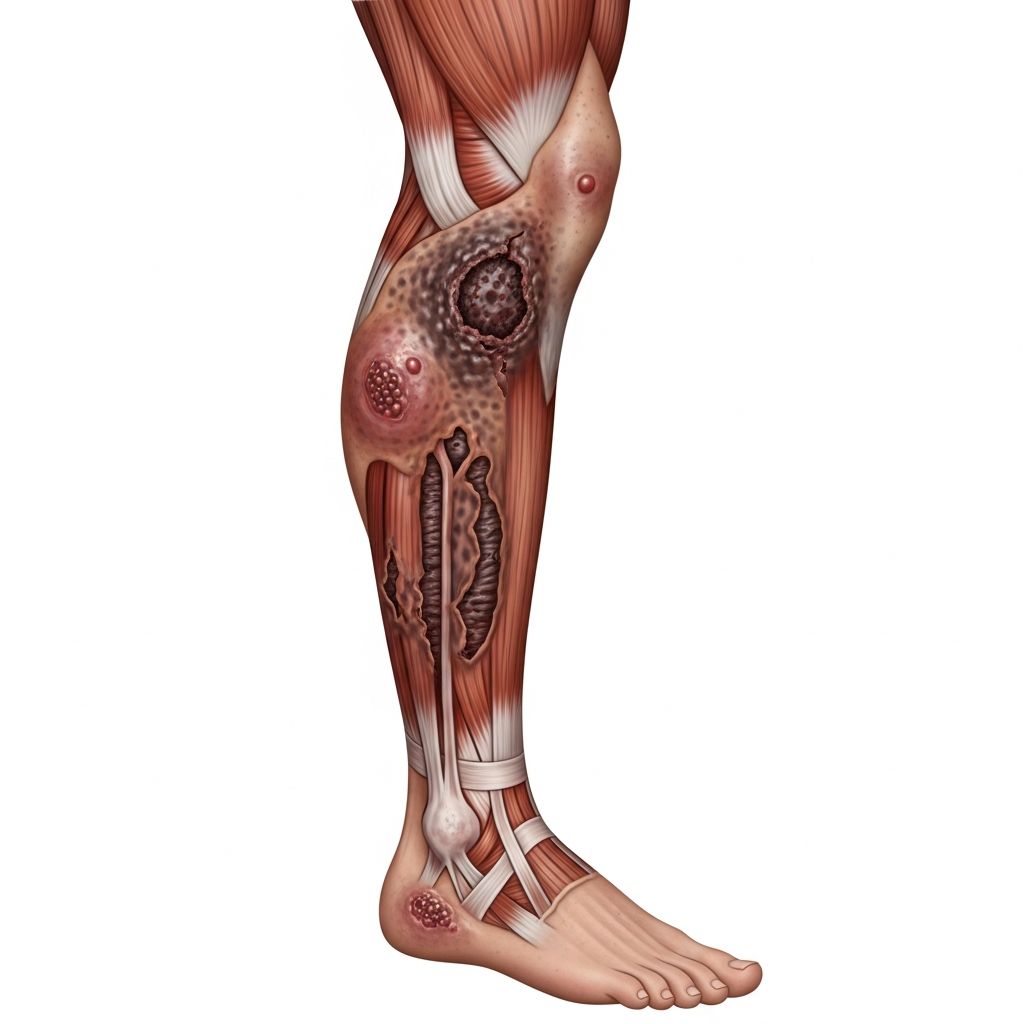
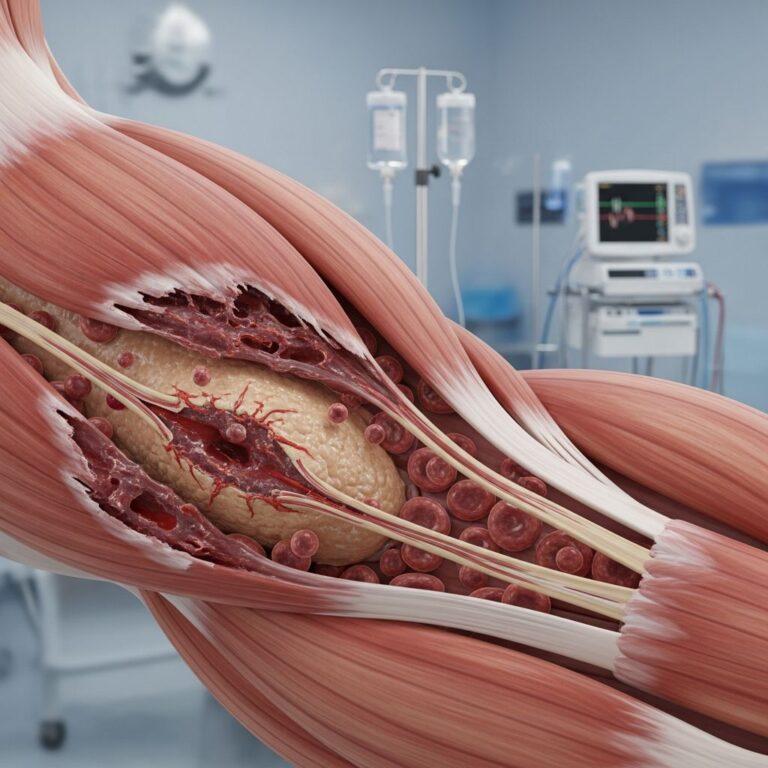
Necrotising fasciitis is a rare but severe and rapidly progressive bacterial infection that affects the fascia, the connective tissue surrounding muscles, leading to extensive tissue necrosis and potentially fatal outcomes if not treated promptly[10]. Known colloquially as ‘flesh-eating disease,’ it spreads swiftly along fascial planes, outpacing visible skin changes, and requires immediate surgical debridement alongside broad-spectrum antibiotics.
What is necrotising fasciitis?
Necrotising fasciitis represents a fulminant soft tissue infection characterised by widespread necrosis of the subcutaneous tissue and fascia, sparing muscle in early stages but progressing to involve deeper structures[10]. The infection typically begins at a site of minor trauma where bacteria enter, producing toxins that facilitate rapid dissemination through tissue planes with relatively spared overlying skin initially. This condition has a high mortality rate, ranging from 20-30% even with optimal care, due to its aggressive nature and frequent association with systemic toxicity like septic shock.
The term ‘necrotising’ derives from the death of soft tissues, while ‘fasciitis’ indicates primary involvement of the fascia—a tough, fibrous layer enveloping muscles and organs. Unlike cellulitis, which is superficial, necrotising fasciitis undermines the skin from below, creating a ‘dishwater’ pus appearance upon incision and easy finger dissection along fascial planes during surgery[10].
Who gets necrotising fasciitis?
Anyone can develop necrotising fasciitis following bacterial entry through broken skin, but certain groups face elevated risk. Individuals with compromised immune systems, such as those with diabetes mellitus, chronic kidney disease, liver cirrhosis, obesity, peripheral vascular disease, or immunosuppression from medications or HIV, are particularly susceptible. Intravenous drug users, alcoholics, and patients with recent surgery or trauma are also at higher risk due to potential portals of entry and impaired healing.
Age plays a role, with adults over 50 years more commonly affected, though cases occur in children and young adults, especially in outbreaks linked to group A Streptococcus. No strong gender predisposition exists, but males may be slightly overrepresented in some series[10]. Healthy individuals can contract it from minor injuries like insect bites, thorns, or even intramuscular injections.
What causes necrotising fasciitis?
Necrotising fasciitis is polymicrobial in many cases (Type I), involving a mix of aerobic and anaerobic bacteria such as Streptococcus species (non-group A), Staphylococcus aureus, Enterobacteriaceae, and Bacteroides[10]. Type II is monomicrobial, most often caused by Group A beta-haemolytic Streptococcus (Streptococcus pyogenes), which produces potent exotoxins leading to tissue destruction and toxic shock syndrome. Less common pathogens include Vibrio vulnificus (linked to seawater exposure), Clostridium species, and methicillin-resistant S. aureus (MRSA).
Bacteria enter via breaches in the skin barrier—cuts, abrasions, burns, surgical wounds, or even trivial punctures. Once inside, they proliferate in hypoxic subcutaneous tissues, releasing enzymes and toxins that liquefy fascia and impair blood flow, creating a nidus for further spread[10]. Host factors like deficient antibodies against streptococcal exotoxins increase susceptibility to progression from soft tissue infection to necrotising fasciitis.
What are the clinical features of necrotising fasciitis?
Symptoms evolve rapidly, often within 24-48 hours of inoculation. Initial signs mimic cellulitis: erythema, warmth, swelling, and disproportionate severe pain beyond the visible area. Pain is intense and out of proportion to skin findings, a hallmark feature.
Related Stories



Systemic symptoms follow: high fever (>39°C), chills, malaise, tachycardia, and hypotension. Skin evolves to violaceous bullae, crepitus (gas in tissues, especially in clostridial cases), haemorrhagic blisters, and necrosis with black eschars. Late stages show anaesthesia over the area due to nerve death, skin induration, and foul-smelling ‘dishwater’ discharge. Without intervention, multi-organ failure ensues.
- Early (hours to 1 day): Pain, swelling, erythema, fever.
- Intermediate (1-2 days): Bullae, crepitus, skin discoloration.
- Advanced (>2 days): Necrosis, hypotension, shock.
How is necrotising fasciitis diagnosed?
Diagnosis relies on high clinical suspicion, as delays increase mortality. The Laboratory Risk Indicator for Necrotising Fasciitis (LRINEC) score uses lab parameters (CRP, WBC, Hb, Na, creatinine, glucose) to stratify risk, with score ≥6 suggesting high probability[10]. Imaging aids: CT shows fat stranding and gas; MRI delineates fascial thickening; ultrasound detects fluid collections.
Definitive diagnosis is surgical: exploration reveals grey necrotic fascia dissecting easily from muscle. Frozen section biopsy may show necrosis but should not delay surgery. Blood and tissue cultures guide antibiotics, though empiric broad coverage starts immediately.
What is the treatment for necrotising fasciitis?
Treatment is multimodal and urgent. Surgical debridement is paramount—radical excision of all necrotic tissue with wide margins, repeated every 24-48 hours until healthy bleeding tissue remains. Even hours of delay raise mortality by 20-30%.
Broad-spectrum IV antibiotics target polymicrobial flora: vancomycin/daptomycin for MRSA, piperacillin-tazobactam or carbapenems for gram-negatives/anaerobes, plus clindamycin to inhibit toxin production[10]. Supportive care includes ICU monitoring, fluids, vasopressors, wound care, hyperbaric oxygen (adjunctive for some), and nutritional support.
Post-debridement, vacuum-assisted closure, skin grafts, or flaps aid reconstruction. Amputation may be necessary for limb involvement. Emerging therapies like reltecimod target toxin effects but lack mortality benefit.
What are the complications of necrotising fasciitis?
Mortality is 20-40%, higher in polymicrobial cases or delayed surgery[10]. Survivors face amputation (up to 50% in extremity cases), scarring, contractures, chronic pain, lymphoedema, and organ dysfunction. Sepsis leads to acute kidney injury, ARDS, and multi-organ failure. Long-term, physiotherapy and psychological support are essential.
How can necrotising fasciitis be prevented?
Prevention focuses on wound care: clean cuts with soap/water, seek medical attention for contaminated wounds, especially in at-risk individuals. Prompt treatment of cellulitis prevents progression. High-risk patients should optimise comorbidities (e.g., diabetes control). Avoid seawater exposure if liver disease present (Vibrio risk). No vaccine exists, but hygiene reduces risk.
Frequently Asked Questions
What is necrotising fasciitis?
A rapid, destructive bacterial infection of fascia and soft tissues, often called flesh-eating disease.
Is necrotising fasciitis contagious?
No, it spreads within the body via tissues, not person-to-person.
How quickly does necrotising fasciitis spread?
Up to 1 cm/hour along fascia, potentially covering a limb in hours[10].
Can necrotising fasciitis be treated at home?
No, requires hospitalisation, IV antibiotics, and surgery.
What does necrotising fasciitis pain feel like?
Severe, disproportionate to visible swelling, often described as excruciating.
Is hyperbaric oxygen therapy effective?
Adjunctive; may aid anaerobic infections but not a substitute for surgery.
| Risk Factor | Description |
|---|---|
| Diabetes | Impaired immunity and vascular disease |
| Obesity | Poor tissue perfusion |
| Immunosuppression | Cancer, steroids, HIV |
| IV drug use | Skin breaks, contaminated needles |
| Alcoholism | Liver disease, malnutrition |
References
- Necrotizing Fasciitis (Flesh-eating Bacteria) — Palmdale Dermatology. Accessed 2026. https://palmdaledermatology.com/medical-dermatology/necrotizing-fasciitis-flesh-eating-bacteria/
- New therapeutic approaches for necrotising fasciitis — Helmholtz Centre for Infection Research (HZI). Accessed 2026. https://www.helmholtz-hzi.de/en/media-center/newsroom/news-detail/new-therapeutic-approaches-for-necrotising-fasciitis/
- Necrotizing fasciitis — Wikipedia (informational, primary sources referenced). Accessed 2026. https://en.wikipedia.org/wiki/Necrotizing_fasciitis
- Necrotising Fasciitis Pro — Patient.info. Accessed 2026. https://patient.info/doctor/dermatology/necrotising-fasciitis-pro
- Necrotising fasciitis — Health Service Executive (HSE.ie). Accessed 2026. https://www2.hse.ie/conditions/necrotising-fasciitis/
- Necrotizing fasciitis — symptoms, treatment — healthdirect.gov.au. Accessed 2026. https://www.healthdirect.gov.au/necrotising-fasciitis
- Necrotising fasciitis — NHS.uk. Accessed 2026. https://www.nhs.uk/conditions/necrotising-fasciitis/
- Necrotizing Fasciitis — National Organization for Rare Disorders (rarediseases.org). Accessed 2026. https://rarediseases.org/rare-diseases/necrotizing-fasciitis/
- Necrotizing Fasciitis (Flesh-Eating Disease) — Cleveland Clinic. Accessed 2026. https://my.clevelandclinic.org/health/diseases/23103-necrotizing-fasciitis
- Necrotizing Fasciitis — StatPearls, NCBI Bookshelf (von HA Wallace, 2023). 2023. https://www.ncbi.nlm.nih.gov/books/NBK430756/
Similar Articles








Read full bio of Sneha Tete