Negative Network in Dermoscopy: Melanoma Diagnosis
Understanding negative network patterns in dermoscopy for accurate melanoma detection and diagnosis.
Negative Network in Dermoscopy: A Comprehensive Guide
The negative pigment network (NPN) represents one of the most important dermoscopic features for identifying melanoma and other serious skin conditions. This distinctive pattern has gained significant recognition in dermatological practice as a valuable diagnostic indicator. Understanding the negative network and its clinical implications is essential for healthcare professionals involved in skin lesion assessment and melanoma screening.
Understanding Negative Network Dermoscopy
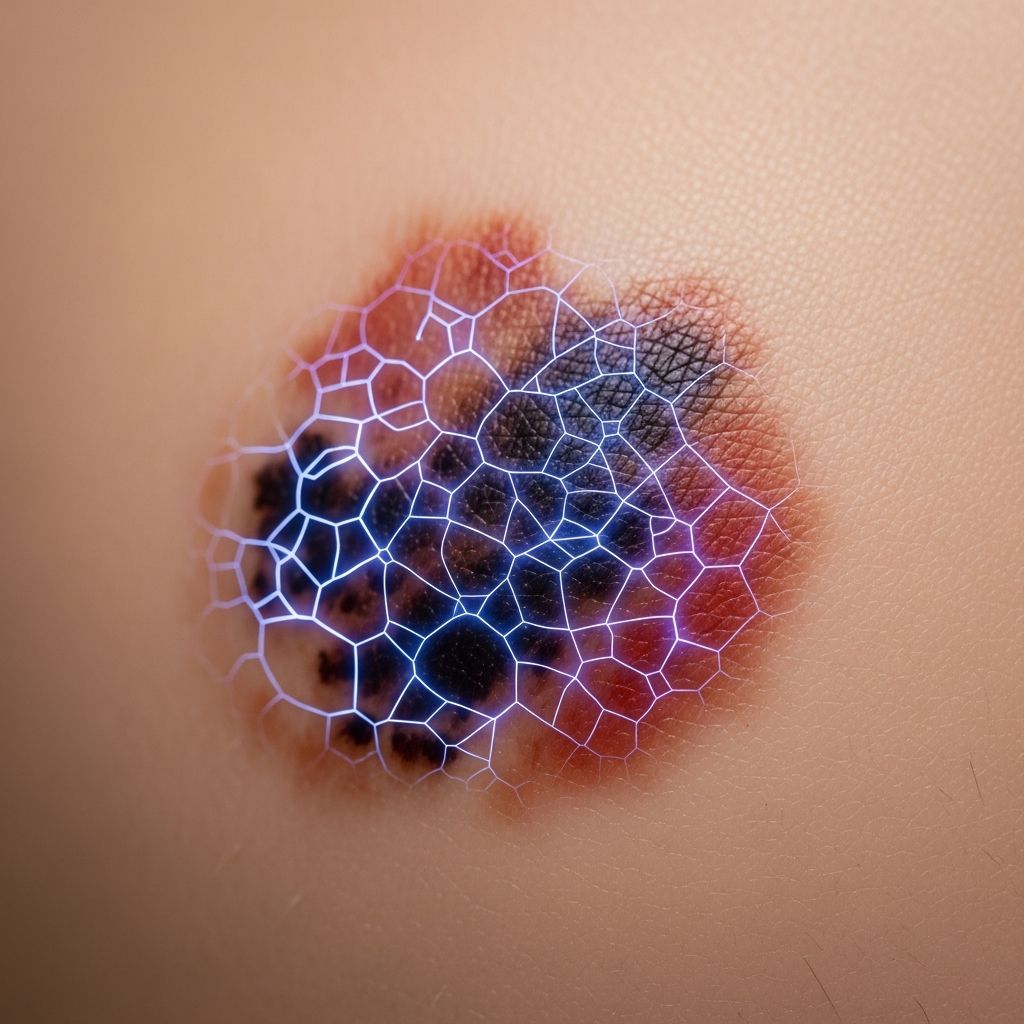
The negative pigment network, also referred to as the inverse network or reverse network, is a specific dermoscopic pattern characterized by relatively lighter areas that comprise the apparent grid structure, with relatively darker areas filling the apparent “holes.” This pattern represents the visual inversion of the traditional positive pigmented network commonly seen in benign melanocytic lesions.
The lighter grid lines in a negative network display a serpiginous (winding or snake-like) appearance, while the darker areas, when viewed in isolation, resemble elongated tubular or curved globules. This distinctive morphology creates a recognizable pattern that experienced dermoscopists can identify with relative consistency when examining skin lesions under magnification.
Dermoscopic Characteristics
The negative network exhibits several key dermoscopic features that distinguish it from other patterns:
- Serpiginous interconnecting hypopigmented lines that form the network grid
- Hyperpigmented, elongated to curvilinear globules that occupy the network holes
- Light and dark contrast that creates the characteristic inverse appearance
- Variable extension across the lesion surface
- Association with specific lesion morphologies and clinical presentations
Histopathological Basis
From a histopathological perspective, the negative network corresponds to specific microscopic structures within the skin. The pattern represents thin elongated hypomelanotic rete ridges accompanied by large nests of melanocytic cells located at the dermal papillae. The bridging of rete ridges creates the characteristic network appearance visible in dermoscopic examination.
The histological substrate underlying the negative network involves a widened papillary dermis with elongated rete ridges that encircle larger melanocytic nests. This architectural arrangement produces the distinctive visual pattern observed during dermoscopic analysis. The relationship between clinical dermoscopic findings and underlying histopathological structures validates the diagnostic utility of this feature.
Clinical Significance and Diagnostic Value
The negative pigment network carries substantial clinical weight in melanoma diagnosis. Research demonstrates that the negative network is highly specific for melanoma, with reported specificity reaching 95%, particularly when associated with melanoma arising within a pre-existing nevus. This high specificity makes it a valuable diagnostic indicator that clinicians should recognize and appropriately act upon.
Studies examining large cohorts of melanomas have documented the prevalence and patterns of negative networks in different melanoma subtypes. A comprehensive analysis of 401 consecutive melanomas revealed that negative pigment network of any extent was found in 27% of melanomas, most frequently identified in invasive melanomas arising from a nevus on the trunk of young subjects. This distribution provides important clinical context regarding which patient populations and lesion locations warrant heightened attention to this feature.
Related Stories



Negative Network and Melanoma Subtypes
The presence and extent of negative network varies among different melanoma presentations, offering additional diagnostic information:
- Melanoma In Situ (MIS): Circumscribed negative network extension typically limited to less than 20% of lesion area in 70% of cases
- Invasive Melanoma: Characterized by more extensive involvement, with 20-50% area involvement common in 35% of cases
- Extensive NPN Melanomas: Approximately 7% of melanomas show negative network presence in more than half of the lesion area, often without displaying typical dermoscopic melanoma features
The recognition of a distinct melanoma subtype characterized by extensive negative network has been proposed by researchers studying this feature. Lesions demonstrating extensive negative network often lack the conventional dermoscopic indicators of malignancy, making the negative network itself a critical diagnostic indicator in these cases.
Differential Diagnosis and Associated Lesions
While negative pigment network carries strong association with melanoma, this feature has been documented in other cutaneous entities that must be considered during differential diagnosis:
- Spitz naevi and Reed naevi
- Dysplastic naevi
- Dermatofibromas
- Other benign melanocytic lesions
In Spitz naevi, the negative network is characterized by a similar histopathological substrate to the chrysalis structure, featured by extensive fibrosis and dermal remodeling causing bi-refractivity under polarized dermoscopy. The distinction between negative network in melanoma versus benign lesions requires careful correlation of dermoscopic patterns with clinical presentation and, when necessary, histopathological examination.
Dermoscopic Examination Techniques
Proper dermoscopic technique is essential for accurate identification of negative network patterns. The fundamental principle of dermoscopy involves transillumination of a lesion with high magnification to visualize subtle features not apparent to naked eye examination. Several technical considerations enhance visualization of dermoscopic patterns:
Polarized Versus Non-Polarized Dermoscopy
Two primary dermoscopic approaches offer different advantages:
- Non-Polarized Dermoscopy: Requires direct contact with the skin using immersion fluid to enhance translucency and improve visibility of subsurface structures
- Polarized Non-Contact Dermoscopy: Allows examination without direct skin contact using polarized light to eliminate surface reflection and visualize vascular structures, particularly useful for lesions on nails or in sensitive areas
Application of immersion fluid over the skin enhances translucency by improving light transmission to reach deeper dermal structures. Smooth, oily skin naturally allows better light penetration compared to dry, scaly surfaces where most light is reflected.
Pattern Recognition and Diagnostic Accuracy
Accurate identification of negative network requires systematic pattern recognition and comparison with established diagnostic criteria. Expert dermoscopists evaluate lesions using standardized definitions to ensure consistent assessment:
- Assessment of network structure relative to expected pigmented network morphology
- Evaluation of the relationship between light and dark components
- Determination of negative network extension as a percentage of total lesion area
- Correlation with other dermoscopic features and clinical presentation
Integration with Dermoscopic Classification Systems
The negative network concept has been integrated into broader dermoscopic classification approaches that enable recognition of specific melanoma subpopulations. Classification into different melanoma subtypes based on dermoscopic appearance facilitates the recognition of melanoma presentations that may not be immediately recognizable according to established main dermoscopic patterns. This systematic approach improves diagnostic confidence and reduces missed melanomas.
Other important descriptors characterizing in situ and thin melanomas that often appear alongside negative network analysis include dermoscopic islands, reticular grey-blue regression, and peculiar network atypias. The integration of multiple features creates a comprehensive diagnostic framework.
Clinical Implications and Management Considerations
Recognition of negative network dermoscopic patterns carries important clinical implications. The primary goal of melanoma treatment involves surgical excision in early phases, making accurate dermoscopic diagnosis critical for optimizing patient outcomes. The high specificity of negative network for melanoma supports taking appropriate action when this feature is identified.
Clinicians should recognize that negative network presence, particularly when extensive or in the context of clinical suspicion, warrants serious consideration of melanoma and appropriate management including biopsy when indicated. The distinctive nature of this feature and its association with malignancy make it a key diagnostic anchor point in clinical decision-making.
Frequently Asked Questions
What is the negative pigment network in dermoscopy?
The negative pigment network is a dermoscopic pattern consisting of relatively lighter areas forming the network grid and darker areas filling the holes, representing the visual inversion of a typical pigmented network.
How specific is negative network for melanoma diagnosis?
The negative network is highly specific for melanoma, with reported specificity of approximately 95%, especially when associated with melanoma arising within a pre-existing nevus.
What is the histological basis of negative network appearance?
Histopathologically, negative network corresponds to thin elongated hypomelanotic rete ridges with large melanocytic nests within a widened papillary dermis or bridging of rete ridges.
Can negative network appear in benign skin lesions?
Yes, negative network can appear in other lesions including Spitz naevi, dysplastic naevi, and dermatofibromas, though it carries the highest association with melanoma.
How frequently does negative network appear in melanomas?
Negative pigment network of any extent is found in approximately 27% of melanomas, with more frequent occurrence in invasive melanomas arising from a nevus on the trunk of young subjects.
What is the significance of extensive negative network in a lesion?
Approximately 7% of melanomas demonstrate negative network in more than half of the lesion area, often without showing typical dermoscopic melanoma features, representing a distinct and potentially challenging melanoma subtype.
References
- Negative Pigment Network Identifies a Peculiar Melanoma Subtype and Represents a Clue to Melanoma Diagnosis: A Dermoscopic Study of 401 Melanomas — Acta Dermato-Venereologica. 2007. https://www.medicaljournals.se/acta/content/html/10.2340/00015555-1588
- Negative Network Dermoscopy: The Crucial Clue for Melanoma — Iboolo Medical Education. 2024. https://www.iboolo.com/blog/dermoscopy-of-negative-network/
- Negative Pigment Network — Dermoscopedia Educational Platform. 2024. https://dermoscopedia.org/Negative_Pigment_Network
- Pigment Network and Variants — Dermoscopedia Educational Platform. 2024. https://dermoscopedia.org/02-Pigment_Network
- Clinical, Dermoscopic and Reflectance Confocal Microscopy Features of Melanoma — National Center for Biotechnology Information. 2024. https://pmc.ncbi.nlm.nih.gov/articles/PMC12381913/
Similar Articles








Read full bio of Sneha Tete