Negative Pressure Wound Therapy: Complete Clinical Guide
Comprehensive guide to NPWT: mechanism, applications, techniques, and clinical benefits.
What is Negative Pressure Wound Therapy?
Negative pressure wound therapy (NPWT), also known as vacuum-assisted closure (VAC) or vacuum sealing technique, is a medical treatment that utilizes sub-atmospheric pressure applied to wound beds to promote healing and tissue regeneration. This therapy aims to optimize the physiological processes involved in wound healing by removing excess fluid, reducing bacterial load, and stimulating cellular activity. Over recent decades, NPWT has become a widely adopted wound management practice in clinical settings across the United States and internationally, with proven efficacy in reducing healing times for various wound types.
The therapy has evolved significantly since its inception and is now adapted not only for open wounds but also for closed surgical incisions and skin grafts, where it helps reduce edema, prevent dehiscence, and promote optimal healing outcomes.
How Does Negative Pressure Wound Therapy Work?
NPWT operates through several interconnected physiological mechanisms that collectively enhance the wound healing environment:
Fluid and Debris Removal
One of the primary mechanisms is the removal of excess exudate and inflammatory fluid from the wound bed. By decreasing pressure in the wound environment to sub-atmospheric levels, the therapy creates a vacuum effect that extracts accumulated fluid, bacteria, and necrotic tissue debris. This process reduces local edema and alleviates tissue compression, which helps restore microvascular circulation and improve blood perfusion to the affected area.
Microstrain and Cellular Stimulation
Negative pressure creates controlled tissue strain, known as microstrain, which stimulates cellular proliferation, migration, differentiation, and angiogenesis. The mechanical deformation induced by sub-atmospheric pressure triggers the release of vascular endothelial growth factors (VEGF) through localized hypoxia, promoting the formation of new blood vessels and enhancing vascularity of the wound bed. This increased vascular supply delivers essential oxygen and nutrients necessary for optimal tissue healing.
Osmotic and Oncotic Pressure Optimization
NPWT improves the overall wound-healing environment by creating favorable osmotic and oncotic pressure gradients. The removal of excess proteins and electrolytes through the drainage system helps maintain optimal conditions for granulation tissue formation and epithelial cell migration, facilitating the proliferative phase of wound healing.
NPWT System Components
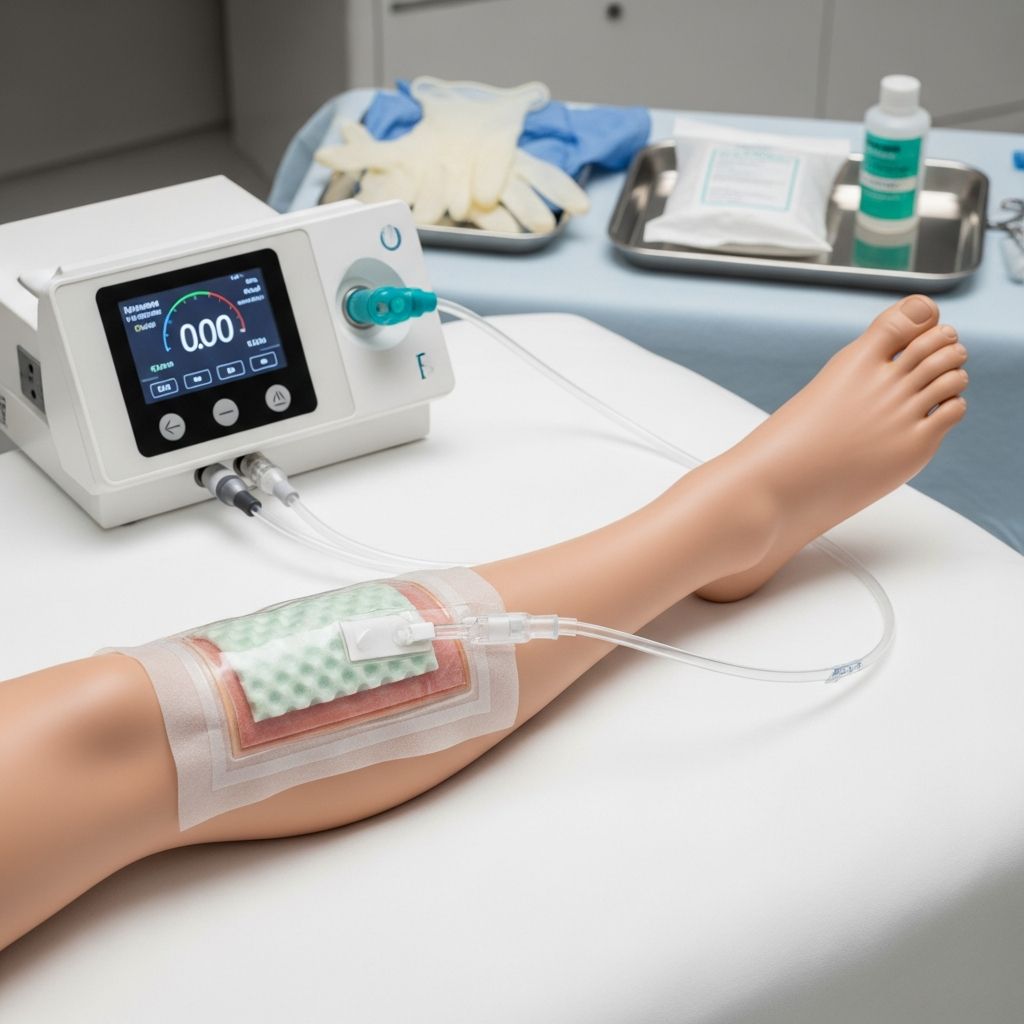
An integrated NPWT system consists of several essential components that work together to deliver therapy effectively:
- Open-cell foam dressing: Placed directly on or within the wound bed to distribute negative pressure evenly and absorb drainage.
- Adhesive dressing (film seal): Creates an airtight, watertight seal around the dressing to maintain sub-atmospheric pressure; this is the single most critical component for successful therapy delivery.
- Tubing and dome connector: Channels fluid and air from the wound to the collection canister through a dome (also called a “stingray”) that connects to the suction unit.
- Vacuum pump unit: Generates and maintains sub-atmospheric pressure, typically set at 125 mmHg below atmospheric pressure, though settings vary based on wound type and clinical goals.
- Drainage canister: Collects exudate and fluid removed from the wound, reducing the need for frequent dressing changes and allowing for convenient outpatient or home-based treatment.
Clinical Applications and Wound Types
NPWT has widespread clinical applications across multiple specialties, including vascular surgery, orthopedics, plastic surgery, dermatology, and tissue viability management. The therapy can effectively treat a diverse range of wound presentations:
Acute and Chronic Wounds
NPWT is effective for managing full- and partial-thickness acute and chronic wounds, including traumatic wounds, postoperative wounds, and dehisced surgical sites. The therapy is particularly well-suited for large cavity wounds with high exudate levels, though it can also be applied to wounds with mild or moderate drainage.
Pressure Ulcers
Once underlying pressure is effectively offloaded through repositioning and support surfaces, NPWT can significantly decrease wound size and manage the substantial exudate commonly present in pressure ulcers, particularly those located on the hips, sacrum, and buttocks. Continuous pressure of 125 mmHg is the standard setting for these wound locations.
Related Stories



Diabetic Foot Ulcers
Diabetic ulcers respond well to NPWT, especially when combined with appropriate offloading and vascular assessment to ensure adequate perfusion for healing.
Venous Leg Ulcers
NPWT can be incorporated into comprehensive management plans for venous insufficiency ulcers, supporting moist wound healing and reducing exudate burden.
Skin Grafts and Flaps
NPWT is frequently used as an adjunct in the clinical application of allografts, xenografts, and synthetic materials, facilitating outpatient treatment by stimulating tissue ingrowth, managing exudate, and maintaining graft immobility. Split- and full-thickness skin grafts benefit from the controlled environment and reduced movement that NPWT provides.
Burn Wounds
Localized full-thickness burn wounds may be treated with a combination of negative pressure therapy and grafting when adequate uninjured skin surrounds the wound perimeter to allow adhesive film application. Partial-thickness burns do not typically benefit from NPWT.
Surgical Incisions and Closed Wounds
In recent years, NPWT has been adapted for closed surgical incisions and primary intention wounds, aiming to reduce edema and seroma formation, prevent dehiscence in high-risk incision sites, and promote healing without requiring open dressing systems.
Advanced NPWT Technique: Instillation Therapy
An emergent and increasingly utilized adaptation of NPWT is therapy with fluid instillation (often designated as NPWT with instillation and dwell, or NPWTi-d). This technique involves the direct administration of saline or antibiotic-containing solutions into the wound bed, followed by a dwell period of ten to twenty minutes to allow solution distribution throughout the wound. Negative pressure is then applied at 125 mmHg for sustained periods of up to six hours, after which the instillation cycle repeats. This approach is particularly valuable for wounds that are colonized or infected, as it reduces wound bioburden and enhances the removal of necrotic tissue and slough.
NPWT Application Technique
Proper technique is essential for effective NPWT delivery. Healthcare professionals should follow these systematic steps:
Wound Preparation
Thorough assessment and preparation of the wound bed are prerequisites for successful NPWT. This includes addressing underlying and associated causes of the wound, debridement of infected or necrotic tissue (typically performed only at initial application unless further necrosis develops), and washout with copious volumes of sterile 0.9% sodium chloride. The wound should then be dried with sterile gauze and protected with a sterile, atraumatic, non-adhesive wound contact layer, with current practice favoring non-paraffinized, coated polyester net. Adequate nutritional status should be evaluated and optimized.
Positioning and Dressing Application
The patient should be positioned to suitably expose the wound site, with the area draped off for sterility. The appropriate NPWT foam is selected and fitted into the wound. For closed wounds, a specialized adhesive dressing is applied, with edges reinforced using wide strips of transparent adhesive sealant tape to create a firm, airtight seal—this is the single most essential component of NPWT application, as without an adequate seal, sub-atmospheric pressure cannot be achieved and therapy fails to deliver.
System Connection and Activation
A small hole is cut into the adhesive film, and the dome is aligned over this opening. Dressing tubing is then connected to the canister tubing to allow exudate drainage. The pump is activated, delivering continuous or intermittent negative pressure according to the treatment protocol. Healthcare professionals should take time when applying and removing dressings to minimize patient discomfort, and non-adherent fenestrated wound contact layers may help reduce pain during dressing changes.
Pressure Settings and Treatment Modes
NPWT can be delivered in several modes, each suited to different clinical scenarios. Continuous negative pressure is the most commonly used setting and is recommended over unstable structures to provide a splinting effect and improve stability. Intermittent mode allows the suction pump to cycle on and off, which some clinicians prefer for patient comfort. Dynamic or variable mode represents an emerging approach with potential benefits in specific wound presentations.
Clinical Benefits and Patient Outcomes
When performed correctly by trained healthcare professionals, NPWT is a high-yield, adjunctive therapy that results in improved wound healing and restoration of dermal integrity. The therapy offers multiple patient advantages: less frequent dressing changes allow for treatment in outpatient or home settings with ease, improving convenience and quality of life. Patients typically tolerate NPWT very well, and the system can be worn while remaining mobile, with the unit secured to the patient’s trouser belt or similar arrangement.
The type of wound involved determines the length of therapy and intended healing process, which can vary significantly between patients based on wound size, depth, tissue type, and patient factors.
Contraindications and Precautions
NPWT is not appropriate for all patients. Treatment should only be commenced following thorough wound assessment, and patients for whom NPWT is contraindicated should be identified and managed through alternative approaches. Contraindications typically include malignant wounds, untreated osteomyelitis in certain contexts, and wounds with exposed major blood vessels or organs without protective barriers. Extensive burn injuries where adequate skin surrounds the wound perimeter cannot be treated due to inability to create an adequate seal.
Common Questions About NPWT
Q: How often do dressing changes occur with NPWT?
A: NPWT typically requires dressing changes every 2-3 days, which is less frequent than traditional dressing changes for similar wound types. This frequency may vary based on exudate levels and clinical protocol.
Q: Can NPWT be used at home?
A: Yes, NPWT can be effectively delivered in outpatient and home settings with appropriate patient education and professional support, making it a convenient option for chronic wound management.
Q: Is NPWT painful?
A: Most patients tolerate NPWT well. Pain during dressing application or removal can be minimized by taking time during these procedures and using non-adherent fenestrated wound contact layers. If pain is significant, the negative pressure level can be reduced to an acceptable range.
Q: How long does NPWT therapy typically last?
A: Treatment duration varies significantly based on wound type, size, and patient factors. The treating clinician determines length of therapy based on healing progress and clinical goals.
Q: Can NPWT be combined with other treatments?
A: Yes, NPWT is often used as an adjunctive therapy alongside grafts, flaps, nutritional support, vascular interventions, and other wound management strategies for optimal outcomes.
Conclusion
Negative pressure wound therapy represents a significant advancement in wound management, offering evidence-based benefits for complex wounds across multiple clinical specialties. Through its multifaceted mechanisms—exudate removal, microstrain stimulation, and creation of an optimal healing environment—NPWT accelerates tissue regeneration and improves patient outcomes. With proper patient selection, meticulous wound preparation, and correct application technique, NPWT remains a valuable tool in the modern clinician’s wound care armamentarium.
References
- Negative Pressure Wound Therapy — National Center for Biotechnology Information (NCBI). 2024. https://www.ncbi.nlm.nih.gov/books/NBK576388/
- The Patients Guide to Negative Pressure Wound Therapy — Lincare. 2025. https://www.lincare.com/resources/Lincare-Learning-Center/the-patients-guide-to-negative-pressure-wound-therapy
- Negative Pressure Wound Therapy – A Detailed Guide — Vohara Wound Care. 2025. https://vohrawoundcare.com/negative-pressure-wound-therapy/
- Ten Top Tips: Using Negative Pressure Wound Therapy Effectively — Wounds International. 2023. https://woundsinternational.com/wp-content/uploads/2023/02/content_11310.pdf
- Negative Pressure Wound Therapy: Guideline — Canadian Lymphedema Framework (CLWK). 2024. https://www.clwk.ca/get-resource/negative-pressure-wound-therapy-reusable-disposable-guideline/
- Guide to Negative Pressure Wound Therapy (NPWT) — Nursing Center. 2025. https://www.nursingcenter.com/getattachment/clinical-resources/nursing-pocket-cards/Guide-to-Negative-Pressure-Wound-Therapy-(NPWT)/Pocket-Card_Guide-to-Negative-Pressure-Wound-Therapy_January-2025.pdf.aspx
- Negative Pressure Wound Therapy — Centers for Medicare & Medicaid Services (CMS). 2025. https://www.cms.gov/training-education/medicare-learning-networkr-mln/compliance/medicare-provider-compliance-tips/negative-pressure-wound-therapy
Similar Articles








Read full bio of Sneha Tete