Nervous System: What It Is, Parts, Function & Disorders
Your body's command center: Understanding the nervous system, its parts, and how it works.
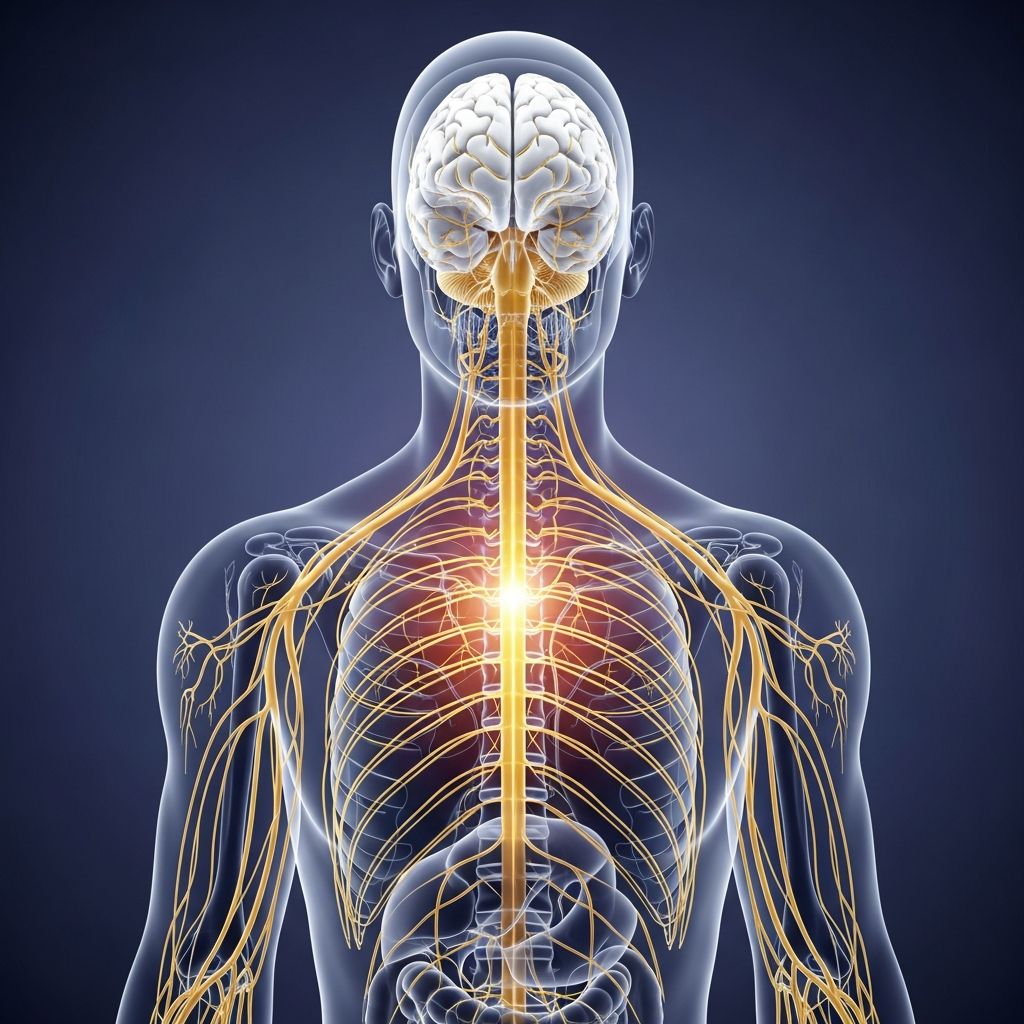
Your nervous system is your body’s command center. It’s made up of your brain, spinal cord and nerves. Your nervous system works by sending messages, or electrical signals, between your brain and all the other parts of your body. These signals tell you to breathe, move, speak and see, for example. Your nervous system keeps track of what’s going on inside and outside of your body and decides how to respond to any situation you’re in.
What Does the Nervous System Do?
Your nervous system’s main function is to send messages from various parts of your body to your brain, and from your brain back out to your body to tell your body what to do. These messages regulate your:
- Thoughts and emotions
- Movement and motor responses
- Sensory perception (sight, smell, taste, touch, hearing)
- Heart rate and breathing
- Digestion and metabolism
- Body temperature and other homeostatic functions
- Sleep and wake cycles
Your nervous system uses nerve cells called neurons to send signals, or messages, all over your body. These electrical signals travel among your brain, skin, organs, glands and muscles.
How the Nervous System Works
Think of your nervous system as a complex communication network. When you experience something—whether it’s a sensation, a thought, or a stimulus from your environment—your sensory neurons detect this information and send electrical signals to your brain. Your brain processes this information, interprets it, and then sends signals back out through your motor neurons to produce a response. This entire process happens in milliseconds, allowing you to react quickly to your environment.
The process works by sending messages through your nervous system. Your brain creates a message. It sends that message (signal) to your spinal cord. Your spinal cord sends the message to your nerves (peripheral nervous system) to complete an action. Signals travel to and from your brain and spinal cord to the rest of your body constantly to keep your body functioning.
Parts of the Nervous System
The nervous system has two main parts:
Central Nervous System (CNS)
Your central nervous system (CNS) is a processing center that manages everything that your body does, from your thoughts and feelings to your movements. Your brain and spinal cord are “central” to your CNS because they take in and send out information to your entire body.
Brain: Your brain is the command center of your entire nervous system. It regulates your thoughts, feelings and movements. It manages the things you do, like bending your fingers, learning and communicating. It also manages how your organs function by telling you to breathe and digest food. Your brain contains approximately 100 billion neurons that process information and coordinate your body’s responses.
Spinal Cord: Your spinal cord is a long bundle of nerves that extends from the base of your brain down through your vertebral column. It serves as the main highway for signals traveling between your brain and the rest of your body. Your spinal cord can also process certain reflexive responses without sending information all the way to your brain, allowing for faster reactions in emergency situations.
Related Stories



Peripheral Nervous System (PNS)
Your peripheral nervous system consists of all the nerves that branch out from your central nervous system to reach every other part of your body. Think of your nervous system as a tree: your central nervous system is the trunk of the tree that contains your brain and spinal cord. The tree branches are your peripheral nervous system (nerves). The branches extend from the trunk (brain and spinal cord) to reach all parts of your body.
There are two parts to your peripheral nervous system:
Somatic Nervous System
The somatic nervous system controls voluntary movements and carries sensory information from your skin, muscles and joints. It’s responsible for actions you consciously control, like walking, writing or lifting an object. This system also processes sensations like pain, temperature and touch.
Autonomic Nervous System
The autonomic nervous system controls involuntary processes—things that happen without you thinking about them. These include breathing, heart rate, digestion, and blood pressure regulation. This system operates automatically, even when you’re asleep, and is crucial for your survival.
The Autonomic Nervous System Divisions
The autonomic nervous system is further divided into three distinct divisions, each with specific roles:
Sympathetic Nervous System (SNS)
Your sympathetic nervous system is a network of nerves that helps your body activate its “fight-or-flight” response. This system’s activity increases when you’re stressed, in danger or physically active. Its effects include increasing your heart rate and breathing ability, improving your eyesight and slowing down processes like digestion.
Most of the signals that your sympathetic nervous system sends start in your spinal cord. The signals leave your spinal cord and activate structures called ganglia. Your sympathetic ganglia then send the necessary signals far and wide to different parts of your body. This could include your heart, lungs, arteries, sweat glands and digestive system.
Parasympathetic Nervous System (PSNS)
Your parasympathetic nervous system is a network of nerves that relaxes your body after periods of stress or danger. Your sympathetic and parasympathetic nervous systems have opposite but complementary roles. Your sympathetic nervous system carries signals that put your body’s systems on alert, and your parasympathetic carries signals that return those systems to their standard activity levels.
Your parasympathetic nervous system uses four of your 12 cranial nerves. These are nerves that connect directly to your brain. The fourth, your vagus nerve, connects to part of your mouth and also extends down through your neck to your chest and abdomen (belly). Your vagus nerve makes up about 75% of your parasympathetic nervous system overall, connecting to your heart, lungs and other vital internal organs.
Enteric Nervous System
The enteric nervous system is a network of neurons embedded in the gastrointestinal tract. Sometimes called the “second brain,” this system manages digestive processes and intestinal function. It can operate independently of the central nervous system to control digestion and nutrient absorption.
Neurons: The Basic Units of the Nervous System
Nerve cells (neurons) are the basis of your nervous system. There are 100 billion neurons in your brain. These cells connect throughout your entire body. Neurons are specialized cells designed to generate, receive and transmit electrical signals throughout the nervous system.
Each neuron consists of a cell body, dendrites (which receive signals from other neurons), and an axon (which sends signals to other neurons). When a neuron receives a signal, it generates an electrical impulse that travels along the axon to the axon terminals, where it may trigger the release of neurotransmitters—chemical messengers that communicate with other neurons or target cells.
There are three main types of neurons:
- Sensory neurons: Carry information from your sensory receptors to your central nervous system
- Motor neurons: Transmit signals from your central nervous system to your muscles and glands
- Interneurons: Connect sensory and motor neurons and are found primarily in the brain and spinal cord
The Three Main Functions of Your Central Nervous System
Your central nervous system performs three critical functions that keep your body functioning:
Sensory Input
Your CNS receives sensory information from throughout your body and the environment. Sensory neurons collect data about temperature, pressure, pain, light, sound and chemical signals. This information is continuously transmitted to your brain and spinal cord for processing.
Integration
Your brain and spinal cord process and interpret the sensory information they receive. This is where your thoughts, emotions and conscious decisions are formed. Your brain compares new information with memories and learned experiences to determine the appropriate response.
Motor Output
After your brain gets and understands the data collected by your sensory neurons (nerve cells), it sends an electrical signal through your spinal cord to your muscles and glands to create a motor output. An example of this process is wanting to walk across the room. Your brain sends a signal through your spinal cord to the muscles in your legs. Your muscles react to this signal and allow you to complete the action (motor output) of walking.
Cranial Nerves
Your cranial nerves are a set of 12 nerves that send electrical signals between your brain and different parts of your head, face, neck and torso. You have 12 cranial nerve pairs. Each nerve pair splits to serve the two sides of your brain and body.
Your cranial nerves play a role in relaying sensory and/or movement (motor) information. Two of your cranial nerve pairs — your olfactory and optic nerves — begin in your cerebrum and branch out to their target tissues. The cerebrum is the largest portion of your brain that sits above your brainstem. The other 10 pairs of cranial nerves start in your brainstem and then branch out. Your brainstem connects your brain and spinal cord.
The longest cranial nerve is your vagus nerve. It runs from your brain to your large intestine, innervating several tissues along the way.
Nervous System Disorders
The nervous system can be affected by various conditions and injuries. When a nerve experiences damage, it doesn’t function as it should. This may cause specific movement or sensory issues, depending on its underlying function. Several conditions and situations can affect the functioning of your nervous system:
- Neurodegenerative diseases (Alzheimer’s disease, Parkinson’s disease, ALS)
- Stroke or cerebrovascular accidents
- Spinal cord injuries
- Peripheral neuropathy
- Multiple sclerosis
- Epilepsy and seizure disorders
- Traumatic brain injuries
- Nerve compression syndromes
- Infections affecting the nervous system (meningitis, encephalitis)
- Autoimmune disorders affecting nerves
Frequently Asked Questions (FAQs)
Q: How fast do nerve signals travel?
A: Nerve signals travel at different speeds depending on the type of neuron and whether the axon is myelinated. Some signals travel up to 120 meters per second, while others travel much more slowly. This variation allows your body to process different types of information at appropriate speeds.
Q: Can the nervous system repair itself?
A: Some parts of the nervous system can repair themselves through a process called neuroplasticity, where the brain can reorganize and create new neural connections. However, damage to certain parts of the spinal cord or brain may be permanent. Recovery depends on the severity of the injury and the location of the damage.
Q: What’s the difference between the central and peripheral nervous systems?
A: The central nervous system (brain and spinal cord) processes information and makes decisions, while the peripheral nervous system (nerves extending throughout the body) carries signals between the CNS and the rest of the body.
Q: How does the sympathetic nervous system differ from the parasympathetic?
A: The sympathetic nervous system prepares your body for action (fight-or-flight), increasing heart rate and alertness. The parasympathetic nervous system promotes relaxation and recovery (rest-and-digest), slowing heart rate and promoting digestion.
Q: What are neurotransmitters?
A: Neurotransmitters are chemical messengers released by neurons that transmit signals across synapses (the gaps between neurons) to other neurons or target cells. Examples include dopamine, serotonin, acetylcholine, and GABA.
References
- Central Nervous System (CNS): What It Is & Function — Cleveland Clinic. 2024. https://my.clevelandclinic.org/health/body/central-nervous-system-cns
- Nervous System: What It Is, Parts, Function & Disorders — Cleveland Clinic. 2024. https://my.clevelandclinic.org/health/body/21202-nervous-system
- Sympathetic Nervous System (SNS): What It Is & Function — Cleveland Clinic. 2024. https://my.clevelandclinic.org/health/body/23262-sympathetic-nervous-system-sns-fight-or-flight
- Parasympathetic Nervous System (PSNS): What It Is & Function — Cleveland Clinic. 2024. https://my.clevelandclinic.org/health/body/23266-parasympathetic-nervous-system-psns
- Cranial Nerves: Function, Anatomy & Location — Cleveland Clinic. 2024. https://my.clevelandclinic.org/health/body/21998-cranial-nerves
- Autonomic Nervous System: What It Is, Function & Disorders — Cleveland Clinic. 2024. https://my.clevelandclinic.org/health/body/23273-autonomic-nervous-system
- Nerves: Types, Function & Anatomy — Cleveland Clinic. 2024. https://my.clevelandclinic.org/health/body/22584-nerves
Similar Articles








Read full bio of medha deb