Neurothekeoma Pathology: 2 Types, Diagnosis, And Management
Comprehensive pathology guide to neurothekeoma: myxoid and cellular variants, histology, diagnosis, and management.
Authoritative facts about the pathology of neurothekeoma from DermNet New Zealand.
Introduction
Neurothekeoma is a rare benign cutaneous neoplasm primarily affecting the skin and subcutaneous tissue. It is histologically divided into two main types:
myxoid
andcellular
, which may represent distinct entities despite sharing the name. The myxoid variant, also known as dermal nerve sheath myxoma, is considered of neural origin, while the cellular variant shows fibrohistiocytic features and lacks neural markers. These tumors typically present as solitary nodules in young patients, predominantly females, on the face, head, neck, or upper extremities.Understanding neurothekeoma pathology is crucial for accurate diagnosis, as it can mimic other myxoid or spindled cell proliferations. Complete surgical excision is curative, with low recurrence rates.
Terminology
Neurothekeoma was first described by Gallagher and Helwig in 1980, named to reflect presumed nerve sheath origin. However, subsequent studies revealed that the cellular variant lacks neural differentiation, leading to debate on whether myxoid and cellular types are related. The myxoid type aligns with nerve sheath myxoma (NSM), first reported by Harkin and Reed, while cellular neurothekeoma (described by Barnhill in 1990) is S100-negative and may derive from fibrohistiocytic cells.
- Myxoid neurothekeoma: Neural origin, S100-positive, resembles NSM.
- Cellular neurothekeoma: Non-neural, S100-negative, epithelioid/spindled cells.
- Intermediate/mixed variants exist but are less common.
Clinical features
Neurothekeomas present as solitary, dome-shaped papules or nodules, typically <2 cm in diameter (range 0.5-3 cm). They are skin-colored, pink, tan, or reddish-brown, often asymptomatic but may be tender on pressure. Growth is slow, with superficial dermal location; rare subcutaneous or muscle involvement.
| Feature | Details |
|---|---|
| Age | Peak in 2nd-3rd decade (10-30 years); any age possible. |
| Sex | Female predominance (M:F ≈1:2). |
| Sites | Face/head/neck (most common), upper extremities, shoulder; rare mucosal. |
| Size | <3 cm, usually <1-2 cm. |
| Behavior | Benign; rare atypia or recurrence post-excision. |
Larger lesions (>1 cm), ulceration, or deep invasion raise concern for atypical features, though metastasis is undocumented.
Histology of cellular neurothekeoma
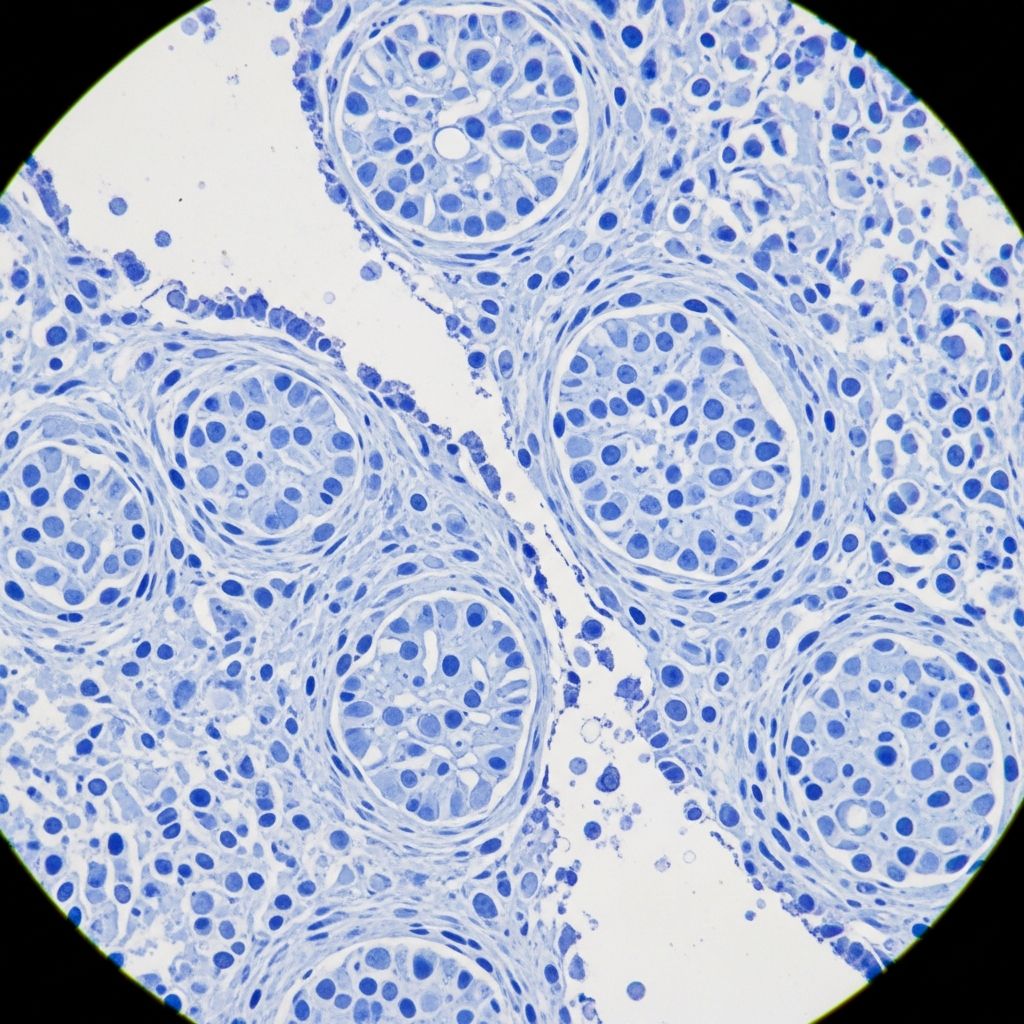
The cellular subtype features a well-circumscribed proliferation of spindled and epithelioid cells arranged in lobules and fascicles within the dermis. Sclerotic collagen bundles separate lobules, creating a lobulated architecture (figures 1-3). Cells have pale cytoplasm, oval/elongated nuclei with fine chromatin, inconspicuous nucleoli, and occasional mitoses (up to 5-10/10 HPF). Multinucleated or binucleated giant cells may intermingle.
Myxoid stroma is scant or absent, distinguishing it from the myxoid variant. Extension into superficial subcutis is possible but papillary dermis is spared. No necrosis or significant atypia in typical cases.
- Key features: Nested epithelioid cells, fibrous septa, pale nuclei, mild myxoid change in some.
- Atypical findings: Increased mitoses, nuclear pleomorphism (benign behavior despite appearances).
Histology of myxoid neurothekeoma
Myxoid neurothekeoma displays lobules of stellate/spindle cells in abundant myxoid stroma, separated by thin fibrovascular septae. Cells have delicate processes, pale cytoplasm, and elongated/angulated nuclei with uniform chromatin. Larger epithelioid cells with eosinophilic cytoplasm may appear. Mast cells, lymphocytes, and plasma cells are scattered. Mitotic figures are rare; no abnormal forms.
The pattern is lamellar/concentric, mimicking pacinian corpuscles. Tumor is unencapsulated but well-defined, dermal-based with minimal subcutis involvement.
Immunohistochemistry
Immunoprofile distinguishes variants and aids differential diagnosis.
Related Stories



| Marker | Cellular Variant | Myxoid Variant |
|---|---|---|
| S100 | Negative | Positive (diffuse) |
| GFAP | Variable/focal | Positive |
| NKI/C3 | Positive | Negative |
| PGP9.5 | Positive | Variable |
| CD57 | Variable | Positive |
| SMA | Focal positive | Negative |
| Others | Vimentin+, Collagen IV+, EMA (perilobular) | Vimentin+, NGF-R+ |
Cellular type: Fibrohistiocytic profile (PGP9.5+, NKI/C3+). Myxoid: Neural (S100+, GFAP+).
Differential diagnosis
- Schwannoma: Myxoid type resembles; lacks Verocay bodies, Antoni A/B patterns; S100+ but organized architecture.
- Melanocytic tumour: Nested cellular pattern mimics Spitz naevus/melanoma; cellular neurothekeoma S100-, melanocytic S100+.
- Dermal myxoma: Hypocellular, abundant mucin, no lobules.
- Myxoid neurofibroma: S100+, collagen bundles, no sharp lobulation.
- Superficial angiomyxoma: Ill-defined, epithelial inclusions, prominent vessels.
- Epithelioid fibrous histiocytoma: Superficial, CD68+, less lobulated.
Melanoma-like atypia in cellular neurothekeoma can alarm, but IHC and context confirm benignity.
Management
Complete surgical excision with clear margins is the treatment of choice. Recurrence is rare (<5%) if fully excised, even with atypical features. No malignant potential reported; conservative excision for small lesions. Mohs micrographic surgery may be considered for facial sites.
Prognosis
Excellent; benign neoplasm with indolent behavior. Atypical features (size >1 cm, mitoses >5/10 HPF, deep invasion) warrant close follow-up but metastasis unproven.
Frequently asked questions
Q: Is neurothekeoma malignant?
A: No, both variants are benign despite occasional atypia in cellular type.
Q: How is cellular neurothekeoma distinguished from melanoma?
A: S100 negativity, PGP9.5 positivity, lobulated growth with fibrous septa.
Q: What is the origin of cellular neurothekeoma?
A: Likely fibrohistiocytic, not neural (unlike myxoid type).
Q: Does neurothekeoma recur?
A: Rarely if completely excised; monitor atypical cases.
Q: Preferred treatment?
A: Surgical excision; no role for adjuvant therapy.
References
- Final Diagnosis — Neurothekeoma — UPMC Pathology. 2023. https://path.upmc.edu/cases/case586/dx.html
- Neurothekeoma — Wikipedia (citing primary sources). 2024-01-15. https://en.wikipedia.org/wiki/Neurothekeoma
- Neurothekeoma pathology — DermNet NZ. 2024. https://dermnetnz.org/topics/neurothekeoma-pathology
- Neurothekeoma — StatPearls, NCBI Bookshelf (NIH). 2023-07-17. https://www.ncbi.nlm.nih.gov/sites/books/NBK519525/
- Cellular neurothekeoma (Pathology Video Excerpt) — YouTube/KiKo Healthcare (peer pathology education). 2023. https://www.youtube.com/watch?v=s-tGQ6R1Fsw
Similar Articles








Read full bio of medha deb