Nevus Sebaceous: Guide To Diagnosis, Treatment, And Risks
Comprehensive guide to nevus sebaceous: congenital birthmark, clinical features, risks, and management strategies.
A
nevus sebaceous
(also known as sebaceous naevus, naevus sebaceous of Jadassohn, or organoid naevus) is a common congenital birthmark characterized by overgrown epidermis, sebaceous glands, hair follicles, apocrine glands, and connective tissue. It affects approximately 0.3% of live births and is most frequently located on the scalp.Introduction
Nevus sebaceous represents a type of epidermal naevus classified as a benign hair follicle tumour due to its organoid nature, incorporating multiple skin components. First described in 1895 by Jadassohn, contemporary research has advanced our understanding through genetic insights. While typically isolated, it associates with rare congenital syndromes like epidermal nevus syndrome and Schimmelpenning-Feuerstein-Mims (SFM) syndrome, also termed linear nevus sebaceous syndrome (LNSS). It is not inherited but arises sporadically.
These lesions manifest as hairless patches at birth, evolving during puberty into thicker, warty plaques due to hormonal influences on sebaceous elements. Although benign, vigilance is required for potential secondary neoplasms, primarily in adulthood.
Demographics
Nevus sebaceous occurs equally across males and females, with no racial or ethnic predilection—all skin phototypes are equally affected. The prevalence stands at 0.3% of newborns, underscoring its commonality among congenital skin lesions. Most are solitary, though rare multiple occurrences link to syndromic presentations.
In darker skin types, diagnostic challenges may arise, as basal cell carcinoma can mimic features, necessitating careful evaluation.
Causes
The etiology stems from a postzygotic mosaic genetic mutation in the ectoderm—the embryonic layer forming epidermis and neural tissue. Specifically, mutations in the
RAS/MAP kinase pathway
disrupt cellular growth, differentiation, and apoptosis. Implicated genes include HRAS, KRAS, and FGFR2, leading to clonal proliferation of affected cells.Unlike germline mutations, this mosaicism explains the localized nature without familial inheritance. Embryologically, it involves disorganized pilosebaceous-apocrine units, resulting in a hamartoma—malformed normal tissue.
Clinical Features
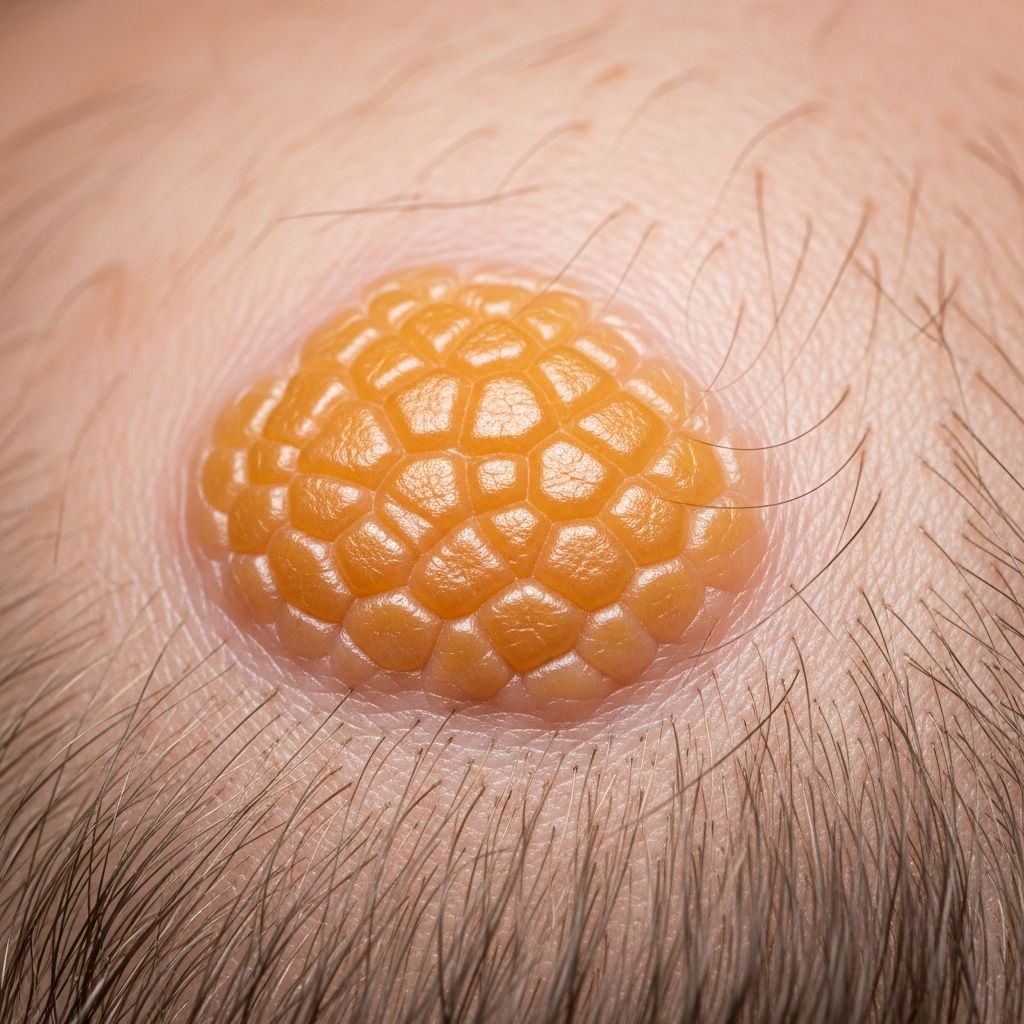
At birth, nevus sebaceous appears as a well-defined, hairless, yellowish-orange or pink plaque, often linear along Blaschko’s lines on the scalp, face, or neck. It measures 1–6 cm, with a velvety or slightly raised surface.
During childhood, it remains stable and quiescent. Puberty triggers transformation: androgen stimulation matures sebaceous glands, causing yellow thickening, verrucous (warty) surface, and papillomatous projections. The lesion enlarges proportionally, developing a pebbly or cerebriform texture.
- Infantile phase: Pale-yellow, smooth, alopecic (hairless) patch.
- Pubertal/adult phase: Orange-yellow, elevated, scaly, nodular plaque with prominent sebaceous lobules.
Images depict characteristic yellow globules, background erythema, and evolution to warty plaques over decades. Rare sites include trunk or limbs.
Variation in Skin Types
All skin phototypes exhibit similar presentations, though subtle differences occur. In lighter skin, the orange-yellow hue dominates; in darker types, erythema may be less visible, with hyperpigmentation possible. Misdiagnosis of basal cell carcinoma as nevus sebaceous is more reported in darker phototypes, highlighting biopsy needs.
Phakomatosis pigmentokeratotica (PPK) combines nevus sebaceous with speckled lentiginous naevus—a flat, light-brown patch with darker speckles—both sharing RAS mutations.
Complications
Benign secondary tumours develop in 15–20% of cases, including trichoblastoma, syringocystadenoma papilliferum, and apocrine hidrocystoma. Malignant transformation is rare (0.3–1% overall), occurring almost exclusively post-puberty, with
basal cell carcinoma
(50%),squamous cell carcinoma
(25%), and others comprising the rest.Related Stories



Case series of nearly 1,300 lesions confirm 15% neoplastic change: 80% benign, 20% malignant. Risks rise with age; childhood changes warrant urgent biopsy. Syndromic associations involve ocular, neurological, or skeletal anomalies in extensive cases.
| Tumour Type | Frequency | Benign/Malignant |
|---|---|---|
| Trichoblastoma | Common | Benign |
| Syringocystadenoma | Common | Benign |
| Basal Cell Carcinoma | 50% of malignancies | Malignant |
| Squamous Cell Carcinoma | 25% of malignancies | Malignant |
Diagnosis
Clinical recognition suffices for typical lesions. Histopathology confirms: childhood biopsies reveal immature pilosebaceous units in acanthotic epidermis; adult specimens show hyperkeratosis, prominent dermal sebaceous glands, and mature follicles. Secondary tumours appear as dermal nodules.
Dermoscopy highlights yellow globules and erythema. Changes like ulceration, nodularity, or bleeding prompt biopsy to exclude malignancy.
Differential Diagnosis
Overlaps exist with other epidermal naevi:
- Apocrine naevus: More cystic.
- Verrucous epidermal naevus: Lacks sebaceous prominence.
- Basal cell carcinoma: Especially in adults; irregular borders.
- Naevus anaemicus: Pale macule without sebaceous features.
RAS mutations link several, complicating distinction.
Treatment
Observation is standard for uncomplicated lesions. Biopsy any childhood changes or adult nodules/ulcers. Elective full-thickness excision is recommended post-puberty for prophylaxis, cosmetics, or symptoms, yielding curative results with inevitable linear scarring.
Superficial therapies (shave excision, dermabrasion, CO2 laser) recur due to incomplete removal. Emerging topical
1% sirolimus
flattens 80% of lesions non-invasively. Lasers offer variable cosmetic improvement but not cure.For syndromic or extensive naevi, multidisciplinary input is essential. UK surveys show varied practices: dermatologists (30%) favour prophylactic excision; plastic surgeons prefer observation.
Outcome
Prognosis excels with monitoring: malignancies are locally invasive but rarely metastasize if excised timely. Reassurance emphasizes low risk and effective intervention. Post-excision, scarring is the main sequela; cosmetics improve quality of life.
Long-term studies affirm stability in most, with excision balancing minimal malignancy risk against surgical morbidity.
Frequently Asked Questions (FAQs)
Q: Is nevus sebaceous cancerous?
A: Benign at birth, but 0.3–1% develop secondary malignancies like basal cell carcinoma in adulthood. Monitor for changes.
Q: When should nevus sebaceous be removed?
A: Post-puberty electively, or sooner if changing. Observation suffices if stable.
Q: Does it affect hair growth?
A: Yes, lesions are hairless due to immature follicles.
Q: Can lasers cure it?
A: No, they improve appearance superficially but do not eradicate deeper components.
Q: Is it hereditary?
A: No, caused by postzygotic mosaicism.
Q: What syndromes associate with it?
A: Schimmelpenning-Feuerstein-Mims syndrome with ocular, neurological involvement.
References
- Nevus Sebaceous (Sebaceous naevus) — DermNet NZ. 2023. https://dermnetnz.org/topics/sebaceous-naevus
- Sebaceous Naevus: Symptoms and Treatment — Patient.info. 2024. https://patient.info/doctor/dermatology/sebaceous-naevus
- A pale macule and a waxy pink lesion in a child — Royal Australian College of General Practitioners (RACGP). 2016-09-01. https://www.racgp.org.au/afp/2016/september/a-pale-macule-and-a-waxy-pink-lesion-in-a-child-wi
- Naevus Sebaceous Images — DermNet NZ. 2023. https://dermnetnz.org/images/naevus-sebaceous-images
- Nevus Sebaceous: A Case Study — PubMed Central (PMC). 2024. https://pmc.ncbi.nlm.nih.gov/articles/PMC11808742/
- Linear Nevus Sebaceous Syndrome (LNSS) — News-Medical.net. 2023. https://www.news-medical.net/health/Linear-Nevus-Sebaceous-Syndrome-(LNSS)-Schimmelpenning-Syndrome.aspx
Similar Articles








Read full bio of Sneha Tete