Newborn Hearing Test: 2 Screening Tests Explained
Essential guide to newborn hearing screening: why it's vital, how it's done, and next steps for parents.
The
newborn hearing test
(also called the newborn hearing screen or screening test) is offered to all babies born in England, Scotland and Wales before they are 4 weeks old. It’s a quick, simple and painless test that checks your baby’s hearing.Why is the newborn hearing test important?
Hearing loss is the most common condition present at birth. One to three babies in every 1,000 will have a hearing loss significant enough to need action. Early detection is crucial because hearing is vital for a child’s speech, language, communication skills and educational development. Babies born with a hearing loss that is not detected until later may have problems learning to speak, read and write.
If a hearing loss is picked up early, treatment and support can start straightaway. Babies who receive early intervention have better language skills and are more likely to reach their potential at school. The test identifies babies who may have a hearing loss so they can be referred quickly for further tests and, if needed, treatment.
When is the newborn hearing test offered?
The test is offered to all babies shortly after birth, ideally before you go home from hospital. If your baby is born outside hospital, or if the test wasn’t done before you left, you will be offered an appointment for the test to be done within the first 4 weeks of your baby’s life.
In the well-baby nursery, screening occurs close to hospital discharge, allowing time for a repeat if needed. For NICU babies, screening happens when medically stable, often at discharge.
Who does the newborn hearing test?
The test is done by a specially trained newborn hearing screener, who may be a health visitor, midwife, nurse or screening technician. They are trained to carry out the test and give you the results.
How is the newborn hearing test done?
There are two types of screening test used:
automated otoacoustic emissions (AOAE)
andautomated auditory brainstem response (AABR)
. Your baby will have one or both of these tests.Automated otoacoustic emissions (AOAE)
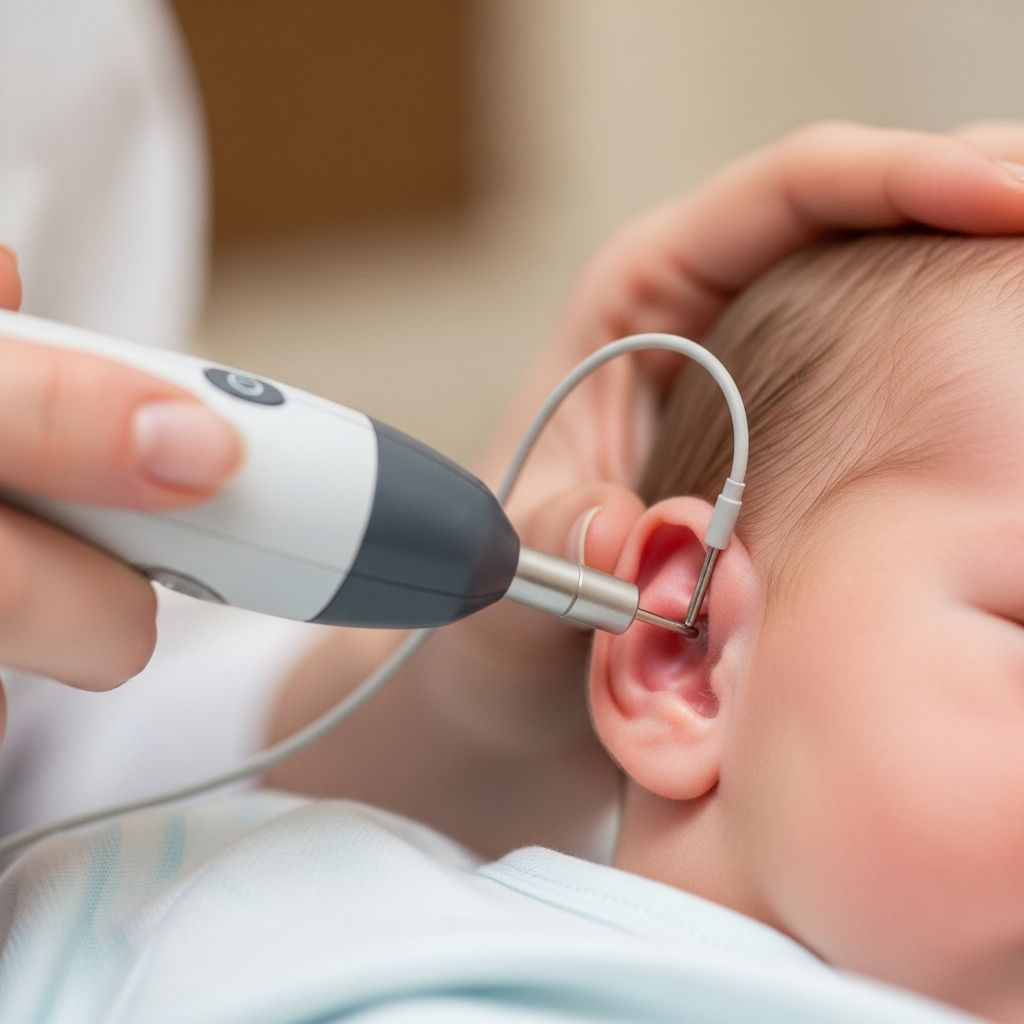
A tiny, soft-tipped earpiece is placed in your baby’s ear. It plays quiet sounds and measures the echoes produced in response from your baby’s inner ear (cochlea). The test takes a few minutes and is done while your baby is settled or asleep. It does not measure how well sound travels through the ear to the hearing nerve.
AOAE measures responses from the cochlea. A small earbud with microphone and earphone plays sounds; normal hearing produces an echo measured by the microphone. Significant hearing loss shows no or reduced echo.
Automated auditory brainstem response (AABR)
Soft earphones are placed over your baby’s ears and three small sensors (electrodes) are placed on their head (forehead and behind each ear). Quiet sounds are played through the earphones and the sensors measure the reactions of the hearing nerves and brain. This test measures how well sound travels through the ear to the hearing nerve and on to the brain. It takes around 10 minutes and your baby needs to be settled or asleep.
Related Stories



AABR uses electrodes on the head and earphones to play clicks/tones. It measures responses from cochlea through auditory brainstem to brain, detecting neural responses even in cases like auditory neuropathy.
What happens during the newborn hearing test?
Your baby will be settled, feeding or asleep during the test. The screener will check your baby’s ears are clear of fluid or wax. For AOAE, the earpiece is inserted gently. For AABR, sensors are attached securely. The room should be quiet. The machine gives a
’pass’
or’refer’
result automatically. Both ears are tested separately.- Ears screened one at a time, baby on side with test ear up.
- Visual inspection of outer ear.
- Quiet environment; baby sleeping or still.
- Pass requires both ears to pass in one session.
Newborn hearing test results
Results are
’pass’
or’refer’
. Aclear pass
means your baby has normal hearing at the frequencies important for speech. Arefer
means a further appointment is needed – it does not mean your baby has a hearing loss.| Result | Meaning | Next Steps |
|---|---|---|
| Pass | Normal hearing detected | No further action needed unless risk factors |
| Refer | Did not pass; possible issues | Rescreen or diagnostic evaluation |
Refer rates: OAEs ~10%, AABR ~3-5%. False positives common due to vernix, fluid.
What happens if my baby does not pass the newborn hearing test (refer)?
If your baby gets a
refer
result in either or both ears, you will be offered an appointment for the test to be repeated (rescreen). This is usually within a few weeks. About half of babies who refer will pass the rescreen. If your baby refers again, you will be referred to an audiologist for further tests.Rescreen protocols: Wait several hours after first screen; outpatient if needed. Both ears rescreened even if one passed.
What happens next if my baby continues to refer?
If your baby does not pass the rescreen you will be referred to audiology services. Your baby will have further tests, usually under sedation or general anaesthetic when they are a few months old. These tests will find out exactly how much hearing your baby has. If your baby has a hearing loss, you will be given advice about hearing aids and other support. You will also be offered referral to services that can support your child’s development and help with hearing equipment.
Diagnostic tests
Further tests may include:
- Auditory Brainstem Response (ABR): Measures electrical activity from hearing nerve and brainstem.
- Otoacoustic Emissions (OAE): Confirms cochlear function.
- Behavioural Observation Audiometry: Observes baby responses to sound.
These provide thresholds and confirm loss type/degree.
Are there any risks?
The test is safe and uses equipment that meets strict safety standards. There are no known risks from the sounds used.
Risk factors for hearing loss
Babies with risk factors may need ongoing monitoring even if they pass:
- Family history of permanent hearing loss.
- High-risk NICU stay (>5 days or with ototoxic meds).
- Conditions like meningitis, low birth weight.
- Craniofacial anomalies.
Participation
The test is voluntary. You can choose to have it or not. If you choose not to have the test, you can ask for it later. Early detection gives the best outcomes.
Frequently Asked Questions
What if my baby is in NICU?
NICU babies screened at discharge/when stable, often with AABR.
How long does the test take?
5-10 minutes per baby; painless.
Can I be with my baby?
Yes, parents encouraged to stay.
What if we miss the hospital test?
Contact health visitor for community appointment.
Does refer mean deaf?
No, often transient; rescreen needed.
References
- Hearing Screening for Newborns, Children & Adolescents — American Academy of Pediatrics (AAP). 2023. https://www.healthychildren.org/English/ages-stages/baby/Pages/Purpose-of-Newborn-Hearing-Screening.aspx
- Newborn Hearing Screening — American Academy of Audiology. 2024. https://www.audiology.org/consumers-and-patients/children-and-hearing-loss/newborn-hearing-screening/
- Newborn Hearing Screening — American Speech-Language-Hearing Association (ASHA). 2023-12-01. https://www.asha.org/practice-portal/professional-issues/newborn-hearing-screening/
- Newborn Hearing Screening Protocol – Iowa — Infant Hearing. 2022. https://www.infanthearing.org/stateguidelines/Iowa/Iowa-Screening.pdf
- Newborn Hearing Screening — Centers for Disease Control and Prevention (CDC). 2025. https://www.cdc.gov/hearing-loss-children-guide/parents-guide/newborn-hearing-screening.html
- Hearing Screening Tests for Newborns — Nationwide Children’s Hospital. 2024. https://www.nationwidechildrens.org/conditions/health-library/hearing-screening-tests-for-newborns
Similar Articles








Read full bio of medha deb