Nodular Melanoma: Diagnosis, Treatment, And Prognosis Guide
Aggressive melanoma subtype with rapid vertical growth, demanding urgent diagnosis and excision for optimal outcomes.
Nodular melanoma is an invasive form of melanoma, a potentially life-threatening skin cancer originating from melanocytes, the pigment-producing cells in the skin. Unlike other melanomas that spread horizontally before invading deeper layers, nodular melanoma exhibits rapid vertical growth, forming a distinct nodule that can quickly penetrate the dermis and metastasize.
What is nodular melanoma?
Nodular melanoma arises from malignant transformation of melanocytes typically along the basal layer of the epidermis. In about 3% of cases, it develops from an existing melanocytic naevus (mole), but most commonly emerges de novo in previously normal-appearing skin. The exact trigger for malignancy is unknown, but it involves cumulative DNA changes, with NRAS gene mutations frequently identified in nodular melanoma patients.
This subtype accounts for approximately 15% of all melanomas and is characterized by its aggressive nature. It skips the prolonged radial (horizontal) growth phase seen in superficial spreading melanoma, instead progressing directly to vertical invasion. Histologically, it presents as a dermal mass of dysplastic tumour cells with upward epidermal invasion but minimal lateral spread. Tumour cells are often epithelioid or round, featuring hyperchromatic nuclei, abundant cytoplasm, nuclear pleomorphism, and prominent nucleoli.
Without early intervention, nodular melanoma can rapidly thicken, increasing the risk of lymphatic and distant metastasis. Early-stage lesions may remain confined to superficial skin layers, but progression leads to dermal and subcutaneous involvement.
Who gets nodular melanoma?
Nodular melanoma affects individuals of all ages, but risk factors mirror those of other melanomas: fair skin, multiple naevi, previous melanoma history, and intense UV exposure. It commonly appears on sun-exposed sites like the head, neck, and torso, though it can occur anywhere on the body. Men are slightly more affected than women, and incidence peaks in middle age, though younger patients are not spared due to its rapid evolution.
- UV radiation: Chronic or intermittent intense sun exposure damages melanocyte DNA.
- Genetic factors: NRAS mutations prevalent; family history increases susceptibility.
- Skin type: Fitzpatrick types I-II (fair skin, poor tanning) at higher risk.
- Pre-existing lesions: Rare origin from naevi (~3%).
What does nodular melanoma look like?
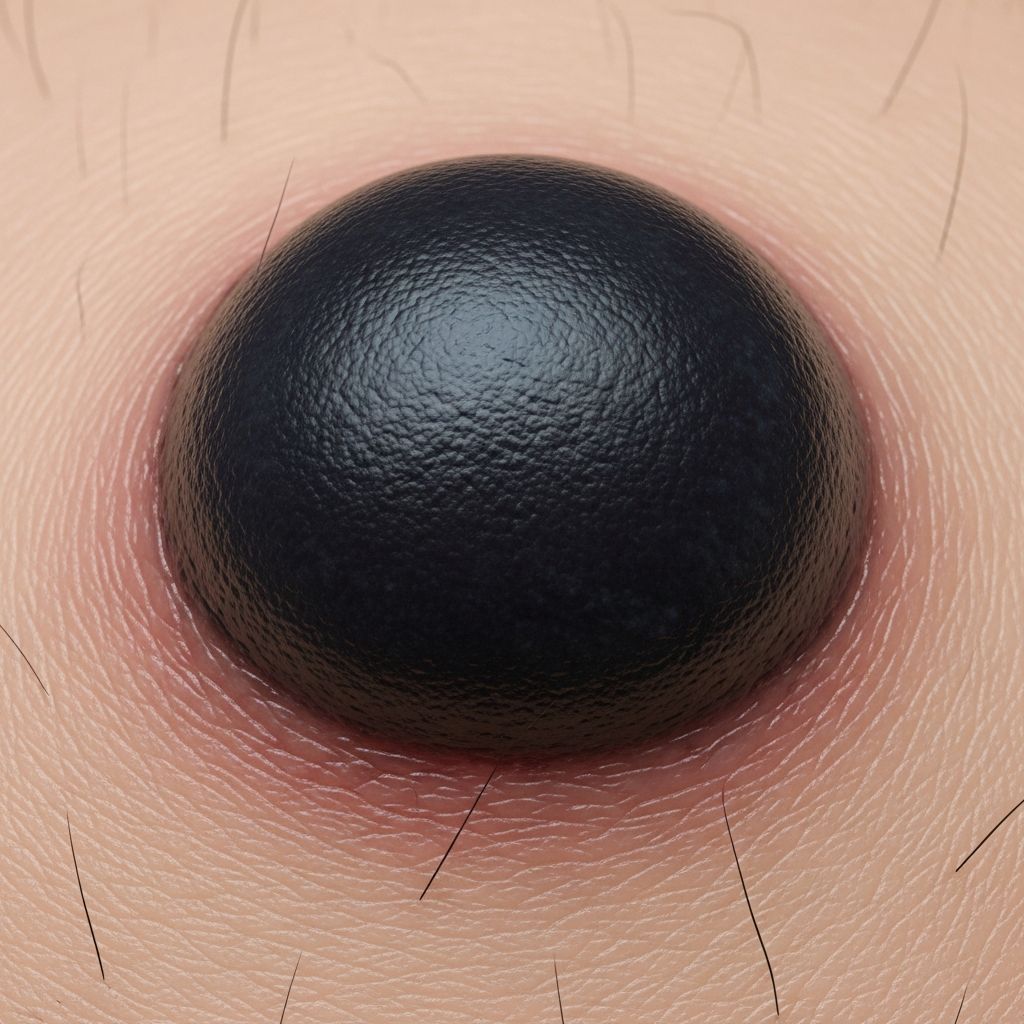
Nodular melanoma typically manifests as a dome-shaped, rapidly enlarging nodule on otherwise healthy skin. It grows over weeks to months, often reaching >2 mm thickness at diagnosis, distinguishing it from slower-growing subtypes.
Classic features include:
- Colour: Dark brown, black, red, pink, or flesh-coloured; rarely amelanotic (pigment-lacking).
- Shape: Symmetrical dome or polypoid nodule, 0.5–1.5 cm diameter initially.
- Surface: Smooth, shiny, crusted, or ulcerated; may bleed or ooze.
- ABCDE criteria: Asymmetrical shape, irregular borders, varied colour, diameter >6 mm, evolving size.
It lacks the irregular plaque-like appearance of superficial spreading melanoma, instead resembling a ‘berry’ on the skin. Amelanotic variants pose diagnostic challenges, appearing pink and mimicking benign lesions like pyogenic granuloma.
Related Stories



How is nodular melanoma diagnosed?
Diagnosis requires a high index of suspicion, aided by clinical examination, dermoscopy, and confirmatory biopsy. Prompt recognition is critical due to rapid progression.
Clinical diagnosis
Suspect nodular melanoma in any rapidly growing, firm nodule with atypical features. Differentiate from mimics: haemangioma, basal cell carcinoma, keratoacanthoma, or Merkel cell carcinoma.
Dermoscopy
Dermoscopy enhances accuracy. Key features of nodular melanoma:
- Blue-white veil.
- Atypical polymorphous vessels (comma, linear irregular, dotted).
- Irregular brown globules or structureless areas.
- Shiny white lines (orthogonal).
- Absence of pigment network.
These distinguish it from benign lesions like angiomas (regular vessels) or seborrhoeic keratoses (comedo-like openings).
Skin biopsy
Urgent excisional biopsy is preferred for suspected lesions, excising the entire nodule with minimal margins. Avoid small incisional or punch biopsies, as they may miss dermal invasion or yield misleading results. Pathology reveals dermal melanocytic proliferation without significant epidermal pagetoid spread, confirming vertical growth.
Pathology of nodular melanoma
Histopathology is challenging due to minimal intraepidermal spread. Key findings:
- Dermal expansile nodule of atypical epithelioid/spindle melanocytes.
- Lack of maturation towards dermis base.
- Mitotic figures, necrosis, ulceration common.
- Immunohistochemistry (S100, HMB45, Melan-A) confirms melanocytic origin.
The pathologist’s report details:
- Breslow thickness: Measured in mm from granular layer to deepest invasion; prime prognosticator (>4 mm worst).
- Clark level: Anatomic invasion depth.
| Level | Characteristics |
|---|---|
| Level 1 | Intraepidermal (in situ) |
| Level 2 | Papillary dermis invasion |
| Level 3 | Fills papillary dermis |
| Level 4 | Reticular dermis invasion |
| Level 5 | Subcutaneous fat invasion |
Clark level predicts metastasis risk in thin tumours; Breslow is superior for thicker ones.
Melanoma staging
Staging per AJCC guidelines assesses spread risk.
| Stage | Characteristics |
|---|---|
| Stage 0 | Melanoma in situ |
| Stage 1 | <2 mm thick, no ulceration |
| Stage 2 | >2 mm thick, ± ulceration |
| Stage 3 | Regional lymph node involvement |
| Stage 4 | Distant metastases |
For >1 mm thick melanomas, sentinel lymph node biopsy (SLNB) is considered, though controversial as it aids staging but not survival.
Treatment of nodular melanoma
Primary treatment is wide local excision with margins based on Breslow thickness:
| Breslow Thickness | Margin |
|---|---|
| <1.0 mm | 1 cm |
| 1.0–2.0 mm | 1–2 cm |
| >2.0–4.0 mm | 2 cm |
| >4.0 mm | 2 cm |
For node-positive disease, complete lymphadenectomy. Adjuvant therapies (immunotherapy, targeted therapy) for high-risk cases. Radiation for symptomatic metastases.
What is the outlook for nodular melanoma?
Prognosis hinges on early detection; 5-year survival >90% for <1 mm thick, drops to <50% for>4 mm or metastatic. Rapid growth underscores self-examination and professional checks.
Frequently Asked Questions
Q: How quickly does nodular melanoma grow?
A: Over weeks to months, often >2 mm at diagnosis, faster than other subtypes.
Q: Can nodular melanoma be pink or red?
A: Yes, amelanotic variants lack pigment, appearing flesh-coloured or red.
Q: Is sentinel node biopsy always needed?
A: Recommended for >1 mm thickness in some guidelines, but does not improve survival.
Q: What are dermoscopic red flags?
A: Blue-white veil, atypical vessels, irregular globules.
Q: How to prevent nodular melanoma?
A: Sun protection, regular skin checks, especially for high-risk individuals.
References
- Nodular Melanoma Pictures: Identification and Treatment — Healthgrades. 2023. https://resources.healthgrades.com/right-care/skin-cancer/nodular-melanoma-pictures
- Nodular melanoma – DermNet — DermNet NZ. 2023-10-01. https://dermnetnz.org/topics/nodular-melanoma
- Melanoma pathology – DermNet — DermNet NZ. 2023. https://dermnetnz.org/topics/melanoma-pathology
- Melanoma Skin Cancer: Images, Diagnosis, and Treatment – DermNet — DermNet NZ. 2023. https://dermnetnz.org/topics/melanoma
- Early Stage Melanoma of the Skin — Cancer Society NZ. 2022. https://www.cancer.org.nz/assets/Downloads/Booklet-a-guide-for-people-with-early-stage-melanoma-of-the-skin.pdf
- Early detection of melanoma and assessment of asymptomatic pigmented lesions — bpac.org.nz. 2021-01-01. https://bpac.org.nz/2021/melanoma-detection.aspx
- Melanoma Comprehensive Guide — Skintel. 2023. https://skintel.co.nz/articles/melanoma/
Similar Articles








Read full bio of medha deb