Nodulocystic Acne: Essential Guide To Diagnosis And Treatment
Severe inflammatory acne with deep nodules and cysts causing scarring; early isotretinoin treatment is essential for management.
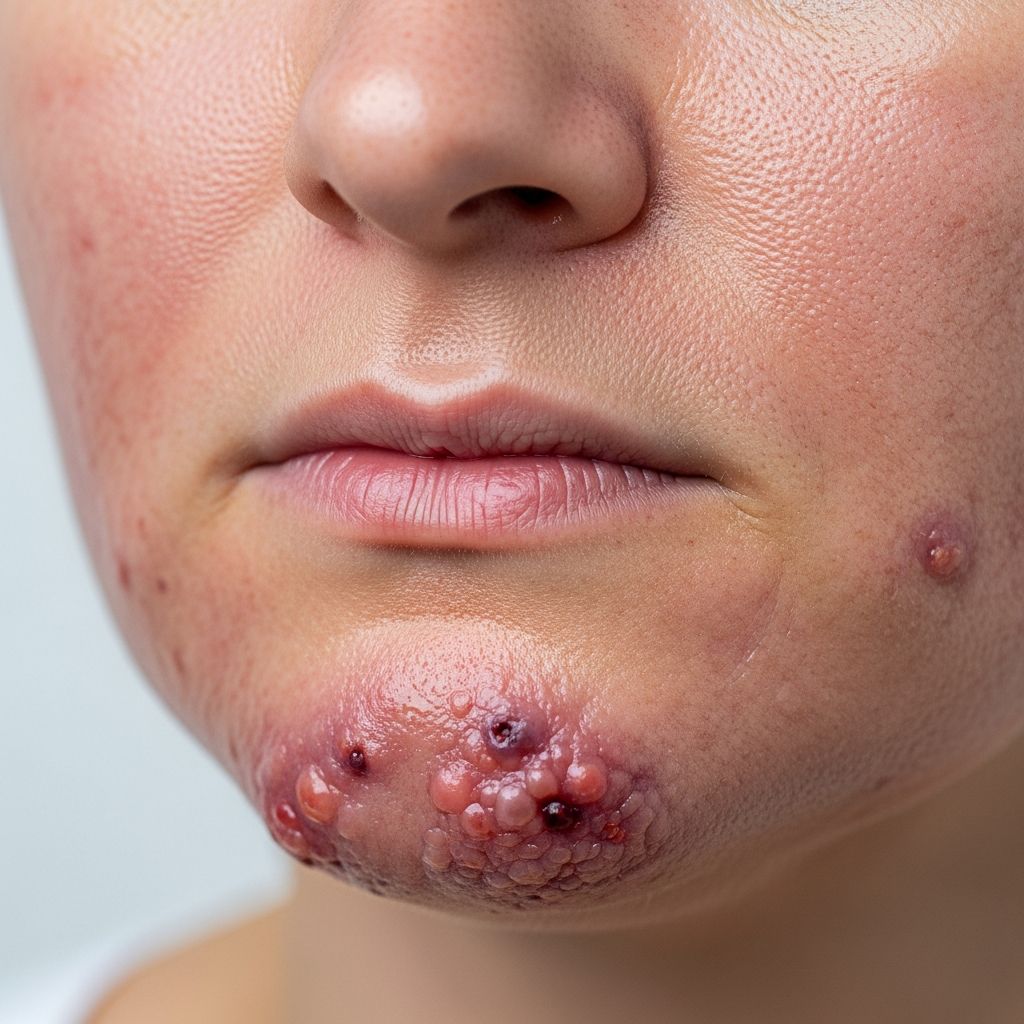
Nodulocystic acne represents the most severe manifestation of acne vulgaris, characterized by deep, inflamed nodules and cysts that often result in significant scarring if not treated promptly. This condition requires aggressive intervention, primarily with oral isotretinoin, to halt progression and minimize long-term skin damage.
What is nodulocystic acne?
Nodulocystic acne is a severe, inflammatory form of acne vulgaris affecting the pilosebaceous units, primarily on the face, chest, back, and shoulders. It features large, painful nodules and pus-filled cysts deeper in the skin, distinguishing it from milder acne types. These lesions arise from blocked pores, excessive sebum production, bacterial proliferation of Cutibacterium acnes, and intense inflammation, leading to tissue destruction and fibrosis.
Unlike comedonal or papulopustular acne, nodulocystic lesions are blind—without visible heads—and extend into the dermis, causing tenderness and potential sinus tract formation. It often overlaps with acne conglobata, a subtype involving interconnecting comedones, abscesses, and hypertrophic scars.
Who gets nodulocystic acne?
This condition predominantly affects adolescents and young adults, particularly males during puberty due to higher androgen levels stimulating sebaceous glands. However, it can persist into adulthood or present later. Genetic predisposition plays a role, with family history increasing risk. Hormonal fluctuations, such as in polycystic ovary syndrome (PCOS) in females, may contribute.
Post-adolescent cases are linked to anabolic steroid use, lithium therapy, or endocrine disorders. It is rare in prepubertal children but can occur in acne fulminans, a hyperinflammatory variant.
What causes nodulocystic acne?
The pathogenesis mirrors acne vulgaris but with exaggerated intensity:
- Excess sebum: Androgens enlarge sebaceous glands, producing thick sebum that clogs pores.
- Hyperkeratinization: Abnormal shedding blocks follicles.
- Bacterial colonization: Cutibacterium acnes proliferates in anaerobic conditions, triggering inflammation.
- Inflammation: Cytokine release and immune activation lead to nodule and cyst formation.
Systemic factors like high-glycemic diets, dairy intake, and stress exacerbate it by influencing insulin-like growth factor-1 (IGF-1) and hormones.
What are the clinical features of nodulocystic acne?
Lesions are deep, firm nodules (1–3 cm) and fluctuant cysts filled with purulent material. They appear red, tender, and may rupture, forming abscesses or sinus tracts. Common sites include the lower face (jawline, chin), back, chest, and shoulders. Scarring is inevitable without early treatment: atrophic (ice-pick, boxcar), hypertrophic, or keloidal.
Symptoms include pain, swelling, and psychological distress from disfigurement. In acne conglobata, multiple nodules coalesce into plaques with comedonal bridging.
Diagnosis
Diagnosis is clinical, based on lesion morphology and distribution. Severity grading uses systems like the Leeds or Global Acne Grading Scale, classifying nodulocystic acne as severe (Grade 4+).
Differential diagnoses include hidradenitis suppurativa, folliculitis decalvans, or pyoderma gangrenosum. Investigations may include hormonal assays (testosterone, DHEA-S) for endocrine causes, especially in females.
How is nodulocystic acne treated?
Treatment is urgent to prevent scarring, prioritizing oral isotretinoin as first-line for its sebosuppressive, anti-inflammatory, and comedolytic effects. Courses last 5–6 months at 0.5–1 mg/kg/day, achieving 85–90% clearance.
Systemic therapies:
- Isotretinoin: Gold standard; start early. Monitor lipids, liver function, and pregnancy prevention.
- Antibiotics: Oral tetracyclines or azithromycin (e.g., 500 mg pulse 3 days/week for 12 weeks) for anti-inflammatory effects.
- Hormonal agents: Spironolactone or OCPs for females.
- Adjuncts: Oral prednisone (1 mg/kg/day for 2–4 weeks) for flares or constitutional symptoms.
- Alternatives: Dapsone (100 mg/day tapering) for isotretinoin failures.
Related Stories



Local therapies:
- Intralesional triamcinolone (2.5–5 mg/mL) or lincomycin-triamcinolone after cyst drainage for rapid nodule resolution.
- Topical retinoids (adapalene), benzoyl peroxide for maintenance.
Procedures:
- Incision and drainage (I&D) for fluctuant cysts.
- Laser therapy, chemical peels for scars post-resolution.
| Treatment Type | Examples | Duration/Notes |
|---|---|---|
| Oral Retinoid | Isotretinoin 0.5–1 mg/kg/day | 5–6 months; prevents scarring |
| Intralesional Injection | Triamcinolone 2.5 mg/mL ± lincomycin | Every 3–4 weeks x 4 doses |
| Systemic Antibiotic | Azithromycin 500 mg pulse | 12 weeks |
| Corticosteroid | Prednisone 1 mg/kg/day | 2–4 weeks adjunct |
Acne conglobata treatment
Acne conglobata demands intensified regimens: isotretinoin plus prednisone initially, followed by biologics like adalimumab if refractory. Multimodal approaches yield best outcomes.
Complications
Scarring (80% of untreated cases) includes ice-pick, rolling, boxcar atrophic scars, and hypertrophic types. Post-inflammatory hyperpigmentation, psychological issues (depression, anxiety), and rare systemic involvement in fulminans.
Prevention
- Early intervention before nodulation.
- Gentle cleansing, non-comedogenic products.
- Avoid picking/squeezing.
- Diet: low-glycemic, limit dairy.
Frequently Asked Questions
Can nodulocystic acne be cured?
Yes, with oral isotretinoin, 85–90% achieve long-term remission, though maintenance therapy prevents relapse.
Is isotretinoin safe for nodulocystic acne?
It is highly effective but requires monitoring for teratogenicity, hyperlipidemia, and mood changes. iPLEDGE program mandates contraception.
How long do treatments take?
Isotretinoin: 5–6 months; intralesional injections show results in 3–4 weeks. Full clearance may need combination therapy.
Does diet affect nodulocystic acne?
High-glycemic foods and dairy may worsen it via IGF-1; a low-glycemic diet helps.
What if isotretinoin fails?
Consider dapsone, biologics, or surgical options. Multimodal therapy is key for recalcitrant cases.
References
- A comprehensive approach to treating recalcitrant nodulocystic acne in a young adult — Cosmoderma. 2023. https://cosmoderma.org/breaking-the-cycle-a-comprehensive-approach-to-treating-recalcitrant-nodulocystic-acne-in-a-young-adult/
- Nodular Acne Symptoms & Treatment — Aurora Health Care. 2024. https://www.aurorahealthcare.org/services/dermatology/acne/nodular-acne
- Nodulocystic acne — DermNet NZ. 2023. https://dermnetnz.org/topics/nodulocystic-acne
- Severe Nodulocystic Acne not Responding to Isotretinoin Therapy — PMC (NCBI). 2018-10-15. https://pmc.ncbi.nlm.nih.gov/articles/PMC6131924/
- Nodular Acne Treatment Options and Home Remedies — Healthline. 2023. https://www.healthline.com/health/acne/treatments-for-nodular-acne
- Acne Conglobata — StatPearls (NCBI Bookshelf). 2023-07-17. https://www.ncbi.nlm.nih.gov/books/NBK459219/
- Acne Vulgaris: Diagnosis and Treatment — AAFP. 2019-10-15. https://www.aafp.org/pubs/afp/issues/2019/1015/p475.html
Similar Articles








Read full bio of Sneha Tete