Noonan Syndrome with Multiple Lentigines
Rare genetic disorder featuring widespread lentigines, heart defects, and characteristic facial traits—key insights into diagnosis and care.
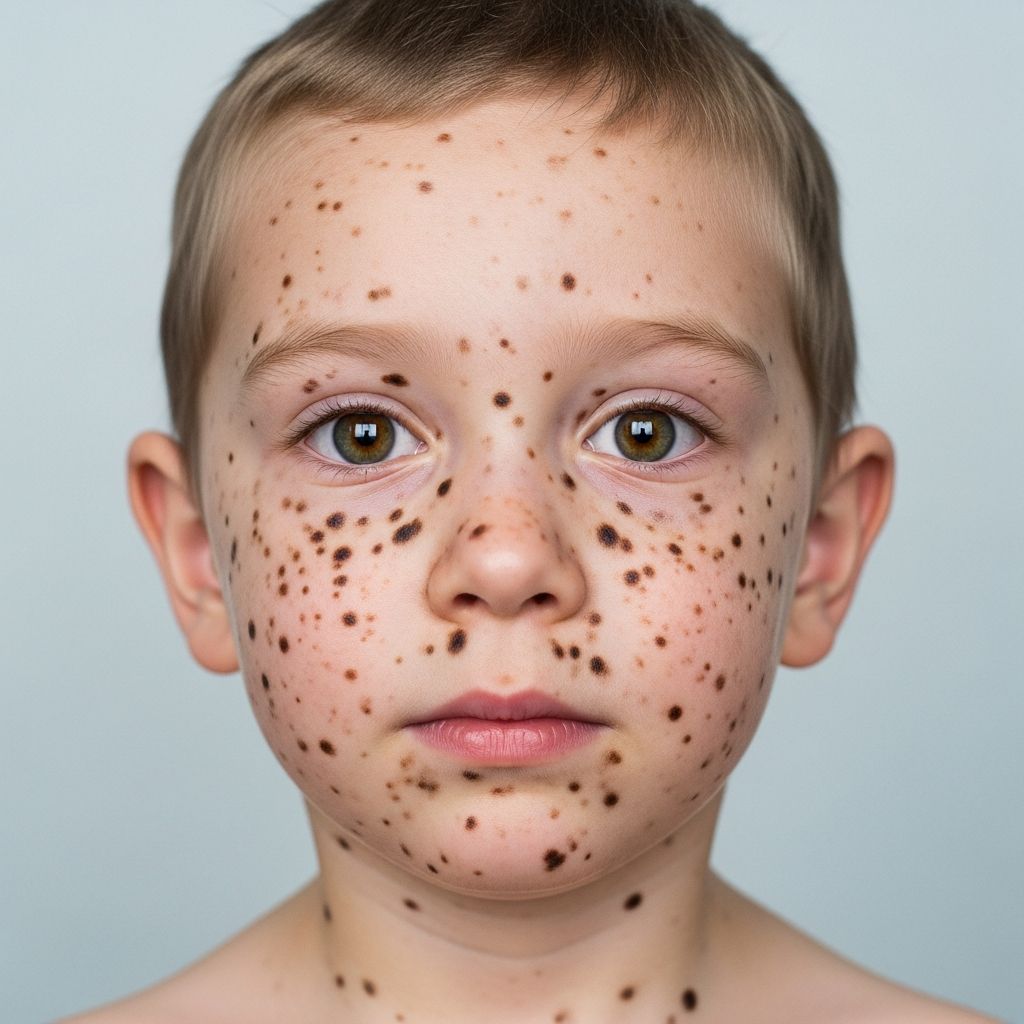
Noonan syndrome with multiple lentigines (NSML), previously known as LEOPARD syndrome, is an exceedingly rare autosomal dominant genetic disorder classified among the RASopathies. It manifests through a constellation of dermatological, cardiac, endocrine, and craniofacial abnormalities, with lentigines serving as the hallmark skin feature in over 90% of cases.
What is the LEOPARD mnemonic?
The acronym
LEOPARD
encapsulates the syndrome’s core manifestations, aiding clinicians in rapid recognition:- Lentigines: Numerous dark-brown, flat macules predominantly on the face, neck, and upper trunk.
- Electrocardiographic conduction abnormalities: Often linked to hypertrophic cardiomyopathy.
- Ocular hypertelorism: Widened interpupillary distance.
- Pulmonary stenosis: Valvular narrowing affecting blood flow to the lungs.
- Abnormalities of genitalia: Such as cryptorchidism in males.
- Retardation of growth: Short stature and skeletal delays.
- Deafness: Sensorineural hearing loss.
While not all patients exhibit every feature, the presence of multiple lentigines alongside cardiac involvement strongly suggests NSML.
Who gets Noonan syndrome with multiple lentigines (Epidemiology)?
NSML affects approximately 1 in 100,000 to 350,000 individuals, though precise prevalence remains unknown due to underdiagnosis. It occurs equally across genders and ethnicities, with about 70% of cases familial (autosomal dominant inheritance) and 30% de novo mutations. Onset varies: cardiac and growth issues appear in infancy, while lentigines emerge around age 4–5, proliferating into thousands by puberty.
What causes Noonan syndrome with multiple lentigines?
NSML arises from germline heterozygous mutations in genes of the
RAS/MAPK signaling pathway
, disrupting cell proliferation, differentiation, and survival. This pathway regulates key developmental processes, and its dysregulation defines RASopathies, including Noonan syndrome (NS).- PTPN11 (85% of cases): Encodes SHP2 phosphatase; mutations (e.g., p.Thr468Met) cause gain-of-function, leading to pathway hyperactivity.
- RAF1 (5–10%): Mutations enhance MEK/ERK signaling, strongly associated with hypertrophic cardiomyopathy.
- BRAF** and **MAP2K1 (rare): Less common variants with overlapping phenotypes.
Inheritance is autosomal dominant: a single mutated allele from an affected parent confers 50% risk per child. Penetrance is high but variable expressivity explains phenotypic diversity.
What are the clinical features of Noonan syndrome with multiple lentigines?
Clinical presentation is heterogeneous; most patients display 3–5 LEOPARD features. Severity ranges from mild cutaneous traits to life-threatening cardiomyopathy.
Skin features
**Lentigines** dominate, appearing post-infancy as 2–5 mm tan-to-brown macules with sharp borders, symmetrically distributed on the face (forehead, cheeks, ears), neck, upper trunk, and extremities—sparing palms, soles, and mucosa. They number in hundreds to thousands by adolescence but remain asymptomatic.
Additional cutaneous signs include:
- Multiple café-au-lait macules (20–30%)
- Generalized hyperpigmentation
- Naevus anaemicus (pale patches blanching on stroking)
- Xerosis and eczema
- Rarely: pilomatricomas or neurofibromas.
Cardiac features
Present in 85%:
Hypertrophic cardiomyopathy (HCM)
(70–80%, often progressive from infancy) with conduction defects like bundle branch block;pulmonary valve stenosis
(50%). ECG abnormalities include prolonged QT or axis deviation. Sudden cardiac death risk necessitates vigilant monitoring.Related Stories



Craniofacial features
Similar to Noonan syndrome: triangular face, hypertelorism, ptosis, downslanting palpebral fissures, low-set ears, thick helices, high-arched palate, micrognathia, and short neck with webbing.
Skeletal and growth features
Short stature (<25th percentile in most; <50% severe); pectus excavatum/carinatum; scoliosis; cubitus valgus; broad chest; delayed puberty.
Genitourinary features
Cryptorchidism (50% males); superior/anteriorly displaced anus; renal anomalies (horseshoe kidney).
Neurological and auditory features
Mild intellectual disability (30%); sensorineural hearing loss (20%); hypotonia; rarely seizures.
Other features
- Lymphatic dysplasia (lymphedema, pleural effusions)
- Endocrine: thyroid dysfunction, GH deficiency
- Hematologic: mild bleeding tendency
- Increased malignancy risk (neuroblastoma, leukemia).
Diagnosis
Diagnosis integrates clinical criteria and genetics. Suspect NSML with ≥2 LEOPARD features, especially lentigines + HCM/short stature.
Minimum criteria: Multiple lentigines + HCM or L + characteristic facies + HCM/pectus.
Confirmatory: Molecular testing via RASopathy panels (PTPN11/RAF1 first). Yield: 90–95%.
Differential: Noonan syndrome (distinguished by lentigines post-childhood), cardiofaciocutaneous syndrome, neurofibromatosis-1.
Treatment and management
Multidisciplinary: cardiologist (echocardiograms, beta-blockers for HCM), endocrinologist (GH therapy for stature), dermatologist, audiologist, orthopedist. Monitor for malignancy.
| System | Management |
|---|---|
| Cardiac | Serial echoes, ICD if high-risk HCM, valve repair |
| Growth | GH if deficiency confirmed |
| Skin | Cosmetic: lasers, peels for lentigines |
| Hearing | Audiometry, aids |
| Genital | Orchiopexy for cryptorchidism |
Lentigines treatment: Q-switched lasers, cryotherapy, retinoids/hydroquinone (limited efficacy).
Frequently Asked Questions
What is the difference between Noonan syndrome and NSML?
NSML features profuse lentigines (absent in classic NS); HCM more prevalent/severe in NSML vs. pulmonic stenosis in NS.
Is NSML curable?
No cure; management is supportive. Genetic counseling essential for families.
Can lentigines be removed?
Yes, via laser (e.g., Nd:YAG), cryotherapy, or peels, though recurrence possible.
What is the prognosis?
Variable; cardiac complications primary mortality risk. Many achieve normal lifespan with monitoring.
Genetic testing recommendations?
Yes, for probands and at-risk relatives; prenatal available.
References
- Noonan Syndrome with Multiple Lentigines (NSML)/LEOPARD — RASopathies Network. Accessed 2026. https://rasopathiesnet.org/rasopathies/syndromes/noonan-syndrome-with-multiple-lentigines-nsmlleopard/
- Noonan syndrome with multiple lentigines — DermNet NZ. Updated 2017. https://dermnetnz.org/topics/noonan-syndrome-with-multiple-lentigines
- Noonan syndrome with multiple lentigines — HealthFinder FL. Accessed 2026. https://quality.healthfinder.fl.gov/health-encyclopedia/HIE/1/001473
- Noonan Syndrome with Multiple Lentigines — Lurie Children’s Hospital. Accessed 2026. https://www.luriechildrens.org/en/specialties-conditions/noonan-syndrome-with-multiple-lentigines/
- Noonan Syndrome with Multiple Lentigines Brochure — Lurie Children’s Hospital. 2023-04-28. https://www.luriechildrens.org/globalassets/media/pages/specialties–conditions/programs/rasopathy-program/nsml-brochure_vs_4-28-2023.pdf
- Noonan Syndrome — Children’s Hospital of Philadelphia. Accessed 2026. https://www.chop.edu/conditions-diseases/noonan-syndrome
- Noonan Syndrome with Multiple Lentigines — GeneReviews (NCBI). 2015 (updated). https://www.ncbi.nlm.nih.gov/books/NBK1383/
Similar Articles








Read full bio of Sneha Tete