Occupational Skin Disorders in Homemakers
Understanding and preventing skin conditions caused by everyday household tasks and cleaning agents in homemakers.
Homemakers, often considered the backbone of family life, face unique occupational hazards that can lead to chronic skin conditions. Despite not working outside the home, their daily exposure to cleaning agents, detergents, and wet work mirrors industrial risks, making occupational skin disorders prevalent.
Contact dermatitis
accounts for the majority of cases, with irritant contact dermatitis being the most common, affecting up to 80% of occupational skin diseases.Who is at risk?
Homemakers performing routine chores like dishwashing, laundry, floor cleaning, and gardening are highly susceptible. Women, who traditionally handle these tasks, represent the primary demographic. Those with a history of
atopic dermatitis
, fair skin, or frequent hand immersion in water are at elevated risk. Studies indicate that repeated exposure to wet work—defined as hands in water for more than 2 hours daily or frequent glove use—exacerbates vulnerability.Additional risk factors include:
- Pre-existing skin conditions like eczema or psoriasis.
- Age over 40, as skin barrier function declines.
- Concurrent use of harsh soaps without protective measures.
- High humidity environments that promote sweating and maceration.
Causes
Skin disorders in homemakers stem primarily from chemical irritants and allergens encountered in household products.
Irritant contact dermatitis (ICD)
results from non-immune mediated damage by substances like detergents, bleach, ammonia, and alkaline soaps, which disrupt the skin’s lipid barrier after cumulative exposure. Weak irritants cause delayed inflammation, while strong ones like oven cleaners provoke immediate reactions.**Allergic contact dermatitis (ACD)** involves type IV hypersensitivity to allergens such as fragrances, preservatives (e.g., formaldehyde releasers), rubber accelerators in gloves, and chromates in leather. Surprisingly, protective gloves can become allergens themselves.
Other contributors include mechanical friction from scrubbing, biological agents like food proteins, and physical factors like heat from cooking or cold from refrigeration handling.
Clinical features
Symptoms typically manifest on the
hands and forearms
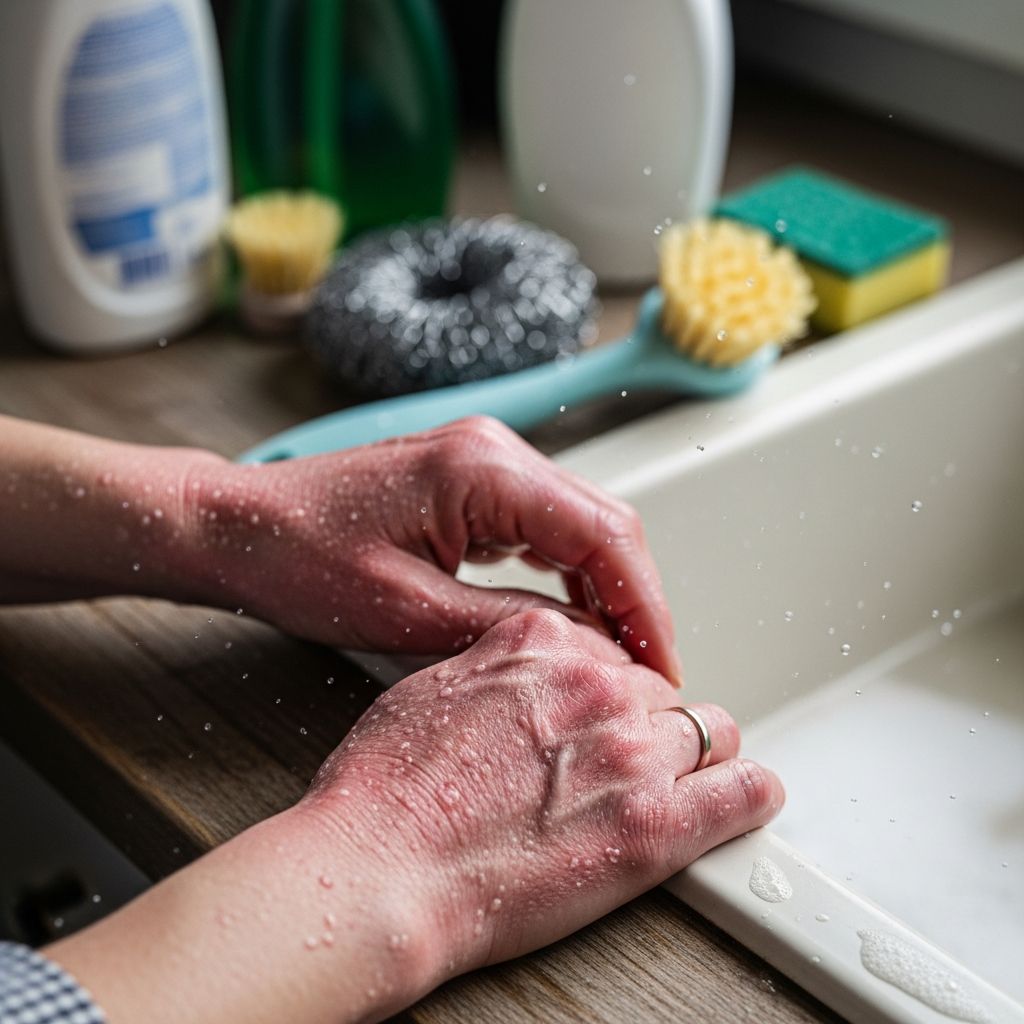
, with dorsal hand involvement classic for homemakers due to dishwashing. Early signs include dryness, chapping, redness, and itching. Progression leads to edema, vesicles, fissuring, scaling, and lichenification—thickened, hardened skin.In severe cases:
- Nail dystrophy with brittleness or onycholysis.
- Secondary bacterial infection causing pustules or impetigo.
- Hyperkeratosis or callosities from chronic friction.
Skin improves during breaks from chores, a key diagnostic clue. Unlike ACD, ICD lacks systemic symptoms and shows no patch test positivity.
Diagnosis
Diagnosis relies on history, examination, and targeted testing. Key questions probe exposure duration, product use, improvement away from home, and family skin history.
Patch testing differentiates ICD from ACD using standard series (e.g., TRUE Test) plus household allergens like cocamidopropyl betaine and methylisothiazolinone. Positive reactions indicate ACD; negative supports ICD.
Additional tools:
- Patch test reading at 48-96 hours.
- Prick testing for urticaria.
- Biopsy if morphea or psoriasis suspected.
| Feature | Irritant Contact Dermatitis | Allergic Contact Dermatitis |
|---|---|---|
| Onset | Cumulative, dose-dependent | Sensitization after repeated exposure |
| Distribution | Exposure site, concentration-related | Idiosyncratic, may spread |
| Patch Test | Negative | Positive to specific allergen |
| Improvement off-work | Rapid | Slower |
Related Stories



Prevention
Prevention emphasizes barrier protection and substitution. Use cotton-lined nitrile or PVC gloves for wet work, limiting immersion to 20 minutes per session. Apply emollients frequently—petrolatum-based for best occlusion.
Household tips:
- Choose fragrance-free, pH-neutral detergents.
- Wear aprons and long sleeves.
- Dry hands thoroughly after washing.
- Use warm, not hot, water.
- Avoid fabric softeners with allergens.
Employers in shared homes (e.g., maids) should provide PPE; self-homemakers must prioritize skin care routines.
Treatment
First-line: avoidance and restoration of barrier with bland emollients (e.g., white soft paraffin) applied 4-6 times daily. Topical corticosteroids—potent for acute flares (betamethasone 0.1%), mild for maintenance (hydrocortisone 1%).
For infected cases, topical (mupirocin) or oral antibiotics. Severe ACD may require systemic steroids or immunosuppressants like tacrolimus.
Phototherapy or change in chores for refractory cases. Multidisciplinary approach with dermatologists essential.
Prognosis
Early intervention yields 70-90% resolution, but chronicity develops in 20-30% with lichenification and persistent sensitivity. ACD prognosis worsens without allergen avoidance; ICD improves with reduced exposure. Long-term emollient use prevents relapse.
Occupational aspects
Though unpaid, homemakers deserve recognition. Compensation rare, but legal precedents exist for disability claims. Education via health campaigns crucial.
Differential diagnosis
- Atopic dermatitis: flexural, personal/family atopy history.
- Psoriasis: plaques with silvery scale.
- Tinea manuum: unilateral, fungal microscopy positive.
- Scabies: burrows, nocturnal itch.
- Juvenile plantar dermatosis: weight-bearing areas.
Investigations
Beyond patch testing: culture for infection, KOH for fungi, blood for eosinophilia in ACD. Use irritant controls like sodium lauryl sulfate.
Management
Holistic: skin care education, product substitution, stress reduction as anxiety exacerbates. Follow-up every 2-4 weeks until clear.
Frequently asked questions
What causes skin problems in homemakers?
Primarily irritants from detergents, water, and cleaning products leading to contact dermatitis.
Can gloves prevent dermatitis?
Cotton-lined gloves yes; latex gloves may cause allergy. Limit wear to 20 min.
How to treat dry, cracked hands?
Emollients hourly, topical steroid if inflamed, avoid irritants.
Is it allergy or irritation?
Patch testing distinguishes; irritation more common.
Does it ever go away completely?
With avoidance, yes; chronic exposure leads to persistence.
References
- Occupational Skin Disease — NHG Health. 2023. https://www.nhghealth.com.sg/FindDS/diseases-conditions/occupational-skin-disease
- Common Occupational Skin Diseases — Michael J. Doyle Law. 2024-08. https://www.michaeljdoylelaw.com/legal-blog/2024/august/common-occupational-skin-diseases/
- Occupational Dermatoses — PMC – NIH. 2023. https://pmc.ncbi.nlm.nih.gov/articles/PMC9910518/
- Occupational Skin Disease — AAFP. 2002-09-15. https://www.aafp.org/pubs/afp/issues/2002/0915/p1025.html
- On the job: Occupational skin diseases easily overlooked — Dermatology Times. 2023. https://www.dermatologytimes.com/view/job-occupational-skin-diseases-easily-overlooked
- Occupational Contact Dermatitis — Mount Sinai. 2023. https://www.mountsinai.org/files/MSHealth/Assets/HS/Patient-Care/Service-Areas/Occupational-Medicine/Contact%20Dermatitits.pdf
Similar Articles








Read full bio of medha deb