OCT Imaging: Advanced Vision Diagnostics Explained
Discover how optical coherence tomography revolutionizes eye disease detection and monitoring
Advances in medical imaging have fundamentally changed how eye care professionals diagnose and monitor vision-related conditions. Among the most significant breakthroughs in ophthalmology is Optical Coherence Tomography (OCT), a sophisticated imaging technique that provides unprecedented detail of the eye’s internal structures. This non-invasive technology has become indispensable in modern eye clinics, enabling physicians to detect diseases at earlier stages and track disease progression with remarkable precision.
The Fundamentals of OCT Technology
OCT represents a quantum leap in how medical professionals visualize the back of the eye. Optical Coherence Tomography is a non-contact imaging technique that generates cross-sectional images of tissue with high resolution, utilizing the principles of light interference to create detailed maps of retinal structures. Unlike traditional eye examinations that provide only surface-level information, OCT penetrates beneath the retina’s outer layers, revealing the intricate architecture of tissues and blood vessels in stunning detail.
The technology operates on a deceptively simple principle: it bounces near-infrared light waves off structures within the eye and measures how these waves reflect back. OCT uses coherent near-infrared light to obtain micrometer-level depth resolved images of biological tissue or other scattering media, with axial resolution capabilities reaching approximately 5 micrometers in specialized systems. This level of precision is comparable to using an optical microscope, but without requiring contact with the eye—making it extraordinarily safe and comfortable for patients.
At the core of OCT systems lies a process called low-coherence interferometry, which distinguishes OCT from conventional imaging methods. The system divides near-infrared light into two pathways: one that interacts with the eye tissue and another that travels a known reference path. When these light beams recombine, they create interference patterns that contain crucial information about tissue depth and structure. Computer algorithms process these patterns to reconstruct detailed cross-sectional images, much like how ultrasound builds pictures from sound waves, except OCT uses light instead.
How OCT Systems Generate Images
Modern OCT devices employ sophisticated optical engineering to capture images with exceptional clarity. Light from a broadband wavelength light source is shone on the sample, the interference light spectrally dispersed, then detected by a linear image sensor, allowing the system to acquire information across multiple depths simultaneously. The process happens remarkably quickly—contemporary systems can scan entire retinal regions in seconds, capturing thousands of individual measurements that computers then assemble into comprehensive three-dimensional representations.
The scanning process itself involves directing a focused light beam across the retina in a systematic pattern. As the beam moves horizontally across the eye, it simultaneously collects vertical depth information, creating a grid of data points. OCT scans a beam of light to create 3D images that show the retina’s layers in microscopic detail, with each layer distinguished by its unique optical properties. This allows physicians to visualize not just the overall structure of the retina, but also to identify specific changes within individual layers that might indicate disease or degeneration.
The Two Main OCT Technologies
The field of OCT encompasses several technological approaches, each with distinct advantages. The two predominant systems represent different solutions to the same fundamental challenge: achieving high-speed imaging with excellent resolution.
Related Stories



Time-Domain OCT (TD-OCT) represents the earlier generation of technology, operating at slower scanning speeds but providing reliable images. These systems mechanically move a reference mirror to measure reflected light timing, creating detailed depth information. While effective, TD-OCT’s mechanical components limit scanning velocity.
Spectral-Domain OCT (SD-OCT) represents a major technological advancement, operating dramatically faster than its predecessor. Rather than physically moving reference components, spectral-domain systems analyze the complete spectrum of reflected light simultaneously, achieving scanning speeds that exceed 70,000 A-scans per second. This increased velocity enables more detailed image averaging, reducing noise and improving overall image quality. Many modern clinical systems employ spectral-domain technology due to its superior speed and image quality combination.
Swept-Source OCT represents the latest advancement, utilizing wavelength-swept laser sources that achieve even faster scanning speeds, often exceeding 400,000 A-scans per second. These systems also penetrate deeper into ocular tissues, making them particularly valuable for examining structures beyond the standard imaging depth of conventional systems.
Specialized Imaging: OCT Angiography
A revolutionary extension of conventional OCT technology is OCT Angiography (OCTA), which visualizes blood vessels without requiring contrast dye injections. OCTA leverages the motion contrast of flowing blood cells, using this to generate en-face images of the vasculature without the need for contrasting agents. This breakthrough eliminates the risks and discomfort associated with traditional angiography procedures, where fluorescent dyes must be injected into the bloodstream.
The technology works by analyzing minute changes in the OCT signal as red blood cells move through capillaries. OCT angiography uses motion contrast by comparing the decorrelation signal between multiple B-scans obtained at each retinal cross-section to detect blood flow, creating detailed maps of the vascular network. Physicians can now observe blood flow patterns, identify abnormal vessels, and detect areas of reduced perfusion—all without any systemic dye administration. This capability has proven invaluable for understanding the vascular complications associated with diabetes, retinal vein occlusions, and other vascular eye diseases.
Clinical Applications in Eye Disease Detection
The diagnostic power of OCT extends across numerous ophthalmologic conditions, fundamentally changing how eye diseases are detected and monitored. Its non-invasive nature and remarkable detail have made it the standard imaging tool in modern eye care facilities.
Age-Related Macular Degeneration
High-resolution images of the retina provided by OCT enable precise identification of drusen, retinal pigment epithelial detachments, and fluid accumulations, aiding in the timely diagnosis and ongoing monitoring of AMD. OCT’s ability to visualize these subtle changes has revolutionized AMD management, allowing physicians to initiate treatment before significant vision loss occurs. The technology can distinguish between dry and wet forms of the disease and track the response to therapeutic interventions with unprecedented precision.
Glaucoma and Nerve Fiber Layer Assessment
The state of the retina including swelling and bleeding can be analyzed by taking tomographic images of the retina and nerve fiber layer. This technology is used for early detection of the symptoms of diseases such as glaucoma. OCT excels at measuring optic nerve head parameters and quantifying nerve fiber layer thickness—changes that often occur before patients notice vision symptoms. Regular OCT monitoring enables ophthalmologists to detect glaucoma progression early and adjust treatment strategies accordingly.
Diabetic Retinopathy and Macular Edema
For patients with diabetes, OCT provides critical insights into retinal health. The technology reveals macular thickening, fluid accumulations, and vascular abnormalities that characterize diabetic complications. This technology is used for early detection of the symptoms of diseases such as glaucoma, age-related macular degeneration (ARMD), and diabetic retinopathy, enabling physicians to intervene before vision-threatening complications develop. OCT measurements of central macular thickness guide treatment decisions and help assess therapeutic response to injected medications or laser procedures.
Image Resolution and Quality Metrics
| OCT Type | Scanning Speed (A-scans/sec) | Axial Resolution (micrometers) | Transverse Resolution (micrometers) | Imaging Depth Range |
|---|---|---|---|---|
| Time-Domain OCT | 400 | 10 | 20 | Vitreoretinal interface to RPE |
| Spectral-Domain OCT | 27,000–70,000 | 5–7 | 14–20 | Posterior cortical vitreous to sclera (with enhanced depth imaging) |
| Swept-Source OCT | 100,000–400,000 | 5 | 20 | Posterior cortical vitreous to sclera (superior penetration) |
Axial resolution is a critical factor in determining the quality of OCT images, as it defines the system’s capability to distinguish between structures along the depth direction. Advanced systems achieve resolutions in the micrometer range, enabling visualization of individual retinal layers and subtle pathological changes that would be imperceptible with older technology.
Advantages Over Traditional Imaging Methods
OCT offers several compelling advantages compared to other diagnostic imaging techniques. OCT offers several advantages, including high speed, high resolution, non-invasiveness, and real-time observation. Unlike MRI or ultrasound, which operate at much lower resolutions, OCT delivers near-microscopic detail. Furthermore, OCT requires no contact with the eye, no dilation is always necessary, and no contrast dye injection is required for basic imaging. The procedure is quick, typically completed in minutes, and patients experience no discomfort or side effects.
OCT delivers high resolution because it is based on light, rather than sound or radio frequency. Light’s shorter wavelength compared to ultrasound allows for dramatically superior detail. This optical basis also enables three-dimensional imaging capabilities that exceed what traditional two-dimensional photography can provide, allowing physicians to examine retinal structures from multiple perspectives and angles.
The Clinical Workflow and Patient Experience
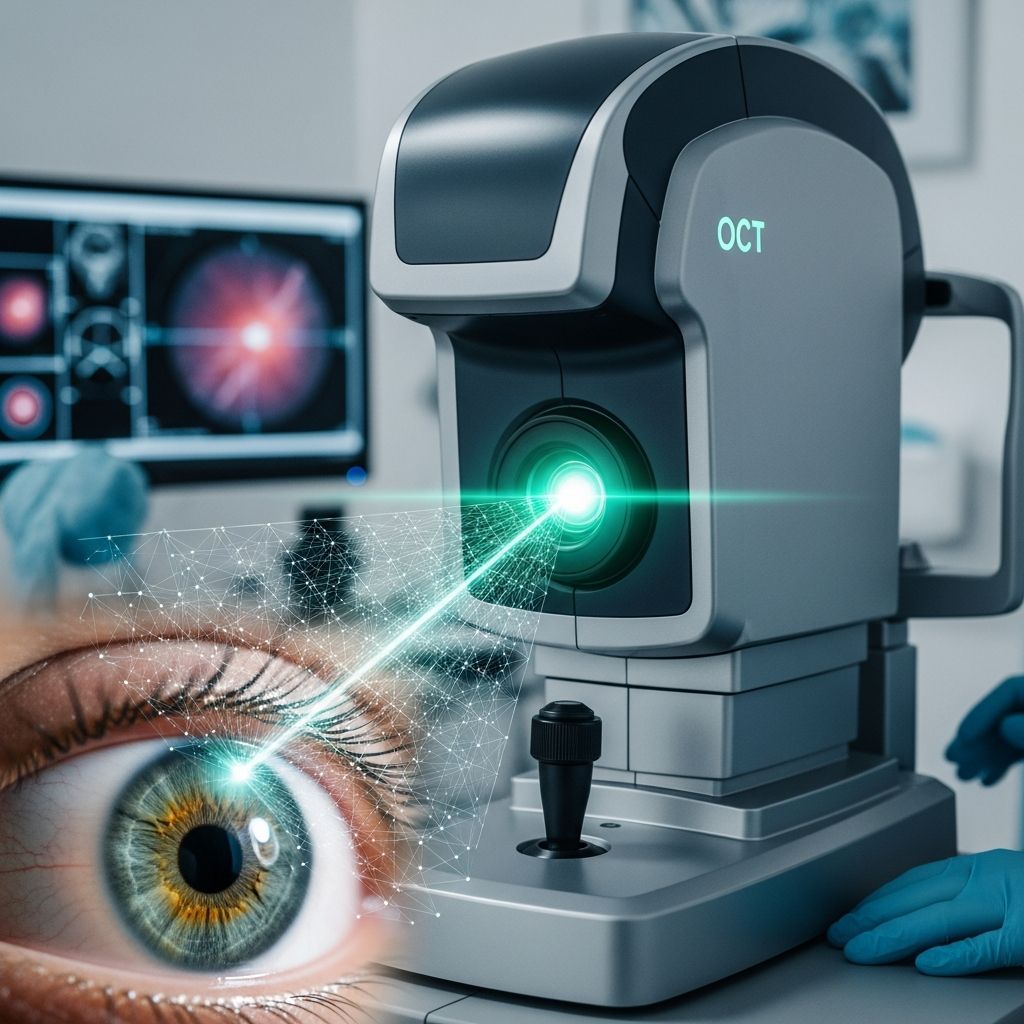
From a patient perspective, OCT imaging is remarkably straightforward. During the examination, patients sit facing the OCT device and rest their chin on a support while focusing on a fixation target. The technician or physician positions the device’s optical path aligned with the pupil, then initiates the scan. The entire process typically requires only seconds to minutes, depending on which retinal areas require imaging and whether multiple scanning protocols are needed.
The non-invasive nature of OCT means that patients can undergo repeated scans without concern, making it ideal for monitoring disease progression or treatment response over time. OCT is a non-invasive, optical imaging technique that produces ultra-high-resolution images of subsurface tissue structures, eliminating the need for more risky or uncomfortable diagnostic procedures in many cases.
Future Directions and Emerging Applications
OCT technology continues to evolve, with researchers exploring applications beyond traditional ophthalmology. Enhanced depth imaging capabilities, improved software algorithms, and integration with artificial intelligence are expanding diagnostic possibilities. Researchers are investigating OCT’s potential in dermatology, cardiology, and gastrointestinal imaging, leveraging its non-invasive, high-resolution capabilities across medical specialties.
The addition of Optical Coherence Tomography Angiography (OCTA) has further enhanced the precision and informativeness of blood vessel imaging, opening new possibilities for understanding and treating vascular diseases. Ongoing research into advanced metrics and biomarkers visible on OCT may enable even earlier disease detection and more personalized treatment strategies in future years.
Frequently Asked Questions About OCT
Is OCT imaging safe?
Yes, OCT imaging is extremely safe. It uses low-power near-infrared light that does not ionize tissue or cause known harm. No contact with the eye occurs, and no contrast dyes are required for standard imaging. Patients experience no discomfort or side effects.
Does OCT require pupil dilation?
While pupil dilation is not absolutely required for OCT imaging, many ophthalmologists dilate pupils before scanning to facilitate better visualization of peripheral retinal structures. Even without dilation, central macular imaging is typically achievable and provides diagnostically valuable information.
How often can OCT scans be performed?
OCT scans can be performed as frequently as clinically indicated. The non-invasive nature and rapid acquisition time mean patients can undergo multiple scans during a single visit or during serial follow-up appointments without concern. Many patients with chronic eye diseases undergo OCT imaging every few months to years, depending on disease status and treatment response.
What conditions require OCT imaging?
OCT imaging is indicated for numerous conditions, including age-related macular degeneration, diabetic retinopathy and macular edema, glaucoma, retinal vein and artery occlusions, macular holes, epiretinal membranes, and various inflammatory retinal conditions. Your ophthalmologist will determine whether OCT imaging is appropriate for your specific situation.
How do physicians interpret OCT images?
Trained ophthalmologists analyze OCT images by examining retinal layer thickness, structure, and the presence of abnormal features such as fluid accumulations, disruptions in normal architecture, or pigment epithelial changes. Specialized software provides quantitative measurements, such as central macular thickness, that assist in diagnosis and guide treatment decisions.
References
- Optical Coherence Tomography (OCT) in Medical Imaging: Capabilities and Key Applications — News Medical Life Sciences. 2024-07-03. https://www.news-medical.net/whitepaper/20240703/Optical-coherence-tomography-(OCT)-in-medical-imaging-Capabilities-and-key-applications.aspx
- OCT (Optical Coherence Tomography) — Hamamatsu Photonics. https://www.hamamatsu.com/eu/en/applications/medical-imaging/oct.html
- Optical Coherence Tomography — EyeWiki, American Academy of Ophthalmology. https://eyewiki.org/Optical_Coherence_Tomography
- Optical Coherence Tomography — Wikipedia. https://en.wikipedia.org/wiki/Optical_coherence_tomography
- OCT Tests for Retina and Macula: Optical Coherence Tomography — Oregon Health & Science University Casey Eye Institute. https://www.ohsu.edu/casey-eye-institute/oct-optical-coherence-tomography
- Optical Coherence Tomography (OCT): Principle and Technical Aspects — National Center for Biotechnology Information (NCBI). https://www.ncbi.nlm.nih.gov/books/NBK554044/
- OCT Imaging for Intraoperative Margin Visualization — Perimeter Medical. https://perimetermed.com/how-oct-works/
Similar Articles








Read full bio of Sneha Tete