Oculomotor Nerve (Cranial Nerve 3): What It Is & Function
Understanding the oculomotor nerve: anatomy, function, and clinical significance.
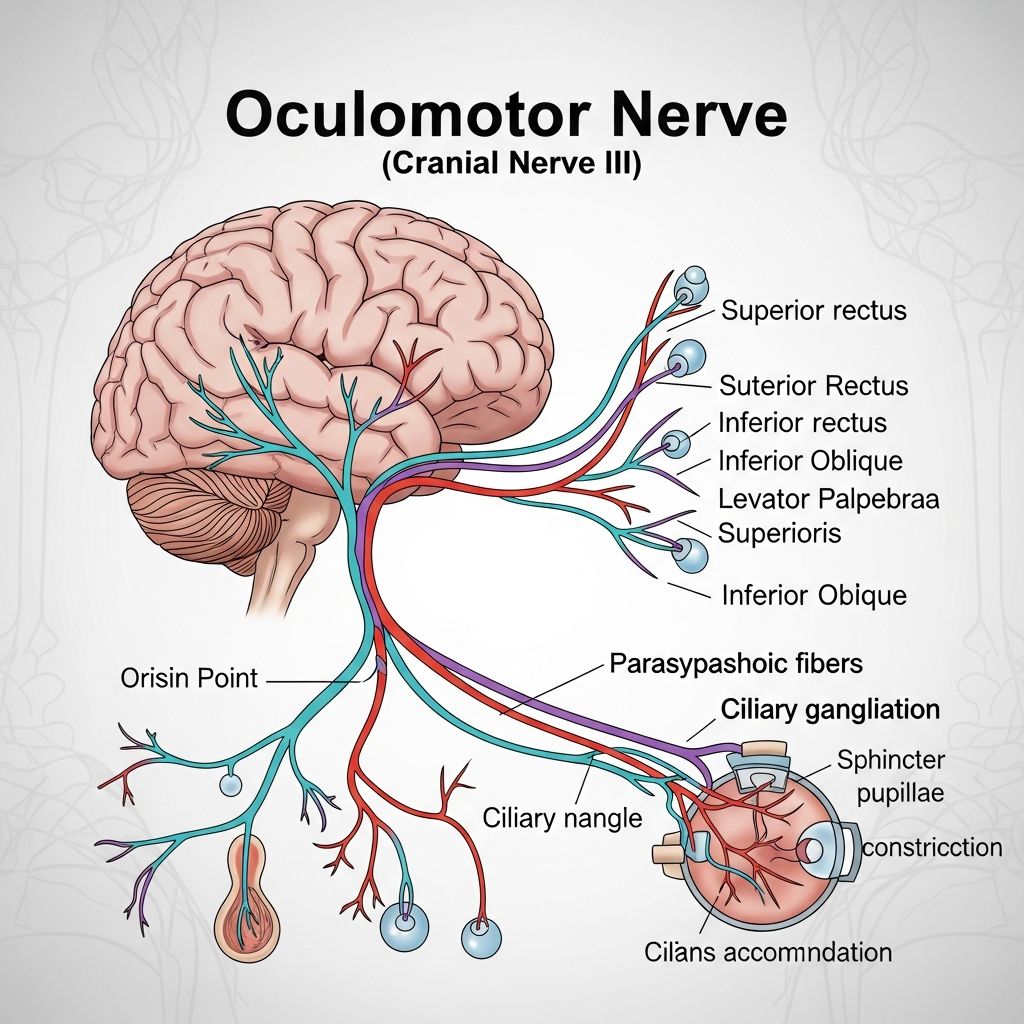
What is the Oculomotor Nerve?
The oculomotor nerve, also known as cranial nerve III (CN III), is one of the twelve cranial nerves in the human body. This crucial nerve pair carries command signals to muscles that control eye movement and plays a key role in how your eyes move and work together. The oculomotor nerve is the chief motor nerve to the ocular and extraocular muscles, making it essential for normal vision and eye function. Unlike many other cranial nerves that carry primarily one type of information, the oculomotor nerve is unique because it performs both somatic motor functions and visceral motor (parasympathetic) functions.
The oculomotor nerve is responsible for innervating most of the extraocular muscles—the muscles that move the eyeball and upper eyelid. Additionally, it provides parasympathetic innervation to structures within the eye that control pupil size and lens accommodation. Understanding the structure and function of the oculomotor nerve is important for recognizing symptoms of damage or dysfunction and seeking appropriate medical attention.
Anatomical Origin and Pathway
The oculomotor nerve originates from two nuclear complexes located within the midbrain of the brainstem. These are the oculomotor nucleus and the Edinger-Westphal nucleus, which are positioned at the level of the superior colliculus. The oculomotor nucleus originates ventral to the cerebral aqueduct on the pre-aqueductal grey matter, with one nucleus located on each side of the midline.
From its origin in the midbrain, the oculomotor nerve follows a specific anatomical pathway to reach the eye. Both the somatic and visceral motor axons exit the anterior surface of the brainstem as the oculomotor nerve, appearing from between the midbrain and pons. The nerve emerges from the substance of the brainstem at the oculomotor sulcus, a groove on the lateral wall of the interpeduncular fossa. At this point, the nerve is invested with a sheath of pia mater and enclosed in a prolongation from the arachnoid membrane.
As the oculomotor nerve travels anteriorly from the brainstem, it passes between the superior cerebellar artery (below) and the posterior cerebral artery (above). The nerve then runs anteriorly in the subarachnoid space, positioned medial to the much larger trigeminal nerve (CN V) and its ganglion.
Passage Through the Cavernous Sinus
The next major point in the oculomotor nerve’s pathway is its passage through the cavernous sinus, a plexus of veins located on either side of the sella turcica. The sella turcica is a shallow depression on the superior aspect of the body of the sphenoid bone that houses the pituitary gland. The oculomotor nerve pierces the dura covering the cavernous sinus and passes through the superolateral aspect of the wall of the cavernous sinus, traveling lateral to the internal carotid artery. During its course through the cavernous sinus, the nerve may receive one or two filaments from the cavernous plexus of the sympathetic nervous system and a communicating branch from the ophthalmic division of the trigeminal nerve.
In the anterior portion of the cavernous sinus, the oculomotor nerve divides into its superior and inferior branches. The superior branch innervates the superior rectus muscle and the levator palpebrae superioris. The inferior branch innervates the medial rectus, inferior rectus, and inferior oblique muscles.
Entry Into the Orbit
Upon exiting the cavernous sinus, the oculomotor nerve branches run below the anterior clinoid process of the sphenoid bone to enter the orbit through the superior orbital fissure. Both branches pass into the orbit within the boundaries of the common tendinous ring, a fibrous ring of tissue that surrounds the optic canal and part of the superior orbital fissure in the posterior aspect of the orbit. From here, the superior and inferior branches pass anteriorly to supply the extraocular muscles of the eye.
Related Stories



Functions of the Oculomotor Nerve
The oculomotor nerve performs multiple critical functions through its somatic motor and visceral motor (parasympathetic) fibers. These functions enable eye movement, eyelid elevation, pupil constriction, and lens accommodation.
Somatic Motor Functions
The somatic motor component of the oculomotor nerve supplies skeletal muscles involved in eye movement and eyelid elevation. Specifically, the oculomotor nerve innervates five of the seven extraocular muscles:
- Superior rectus muscle: Elevates the eyeball, moving it upward
- Medial rectus muscle: Adducts the eyeball, moving it toward the nose
- Inferior rectus muscle: Depresses the eyeball, moving it downward
- Inferior oblique muscle: Elevates, abducts, and laterally rotates the eyeball
- Levator palpebrae superioris muscle: Elevates the upper eyelid
It is important to note that the oculomotor nerve does not innervate all extraocular muscles. The superior oblique muscle is innervated by the trochlear nerve (CN IV), while the lateral rectus muscle is innervated by the abducens nerve (CN VI).
These muscles work together to enable smooth eye movements, gaze fixation, and eye tracking. The coordinated action of these muscles allows for conjugate eye movements, where both eyes move together in the same direction. This coordination is essential for binocular vision and depth perception.
Visceral Motor (Parasympathetic) Functions
The visceral motor component of the oculomotor nerve originates from the Edinger-Westphal nucleus in the midbrain and provides parasympathetic innervation to the eye. Once inside the orbit, the inferior branch of the oculomotor nerve sends a preganglionic branch to the ciliary ganglion, which is located just behind the eyeball. The preganglionic branch carries parasympathetic nerve fibers that synapse with parasympathetic postganglionic fibers within the ganglion. These postganglionic fibers then pass anteriorly to supply two intrinsic muscles of the eye.
The parasympathetic functions of the oculomotor nerve include:
- Pupil constriction (miosis): The oculomotor nerve innervates the sphincter pupillae muscle, a smooth muscle near the pupil. When this muscle contracts, it constricts the pupil, reducing the amount of light entering the eye. This reflex, known as the pupillary light reflex, is essential for protecting the retina from excessive light and maintaining clear vision in varying light conditions.
- Lens accommodation: The oculomotor nerve also innervates the ciliary muscle through parasympathetic fibers. The ciliary muscle changes the shape of the lens, allowing the eye to focus on objects at different distances. This process, called accommodation, enables clear vision for both near and far objects.
Clinical Significance and Oculomotor Nerve Damage
Damage to the oculomotor nerve can result in a variety of symptoms affecting eye movement, eyelid function, and pupil response. The specific symptoms depend on whether the damage is complete or partial and whether it affects the nuclear, fascicular, or peripheral portions of the nerve.
Signs and Symptoms of Oculomotor Nerve Damage
When the oculomotor nerve is damaged, the following clinical manifestations may occur:
- Ptosis: Drooping of the upper eyelid occurs because the levator palpebrae superioris muscle is paralyzed and cannot elevate the lid
- Ophthalmoplegia: Paralysis of the extraocular muscles supplied by the oculomotor nerve, resulting in inability to move the eye in multiple directions
- Down and out position: The affected eye is positioned downward and outward at rest due to unopposed action of the lateral rectus and superior oblique muscles
- Pupil dilation (mydriasis): Loss of parasympathetic innervation results in unopposed sympathetic innervation, causing the pupil to dilate
- Loss of accommodation: Inability to focus on near objects due to paralysis of the ciliary muscle
- Diplopia: Double vision may occur due to misalignment of the eyes
Causes of Oculomotor Nerve Damage
Oculomotor nerve damage can result from various causes, including:
- Stroke or ischemia affecting the midbrain
- Compression from tumors, aneurysms, or mass lesions
- Trauma or head injury
- Inflammatory conditions affecting the nerve
- Diabetes and other systemic conditions affecting nerve function
- Increased intracranial pressure
Comparative Anatomy: Oculomotor Nerve Branches
The oculomotor nerve’s division into superior and inferior branches is clinically significant, as damage to specific branches results in different patterns of weakness.
| Branch | Muscles Innervated | Functions |
|---|---|---|
| Superior Branch | Superior rectus, Levator palpebrae superioris | Eye elevation, upper eyelid elevation |
| Inferior Branch | Medial rectus, Inferior rectus, Inferior oblique | Eye adduction, depression, elevation and abduction; also carries parasympathetic fibers to ciliary ganglion |
Frequently Asked Questions (FAQs)
Q: How is oculomotor nerve damage diagnosed?
A: Oculomotor nerve damage is diagnosed through clinical examination, including assessment of eye movements, pupil size and reactivity, and eyelid function. Imaging studies such as MRI or CT may be used to identify structural abnormalities or compression.
Q: Can oculomotor nerve damage be reversed?
A: The prognosis for oculomotor nerve damage depends on the cause and severity of the injury. Some cases may improve spontaneously, while others require targeted treatment of the underlying cause. Recovery varies from complete to partial, depending on individual circumstances.
Q: What is the difference between Weber’s syndrome and other oculomotor nerve palsies?
A: Weber’s syndrome is a specific type of oculomotor nerve palsy caused by midbrain stroke affecting the fascicular portion of the nerve. It results in oculomotor nerve palsy on one side combined with contralateral hemiparesis.
Q: How does the pupillary light reflex test oculomotor nerve function?
A: The pupillary light reflex tests the parasympathetic fibers of the oculomotor nerve. When light shines in the eye, parasympathetic fibers cause pupil constriction. An abnormal response indicates potential oculomotor nerve dysfunction.
Q: Why is the oculomotor nerve sometimes affected in diabetes?
A: Diabetes can cause microvascular ischemia affecting the oculomotor nerve, particularly the somatic motor fibers. This typically presents with acute eye movement problems while pupil function remains relatively preserved.
References
- Oculomotor nerve (CN III): Anatomy, function and pathway — Kenhub. Accessed 2025-12-01. https://www.kenhub.com/en/library/anatomy/the-oculomotor-nerve
- Oculomotor nerve — Wikipedia. Updated 2025. https://en.wikipedia.org/wiki/Oculomotor_nere
- Oculomotor Nerve — Physiopedia. Accessed 2025-12-01. https://www.physio-pedia.com/Oculomotor_Nerve
- Anatomy of the oculomotor (CN III), trochlear (CN IV) and abducens (CN VI) nerves — Osmosis. Accessed 2025-12-01. https://www.osmosis.org/learn/Anatomy_of_the_oculomotor_(CN_III),_trochlear_(CN_IV)_and_abducens_(CN_VI)_nerves
- The Oculomotor Nerve (CN III) – Course – Motor — TeachMeAnatomy. Accessed 2025-12-01. https://teachmeanatomy.info/head/cranial-nerves/oculomotor/
- Oculomotor Nerve (Cranial Nerve 3): What It Is & Function — Cleveland Clinic. Accessed 2025-12-01. https://my.clevelandclinic.org/health/body/21708-oculomotor-nerve
- Oculomotor nerve (CN III) — Stroke Manual. Accessed 2025-12-01. https://www.stroke-manual.com/oculomotor-nerve-cn-iii/
Similar Articles








Read full bio of Sneha Tete