Open Application Test: 5 Steps To Spot Contact Dermatitis
Simple self-testing method for detecting allergic contact dermatitis from cosmetics and skincare products.

The
open application test
, also known as therepeat open application test (ROAT)
, is a straightforward diagnostic tool for identifyingallergic contact dermatitis
—a type IV hypersensitivity reaction caused by delayed immune response to skin-contact substances. Unlike formal patch testing performed in clinical settings, this method allows patients to apply suspect products directly to a small skin area repeatedly over days, mimicking real-world use to provoke reactions if an allergy exists.What is the open application test?
The open application test involves applying a thin layer of the test product to a limited area of unaffected skin, typically 5–10 cm², twice daily for up to one week without occlusion (covering). This non-invasive approach assesses whether everyday exposure to cosmetics, moisturizers, or medications triggers dermatitis, bridging the gap between standardized patch tests and actual product use. ROAT is particularly valuable when patch tests yield equivocal results or to confirm clinical relevance of weak positives.
Developed as an adjuvant to patch testing, ROAT addresses limitations of occluded patches, which use higher allergen concentrations than real-life scenarios. Real products may contain synergistic allergen combinations absent in standardized tests. Surveys indicate variability in practitioner methods, prompting calls for standardization in application area (e.g., marking with waterproof stencil) and volume (e.g., 0.02–0.1 mL via syringe).
Why use open application testing?
Open application testing is indicated when allergic contact dermatitis is suspected from leave-on products like creams, lotions, fragrances, or topical steroids, especially if formal patch testing is delayed or inconclusive. It helps:
- Verify relevance of doubtful patch test reactions.
- Test new products in allergy-prone individuals before widespread use.
- Evaluate patient-applied substances outside clinic control, such as personal care items.
ROAT outperforms patch tests for simulating daily exposure without occlusion-related irritancy, reducing false positives. A 2015 survey of U.S. dermatologists found ROAT underutilized due to methodological inconsistencies, but consensus supports its efficacy for corticosteroids and cosmetics.
What products can be tested?
Suitable products are those intended for prolonged skin contact:
- Leave-on items: Cosmetics (foundation, lipstick), moisturizers, sunscreens, antiperspirants, topical corticosteroids.
- Rinse-off items: Soaps, shampoos—apply, leave 5–10 minutes, then rinse as usual.
Contraindicated: Known irritants like detergents, acids, or alkalis, which cause non-allergic irritant dermatitis. Avoid testing on broken, eczematous, or sun-damaged skin to prevent confounding reactions.
How to perform an open application test
Follow these steps for reliable results:
- Select site: Choose a hairless, healthy area like the inner forearm or upper arm (5×5 cm patch). Avoid flexures or pressure zones.
- Mark area: Use waterproof marker and stencil for precision (e.g., 5 cm diameter circle).
- Apply product: Use ~0.02–0.1 mL (pea-sized) twice daily (morning/evening), rubbing gently. For liquids, 1–2 drops.
- Duration: Continue 5–7 days or until reaction develops. Do not cover.
- Observe: Monitor daily for changes. Stop if severe reaction occurs and consult a dermatologist.
Standardization tip: Dispense via 1 cm³ syringe for consistent dosing. Table below summarizes protocols:
Related Stories



| Parameter | Recommended | Source |
|---|---|---|
| Area | 5×5 cm or 5–10 cm² | |
| Frequency | Twice daily | |
| Duration | 5–10 days | |
| Volume | 0.02–0.1 mL |
Interpreting results
Assess at application site end-of-week:
- Negative: Normal skin (no redness, dryness, itch)—allergy unlikely. Safe for broader use.
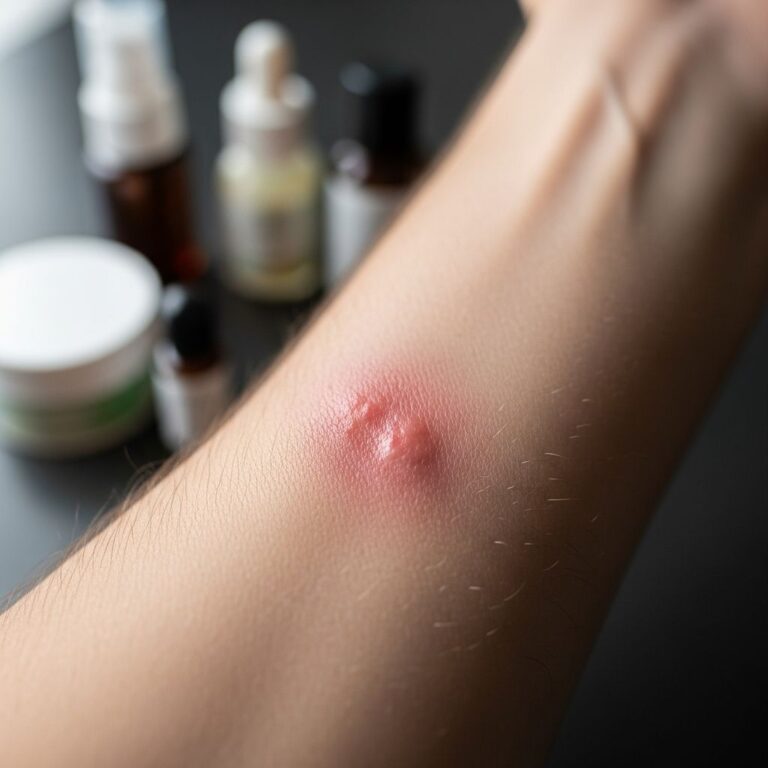
- Positive (allergic): Delayed onset (day 2–7): redness, dryness, itch, vesicles, or dermatitis. Indicates allergy; discontinue product.
- Irritant reaction: Immediate (hours): stinging, burning without progression. Common with rinse-offs; not allergy.
Positive ROAT often warrants formal patch testing to pinpoint the allergen. Negative on normal skin may turn positive on damaged skin due to enhanced penetration.
Differences from patch testing
| Aspect | Patch Test | Open Application Test (ROAT) |
|---|---|---|
| Setting | Clinic, occluded 48h | Home, open application |
| Allergen dose | High concentration | Real product dilution |
| Reading time | 48–96h | Daily, up to 7 days |
| Best for | Identifying specific haptens | Real-life relevance |
| Risk | Occlusion irritancy | Lower false positives |
Patch tests use standardized allergens on the back; ROAT uses patient products on extremities. ROAT confirms patch relevance, especially for weak reactions.
Who should do the test?
- Patients with suspected cosmetic/shampoo dermatitis.
- Post-patch test with ?+ or 1+ reactions.
- Atopic individuals trialing new products.
- Dermatologists evaluating topical therapies.
Not for type I allergies (urticaria, anaphylaxis)—use prick tests.
Limitations and risks
ROAT may miss low-sensitivity allergies or provoke severe reactions in highly sensitized individuals. Variability in site, dose, and compliance affects validity. Adverse events include dermatitis flares, secondary infections, or koebnerization in psoriatics. Discontinue if blistering or spreading occurs; seek medical advice. Products with multiple allergens complicate single-ingredient identification.
Regional skin differences (e.g., forearm vs. face) impact penetration; negative arm ROAT doesn’t rule out facial allergy.
Frequently Asked Questions (FAQs)
What if I get a reaction during ROAT?
Stop immediately. Redness/itch after days suggests allergy; seek patch testing. Immediate irritation likely non-allergic.
How long until results?
Allergic reactions peak days 4–7; observe full week if mild.
Can I test hair dye?
Yes, apply to forearm 48–72h pre-use per instructions. Positive = avoid.
Is ROAT safe for children?
Use caution; consult pediatric dermatologist. Smaller area/duration advised.
Negative ROAT but still react elsewhere?
Possible: higher exposure, damaged skin, or different allergen combo.
Conclusion
The open application test empowers proactive allergy screening, enhancing patch testing’s diagnostic power. Standardization improves reliability, making ROAT indispensable for contact dermatitis management. Always consult professionals for interpretation.
References
- Open application test — DermNet NZ. 2023. https://dermnetnz.org/topics/open-application-test
- Practical suggestions to improve standardization of repeated open application testing (ROAT) in allergic contact dermatitis — PMC (PubMed Central). 2022-05-16. https://pmc.ncbi.nlm.nih.gov/articles/PMC9131969/
- Skin Allergy Patch Testing — Michele Green MD. 2024. https://www.michelegreenmd.com/medical/skin-allergy-patch-testing
- ROAT (repeated open application test)/PUT (provocative use test) — PubMed. 2000. https://pubmed.ncbi.nlm.nih.gov/10902580/
- Patch tests — DermNet NZ. 2023. https://dermnetnz.org/topics/patch-tests
Similar Articles








Read full bio of medha deb