Oral Blistering Diseases: 6 Key Conditions And Treatments
Comprehensive guide to autoimmune blistering disorders affecting the oral mucosa, diagnosis, and management strategies.
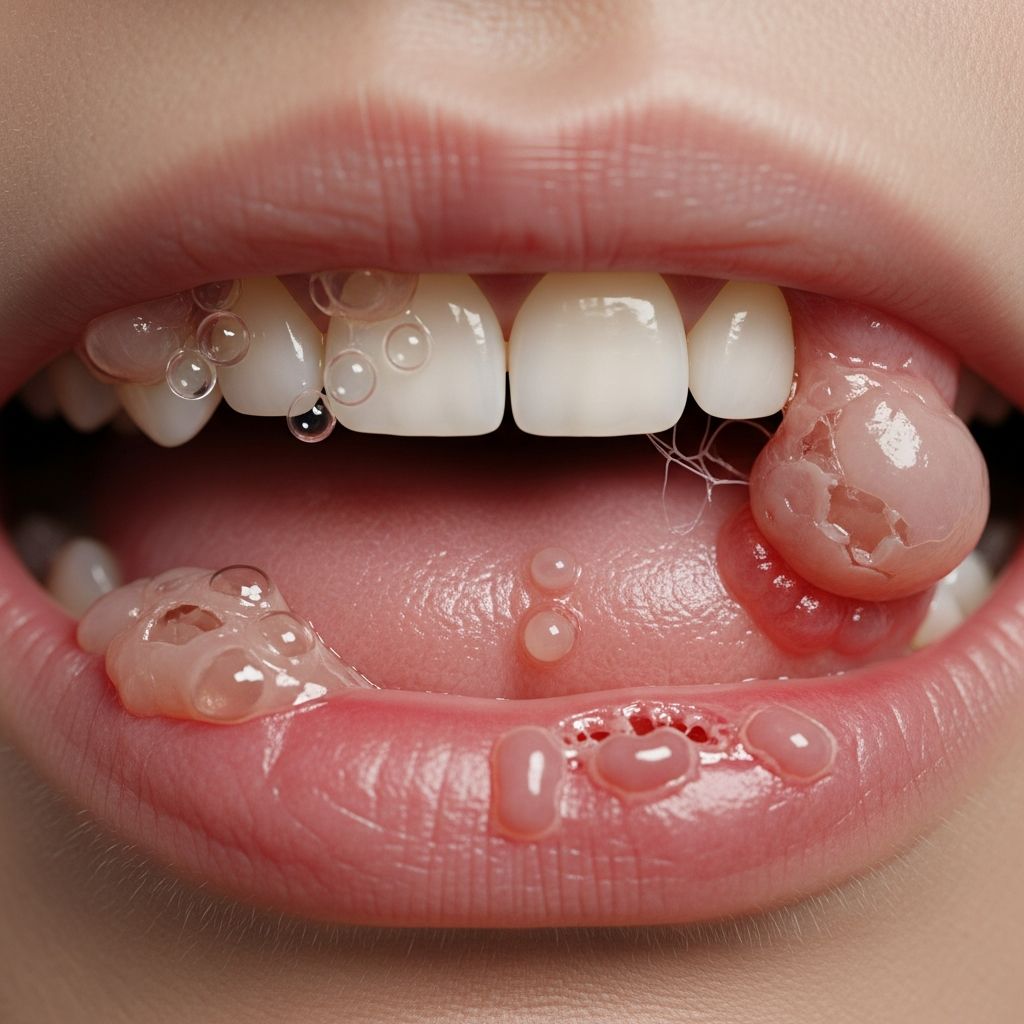
Oral blistering diseases encompass a group of autoimmune conditions characterized by blisters and erosions in the mouth due to autoantibodies targeting epithelial adhesion proteins. These disorders often present with painful mucosal lesions that rupture quickly, leading to widespread erosions affecting eating, speaking, and oral hygiene.
What are the clinical features of oral blistering diseases?
Patients typically report
painful oral erosions
as the initial symptom, since intact blisters rarely persist in the wet oral environment. Lesions commonly affect the buccal mucosa, palate, gingiva, and tongue, with extension to other sites like the nose, genitals, or conjunctiva depending on the disease subtype. Difficulty eating spicy or acidic foods exacerbates discomfort, and secondary infections may occur if hygiene is compromised.- Prodromal symptoms: Burning sensation or pain preceding visible lesions
- Lesion morphology: Flaccid blisters that rupture to form irregular, shallow erosions with erythematous borders
- Symptom severity: Ranges from localized discomfort to severe odynophagia preventing nutrition
- Systemic signs: Skin involvement in 30-50% of cases, fever, weight loss in progressive disease
Diagnosis requires correlation of clinical findings with histopathology and direct immunofluorescence (DIF) demonstrating specific antibody deposition patterns.
Pemphigus vulgaris
**Pemphigus vulgaris (PV)** represents the most common oral autoimmune blistering disease, with incidence of 0.1-0.5 per 100,000 adults, predominantly affecting those aged 50-60 years. It shows higher prevalence in Ashkenazi Jewish and Mediterranean populations, with equal gender distribution.
PV autoantibodies target desmoglein 3 (Dsg3), a desmosomal protein essential for keratinocyte adhesion in stratified squamous epithelium. Oral mucosa involvement occurs in 50-70% of cases, often preceding skin lesions by weeks to months.
Clinical features
Intact vesicles rarely observed; instead, fragile
intraepithelial blisters
rupture rapidly forming extensive, jagged erosions. Common sites include non-keratinized mucosa (buccal, ventral tongue, soft palate). PositiveNikolsky sign
(epithelial sloughing with lateral pressure) pathognomonic for suprabasal acantholysis.- Painful erosions causing odynophagia and weight loss
- Desquamative gingivitis in 30% of cases
- Progression to skin (scalp, face, trunk) within 6 months if untreated
Histopathology
Suprabasal acantholysis creates “row of tombstones” appearance with rounded basal keratinocytes attached to basement membrane. Inflammatory infiltrate sparse; Tzanck cells (acantholytic keratinocytes) visible on cytology.
Immunopathology
**DIF** reveals intercellular IgG/C3 deposition (fishnet pattern) throughout spinous layer. Indirect immunofluorescence (IIF) serum titers correlate with disease activity.
Paraneoplastic pemphigus
**Paraneoplastic pemphigus (PNP)** is a life-threatening acantholytic disorder associated with underlying neoplasms, affecting oral mucosa severely in nearly 100% of cases. Mean age 50-60 years; equal M:F ratio.
Complex autoantibody profile targets desmoplakins, envoplakin, periplakin, and desmogleins, explaining multi-site involvement including respiratory epithelium.
Associated neoplasms
- Benign: Thymoma (most common), Castleman disease
- Malignant: Non-Hodgkin lymphoma, CLL, sarcomas, Castleman tumor
Oral manifestations
Progress from
lip crusting
to hemorrhagic erosions, lichenoid lesions, or severe desquamative gingivitis. Pain intensity rivals PV but respiratory involvement distinguishes PNP.Related Stories



Diagnosis: DIF shows both intercellular AND basement membrane zone staining. IIF on rat bladder substrate highly specific.
Pemphigus foliaceus and variants
**Pemphigus foliaceus (PF)** primarily affects superficial skin (scalp, face, trunk) targeting Dsg1, sparing mucosa in 90% of cases. Superficial acantholysis yields scaly, crusted erosions rather than frank blisters.
- Rare mucosal involvement in endemic PF (fogo selvagem)
- Drug-induced PF from penicillamine, ACE inhibitors
- IIF titers lower than PV
Mucous membrane pemphigoid
**Mucous membrane pemphigoid (MMP)**, formerly cicatricial pemphigoid, comprises subepithelial blistering targeting basement membrane zone antigens (BP180, laminin 332, integrin α6β4). Oral cavity affected in 85-90% of cases, often with scarring.
Clinical variants
- Ocular MMP: Symblepharon, corneal scarring
- Oral MMP: Desquamative gingivitis (60%), palatal/ buccal erosions
- Laryngeal MMP: Hoarseness, airway compromise
**Tense blisters** rupture slower than PV, healing with
milk-of-calcium pseudomembrane
and potential fibrosis. Negative Nikolsky sign.Immunopathology
DIF: Linear IgG/C3/ IgA at basement membrane. Salt-split skin: Epidermal roof staining for anti-BP180.
Linear IgA disease
**Linear IgA bullous dermatosis** features homogeneous linear IgA deposition at basement membrane, mimicking MMP clinically. Oral lesions in 50% of adults: gingival erythema, desquamative gingivitis, vesicles.
- Drug-induced (vancomycin most common)
- Children: Chronic bullous disease of childhood
- Spontaneous resolution frequent
Epidermolysis bullosa acquisita
**EBA** autoantibodies target type VII collagen anchoring fibrils. Oral involvement 50%: trauma-induced blisters, milia formation, scarring. Mechanobullous variant shows fragility without inflammation.
Diagnosis
Clinical assessment
History: Disease onset, progression, extraoral sites, medications, neoplasms. Examination: Lesion distribution, Nikolsky sign, scarring.
Investigations
| Test | Purpose | Key Findings |
|---|---|---|
| Incisional biopsy | Histopathology | Suprabasal (PV) vs subepidermal (MMP) split |
| Perilesional DIF | Immunopathology | Intercellular IgG (PV) vs linear BMZ IgG/IgA (MMP) |
| IIF/ELISA | Autoantibody detection | Dsg3 titers (PV), BP180 (MMP) |
| Serum ELISA | Disease monitoring | Titer correlation with activity |
Multidisciplinary approach essential: Dermatology, oral medicine, ophthalmology.
Treatment
First-line: Corticosteroids
- Mild oral disease: Topical superpotent (clobetasol) or intralesional steroids
- Moderate-severe: Prednisone 0.5-1 mg/kg/day + steroid-sparing agent
Steroid-sparing immunosuppressants
| Agent | Indications | Dose | Monitoring |
|---|---|---|---|
| Azathioprine | First-line adjunct | 1-2.5 mg/kg/day | TPMT, CBC, LFTs |
| Mycophenolate mofetil | Azathioprine intolerant | 2-3 g/day | CBC, GI tolerance |
| Rituximab | Refractory PV | 375 mg/m² ×4 or 1g ×2 | Infusion reactions, infections |
| Cyclophosphamide | PNP, severe MMP | Pulse therapy | Cystitis prophylaxis |
Supportive care
- Topical anesthetics (lidocaine gel)
- Antiseptics (chlorhexidine)
- Soft diet, nutritional supplements
- Pain management (benzydamine)
Disease-specific
- PNP: Treat underlying neoplasm; IVIG, rituximab
- Ocular MMP: Dapsone, IVIG; surgical intervention
- Linear IgA: Dapsone 50-150 mg/day
Frequently Asked Questions (FAQs)
Q: Do oral blisters always indicate autoimmune disease?
A: No, viral infections (herpes), trauma, or malignancy must be excluded. Biopsy with DIF differentiates autoimmune blistering.
Q: Can pemphigus vulgaris be cured?
A: Not curative but long-term remission achievable with immunosuppression. Relapse common upon tapering.
Q: Is scarring inevitable in oral pemphigoid?
A: Oral scarring less common than ocular/genital sites but desquamative gingivitis may persist despite treatment.
Q: What is the prognosis for paraneoplastic pemphigus?
A: Poor; mortality 75-90% due to sepsis, respiratory failure despite immunosuppression.
Q: Are biologic therapies safe for oral blistering diseases?
A: Rituximab effective for refractory PV (remission rates 80-90%) but increases infection risk requiring prophylaxis.
References
- Pemphigus – Symptoms and causes — Mayo Clinic. 2023-10-15. https://www.mayoclinic.org/diseases-conditions/pemphigus/symptoms-causes/syc-20350404
- Oral autoimmune blistering diseases — DermNet NZ. 2024-05-20. https://dermnetnz.org/topics/oral-blistering-diseases
- Mouth Sores and Inflammation — Merck Manuals. 2025-01-10. https://www.merckmanuals.com/home/mouth-and-dental-disorders/symptoms-of-oral-and-dental-disorders/mouth-sores-and-inflammation
- Autoimmune Diseases and Their Manifestations on Oral Cavity — PMC (NCBI). 2018-07-15. https://pmc.ncbi.nlm.nih.gov/articles/PMC5994274/
- Oral Mucosal Diseases — UC Davis Health. 2024-11-05. https://health.ucdavis.edu/dermatology/specialties/medical/oral.html
- Blistering Diseases — UChicago Medicine. 2024-08-22. https://www.uchicagomedicine.org/conditions-services/dermatology/treatments-and-services/blistering-diseases
Similar Articles








Read full bio of Sneha Tete