Orf And Milker’s Nodules: A Complete Guide On Diagnosis & Care
Comprehensive guide to orf and milker's nodules: causes, clinical features, diagnosis, and management of these parapoxvirus infections.
Orf (also known as
ecthyma contagiosum
) and milker’s nodules are benign viral infections of the skin caused byparapoxviruses
. Thesezoonotic
conditions primarily affect individuals in contact with infected animals, such as farmers, veterinarians, and abattoir workers. Orf is transmitted from sheep and goats, while milker’s nodules come from cows. Both present as self-limiting papulonodular lesions on the hands, with characteristic evolution through stages. Diagnosis is typically clinical, supported by histopathology or PCR if needed. Management is supportive, as lesions resolve spontaneously within 4–8 weeks.What are orf and milker’s nodules?
Orf and milker’s nodules belong to the
Parapoxvirus
genus within thePoxviridae
family. These double-stranded DNA viruses are host-specific but can infect humans viadirect contact
with infected animal skin lesions or fomites. Orf virus infects sheep and goats, causing contagious ecthyma, while bovine papular stomatitis virus or pseudocowpox virus causes milker’s nodules in cattle.In humans, infections manifest as
localized skin lesions
, rarely systemic. They areoccupational hazards
for those handling livestock. Globally prevalent in rural areas, with higher incidence in developing countries due to limited animal vaccination. Unlike more severe poxviruses like smallpox, these aremild and self-resolving
, but can be painful and complicate wound healing.- Orf: Most common in children and adults exposed to lambs/kids during weaning.
- Milker’s nodules: Affects dairy workers during milking.
Who gets orf and milker’s nodules?
At-risk groups include:
- Farmers, shepherds, and goat herders.
- Veterinarians and animal handlers.
- Abattoir and meat processing workers.
- Children in rural areas with pet lambs or goats.
- Butchers and tanners.
- Rarely, laboratory workers handling samples.
Immunocompromised individuals (e.g., HIV, transplant patients) may experience
atypical giant forms
or prolonged healing. No strong gender predilection, but males predominate due to occupational exposure. Seasonal peaks occur during lambing/kidding (spring) for orf and calving/milking seasons for milker’s nodules.What causes orf and milker’s nodules?
These infections result from
mechanical inoculation
of virus throughskin abrasions
during animal contact. Virus enters via microtrauma from scratches, bites, or rough skin.| Condition | Virus | Animal Reservoir |
|---|---|---|
| Orf | Orf virus | Sheep, goats |
| Milker’s nodules | Pseudocowpox virus or Bovine papular stomatitis virus | Cows |
Virus replicates in keratinocytes, inducing hyperplasia and immune response. Lesions evolve through 6 stages for orf (macule → target → nodular → papillomatous → regressing → resolving) over 35–40 days. Milker’s nodules have fewer stages: maculopapular → nodular → regressive.
What are the clinical features of orf and milker’s nodules?
Orf
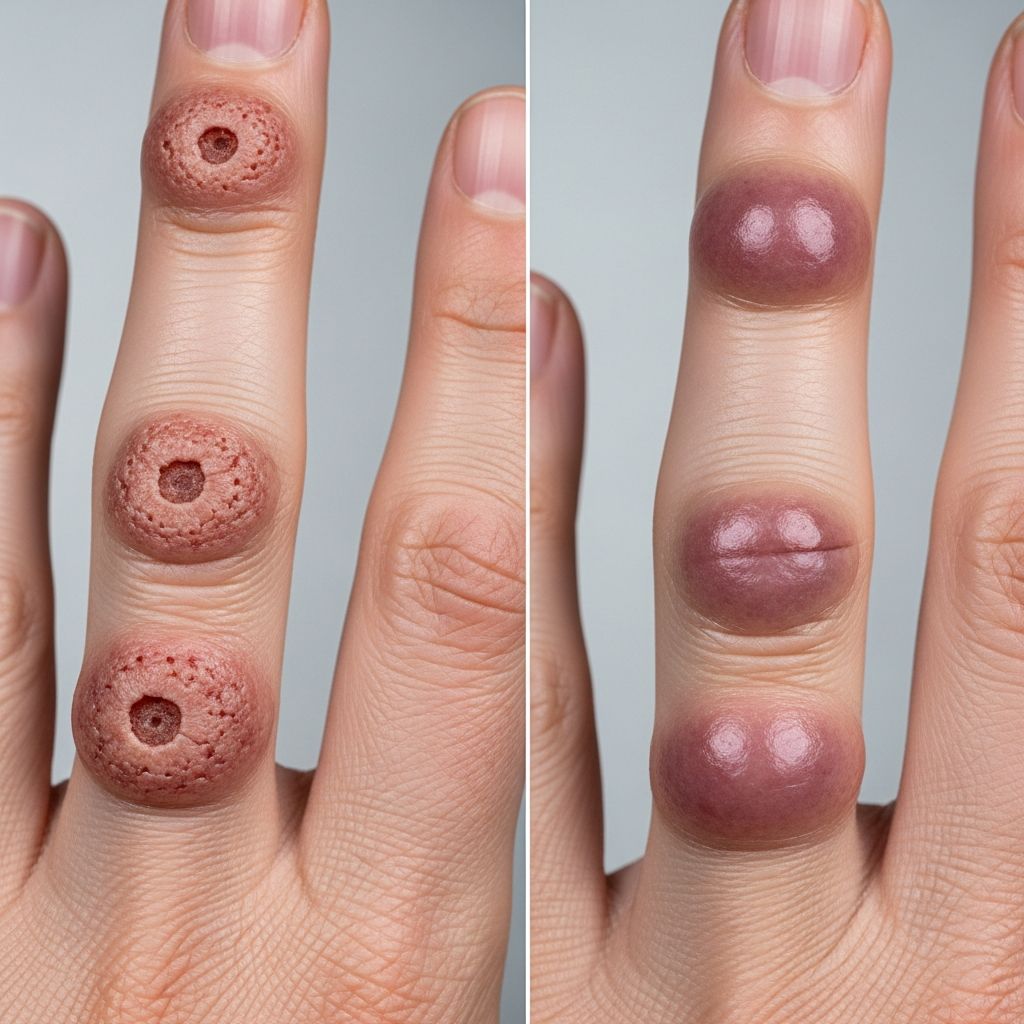
Typically 1–3 lesions (up to 20 in outbreaks) on dorsal fingers, hands, forearms, or face. Size 0.5–3 cm. Evolution:
- Maculopapular (1–2 days): Red macule.
- Target (3–7 days): Central grey vesicle with red halo.
- Acute nodular (7–10 days): Raised nodule.
- Papillomatous/regressing (10–14 days): Verrucous, black core.
- Proliferative: Thickened papilloma.
- Resolving (4–8 weeks): Crusting, scarring.
Related Stories



Painful, may bleed/ooze. Lymphadenopathy, fever in 10–20%. Complications:
bacterials superinfection
,auto-inoculation
(e.g., eye),giant orf
in immunocompromised (>3 cm, slow healing).Milker’s nodules
Multiple (5–20) smaller lesions (0.5–1 cm) on milking hand fingers, palms. Bluish-red nodules with gelatinous halo. Less staged evolution, resolve in 4–6 weeks without scarring. Mildly tender, rare systemic symptoms.
Differential diagnosis: Herpetic whitlow, pyogenic granuloma, warts, BCC, orf vs. milker’s (history differentiates).
Diagnosis of orf and milker’s nodules
Clinical diagnosis based on exposure history, lesion morphology/stages. Confirm with:
- Histopathology: Parapoxvirus inclusions (A-type), epidermal hyperplasia, ballooning degeneration.
- PCR/electron microscopy: Virus detection from lesion swab/biopsy.
- Viral culture: Rarely done.
Biopsy if atypical or immunocompromised patient. Serology not useful due to cross-reactivity.
Treatment of orf and milker’s nodules
Supportive care primary, as self-limiting:
- Wound care: Clean, occlusive dressings.
- Pain relief: Paracetamol/NSAIDs.
- Antibiotics for secondary infection (e.g., flucloxacillin).
Interventions for complications:
- Curettage/electrocautery: Painful lesions (local anesthetic).
- Cidofovir cream/topical imiquimod: Refractory/giant forms (limited evidence).
- Intralesional IFN-α: Severe cases.
- Avoid cryotherapy (risk dissemination).
Healing accelerated in 20–30% with debridement. No routine antivirals effective.
Complications and prognosis
Excellent prognosis: Complete resolution without scarring in most. Rare complications:
- Cellulitis/lymphangitis.
- Erythema multiforme.
- Norwegian-like giant lesions in immunosuppression.
- Eye involvement (keratitis).
Recurrence uncommon due to immunity (lasting years). No long-term sequelae.
Prevention of orf and milker’s nodules
- Animal vaccination: Live attenuated orf vaccine for sheep/goats.
- PPE: Gloves, protective clothing during handling.
- Hygiene: Handwashing, wound coverage.
- Educate at-risk workers. Isolate infected animals.
Frequently Asked Questions (FAQs)
Q: Is orf contagious between humans?
A: No, human-to-human transmission is not reported. Only zoonotic from animals.
Q: How long do orf lesions last?
A: 4–8 weeks typically, through 6 evolutionary stages.
Q: Can milker’s nodules scar?
A: Rarely; they usually resolve without scarring unlike some orf lesions.
Q: What if I’m immunocompromised and get orf?
A: Seek medical advice promptly; may develop giant, persistent lesions requiring intervention.
Q: Is there a vaccine for humans?
A: No human vaccine; prevention relies on animal vaccination and barriers.
References
- Orf (disease) – Wikipedia — Informed by CDC/WHO data. 2023-05-15. https://en.wikipedia.org/wiki/Orf_(disease)
- Parapoxvirus Infections — CDC Yellow Book. 2024-07-22. https://wwwnc.cdc.gov/travel/yellowbook/2024/infections-diseases/parapoxvirus-infections
- Milker’s nodule and bovine papular stomatitis — DermNet NZ (primary source). 2023-11-10. https://dermnetnz.org/topics/milkers-nodule-and-bovine-papular-stomatitis
- Orf virus infection — WHO. 2022-03-01. https://www.who.int/health-topics/zootonic-diseases
- Human Orf Infection — PubMed/PMC (peer-reviewed). 2021-06-15. https://pmc.ncbi.nlm.nih.gov/articles/PMC8202387/
- Viral Skin Diseases: Poxviruses — American Academy of Dermatology. 2024-01-29. https://www.aad.org/public/diseases/a-z/orf-overview
Similar Articles








Read full bio of medha deb