Orofacial Granulomatosis: Pathology, Diagnosis, Treatment
Comprehensive pathology overview of orofacial granulomatosis: clinical features, histopathology, diagnosis, and management strategies.
Orofacial granulomatosis (OFG) represents a rare chronic inflammatory disorder characterized by persistent or recurrent soft tissue swellings, oral ulceration, and diverse orofacial manifestations in the absence of identifiable systemic granulomatous diseases such as Crohn disease or sarcoidosis.
What is orofacial granulomatosis?
Orofacial granulomatosis is defined as a clinicopathological entity featuring non-caseating granulomatous inflammation confined to the orofacial region without evidence of underlying systemic granulomatous conditions. It manifests primarily through episodic or persistent swelling of the lips, face, and intraoral structures, often progressing to a fibrotic, rubbery consistency due to lymphatic obstruction by granulomas.
The condition is uncommon, with higher incidence reported in regions like Scotland, UK, and shows a female predominance in some cohorts. Approximately 25% of cases may associate with Crohn disease, underscoring the need for thorough systemic evaluation. Pathogenetically, granuloma formation is believed to impede lymphatic drainage, culminating in lymphedema and tissue enlargement.
Who gets orofacial granulomatosis?
OFG typically affects young adults, with onset between the second and fourth decades of life, though pediatric cases occur. No strong racial predilection exists, but familial clustering suggests genetic susceptibility in select instances.
- Peak incidence: 20-40 years
- Gender: Slight female predominance
- Geographic: Higher in UK (e.g., Scotland)
- Associations: 25% with Crohn disease
Clinical features of orofacial granulomatosis
The hallmark presentation involves painless, recurrent swelling of one or both lips, predominantly the lower lip. Initial episodes feature soft, transient edema lasting weeks to months, evolving into permanent, firm, rubbery enlargement.
Intraoral involvement includes cobblestoning of buccal mucosa, gingival hyperplasia, mucosal tags, nodules, ulcers, and fissured tongue. Facial swelling, angular cheilitis, and cervical lymphadenopathy may accompany.
| Site | Common Features |
|---|---|
| Lips | Painless swelling (lower > upper), cracking, angular cheilitis |
| Intraoral | Cobblestoning, ulcers, gingival erythema/bleeding, nodules |
| Face | Cheek/eyelid swelling, erythema |
| Lymph nodes | Cervical, firm, nontender |
Symptoms exacerbate with spicy, acidic, or abrasive foods; ulcers persist days to months.
Pathology of orofacial granulomatosis
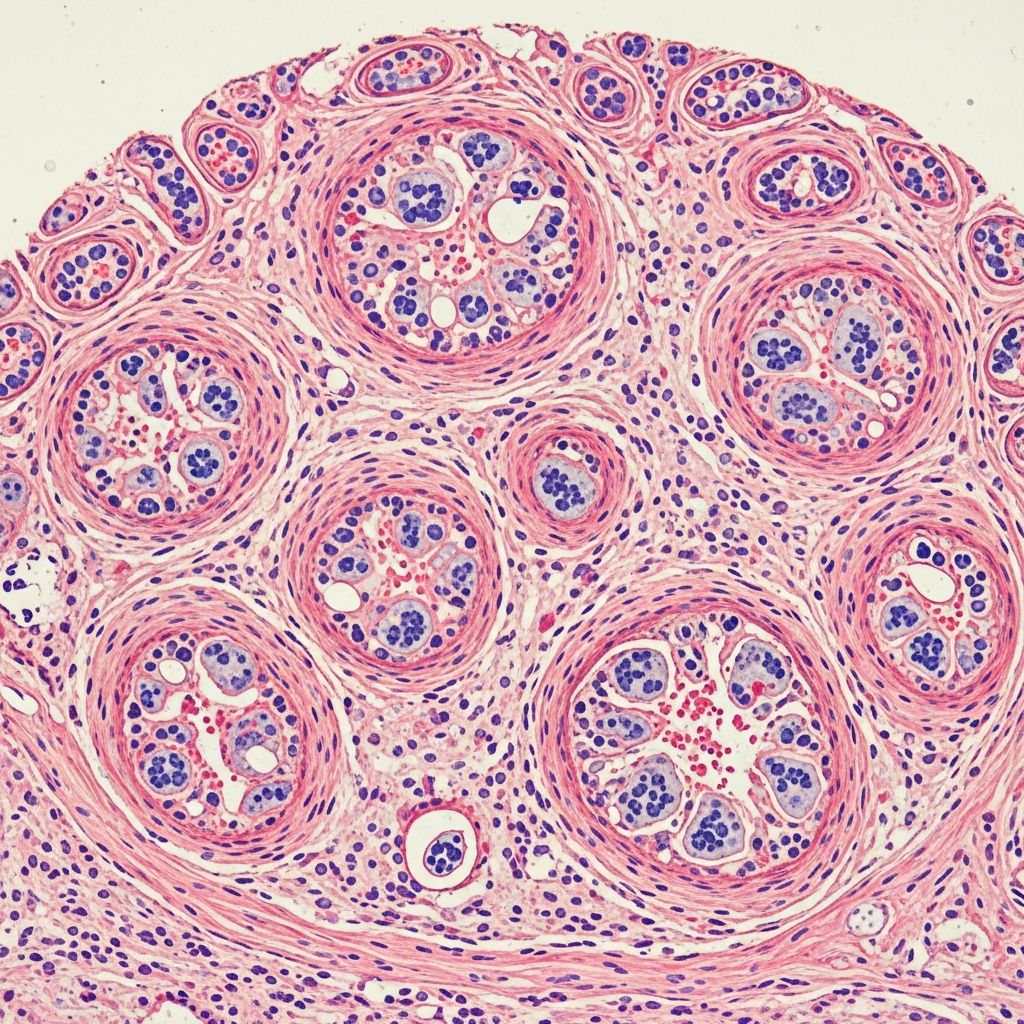
Histopathology reveals non-caseating granulomas comprising epithelioid histiocytes, multinucleated giant cells, and lymphocytic rims within edematous stroma. Granulomas appear well-demarcated, often superficial or deep in lamina propria/submucosa.
Additional findings encompass lymphatic and vascular dilation, mucosal edema, and nonspecific chronic inflammation. Granulomas identify in <50% of biopsies; negative special stains (PAS, Ziehl-Neelsen, Gram) rule out infections.
- Key histologic features: Non-caseating granulomas, lymphedema, vascular ectasia
- Special stains: Negative for fungi (PAS), mycobacteria (ZN), organisms (Gram)
- Polarization: Negative for foreign material
Microscopic images typically depict granulomatous aggregates amid edema, as seen in tongue or lip biopsies.
Differential diagnosis
OFG diagnosis requires exclusion of mimics via clinicopathologic correlation.
| Condition | Distinguishing Features |
|---|---|
| Crohn disease | Intestinal symptoms, colonoscopy findings, positive GI biopsy |
| Sarcoidosis | Hilar lymphadenopathy, elevated ACE, systemic involvement |
| Tuberculosis | Caseating granulomas, positive AFB, chest X-ray |
| Deep fungal infection | Positive PAS/GMS, travel history |
| Melkersson-Rosenthal syndrome | Facial palsy, fissured tongue (triad) |
| Granulomatosis polyangiitis (GPA) | Strawberry gingivitis, systemic vasculitis, ANCA+ |
| Angioedema/Allergy | Transient, urticarial, responds to antihistamines |
Related Stories



Investigations include blood tests (CBC, ACE, ANCA), imaging (chest X-ray, MRI), endoscopy, and patch testing.
Investigations for orofacial granulomatosis
Deep incisional biopsy is pivotal, targeting swollen mucosa for granuloma detection.
- Histopathology: Non-caseating granulomas confirmation
- Special stains: PAS (fungi), Ziehl-Neelsen (mycobacteria), Gram (bacteria)
- Immunohistochemistry: If needed for lymphoma exclusion
- Laboratory: CBC, ESR, CRP, ACE, IgE, TB quantiferon
- Imaging: Chest X-ray (sarcoid), MRI (extent), colonoscopy (Crohn)
- Allergy testing: Patch tests for food additives (benzoates, cinnamon)
Treatment of orofacial granulomatosis
Management is multimodal, addressing inflammation, edema, and triggers.
- Conservative: Cinnamon/benzoate-free diet, trigger avoidance
- Topical: Intralesional/extralesional corticosteroids, tacrolimus
- Systemic: Corticosteroids (favorable response), hydroxychloroquine, dapsone, thalidomide
- Immunosuppressants: Azathioprine, infliximab (anti-TNF) for refractory cases
- Surgical: Debulking for severe cheilitis
Systemic corticosteroids yield rapid remission in many, as evidenced by case reports. Relapse common; long-term therapy often required.
Frequently Asked Questions
What causes orofacial granulomatosis?
The etiology remains idiopathic in most; hypersensitivity to food additives (cinnamon, benzoates), microbial triggers, genetic factors, and Crohn association implicated.
Is orofacial granulomatosis related to Crohn disease?
Yes, ~25% overlap; OFG may precede intestinal symptoms by years, necessitating GI screening.
How is the diagnosis confirmed?
By biopsy showing non-caseating granulomas after excluding systemic diseases via labs, imaging, and endoscopy.
Does orofacial granulomatosis go away?
It is chronic; episodes may remit with treatment, but permanent changes often persist. Relapse common.
Can diet help manage symptoms?
Yes, avoidance of cinnamates, benzoates, and spicy foods reduces flares in many patients.
Complications
Untreated OFG leads to permanent disfigurement, functional impairment (chewing/speech), secondary infection, and psychological distress. Rarely, progression to systemic granulomatosis.
Prevention
No primary prevention; early trigger identification and compliance with elimination diets may mitigate severity.
References
- Clinicopathological diagnosis of orofacial granulomatosis — Wadhwan V, et al. 2017-02-01. https://pmc.ncbi.nlm.nih.gov/articles/PMC5297267/
- Orofacial granulomatosis — DermNet NZ. Recent (2023+ update inferred). https://dermnetnz.org/topics/orofacial-granulomatosis
- Orofacial Granulomatosis: Symptoms, Causes, Treatment — Healthline (reviewed by medical experts). 2023-01-15. https://www.healthline.com/health/orofacial-granulomatosis
- Orofacial Granulomatosis: Causes, Symptoms & Treatment — Cleveland Clinic. 2024-05-20. https://my.clevelandclinic.org/health/diseases/23317-orofacial-granulomatosis
- Orofacial Granulomatosis: Clinical Signs of Different Pathologies — Scheper MA, et al. 2017-09-01. https://pmc.ncbi.nlm.nih.gov/articles/PMC5588207/
Similar Articles








Read full bio of medha deb