Osteoblasts and Osteoclasts: Bone Cell Functions
Understanding how bone-building and bone-breaking cells maintain skeletal health.
Osteoblasts and Osteoclasts: Understanding Your Bone Cells
Your skeleton is more than just a static framework supporting your body. It is a dynamic, living system constantly undergoing renewal and repair. At the heart of this continuous process are two specialized cell types: osteoblasts and osteoclasts. These remarkable cells work in concert to maintain bone strength, facilitate healing, and ensure your skeletal system remains resilient throughout your lifetime. Understanding how these cells function and interact provides valuable insight into bone health and the factors that influence skeletal integrity.
What Are Osteoblasts?
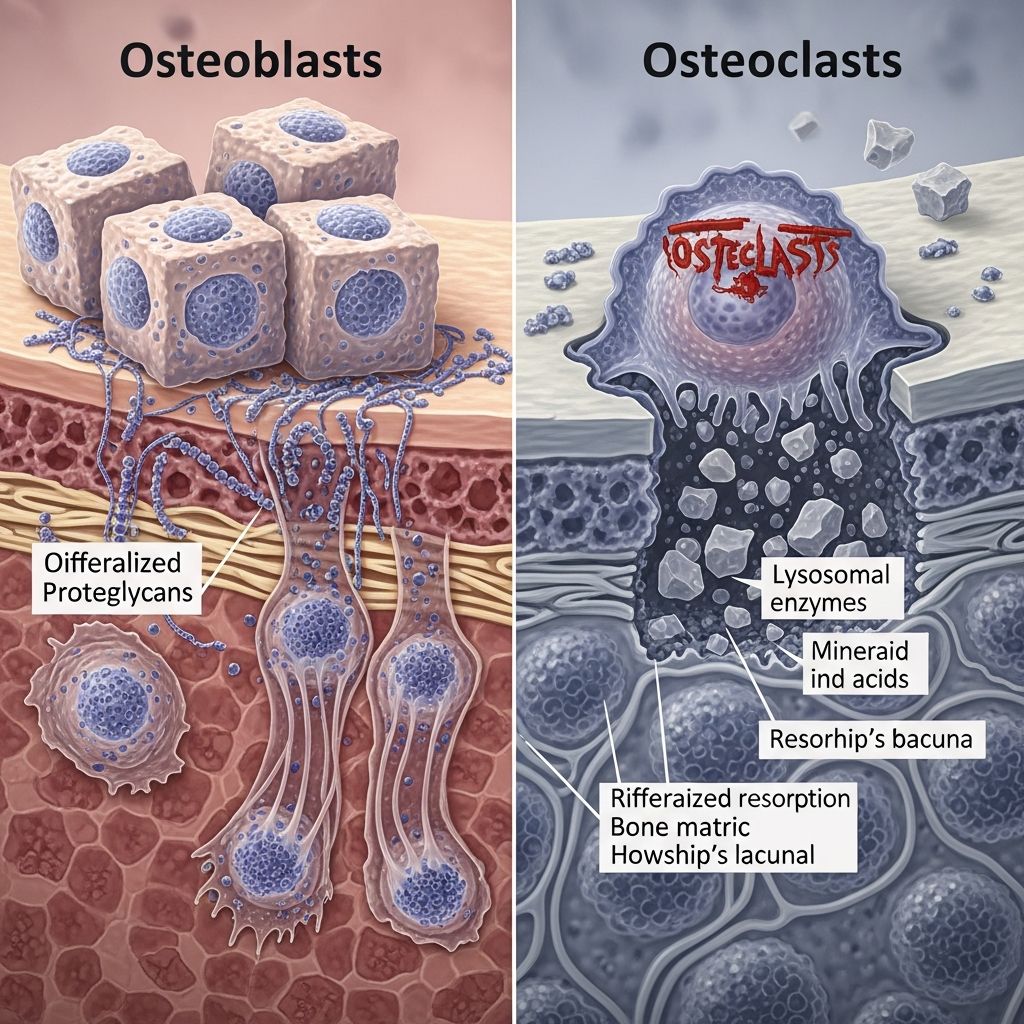
Osteoblasts are the primary bone-building cells in your body, responsible for creating and maintaining bone tissue. These specialized cells originate from mesenchymal stem cells located in the periosteum—the protective tissue layer covering the outer surface of bones. Osteoblasts appear as a densely packed layer of cuboidal cells on the bone surface, actively engaged in synthesizing new bone matrix.
Key characteristics of osteoblasts include:
- Small, uniformly sized cells with a single nucleus
- Relatively simple cellular structure with fewer organelles compared to osteoclasts
- Linked together through tight junctions and gap junctions, allowing them to function as an integrated unit
- Capable of responding to various hormones through specialized proteins on their cell membranes
- Organized in functional groups that oversee the construction of osteon units—the basic structural components of bone
The primary function of osteoblasts is synthesizing and secreting the organic components of bone matrix, including collagen proteins and other extracellular materials essential for bone structure and strength. These cells produce alkaline phosphatase, an enzyme crucial for bone mineralization, and they generate hydroxyapatite—a mineral compound that hardens bone tissue and provides its characteristic rigidity.
What Are Osteoclasts?
Osteoclasts represent the opposing force in bone physiology, functioning as specialized bone-resorbing cells that break down and remove aged or damaged bone tissue. Unlike osteoblasts, osteoclasts originate from hematopoietic stem cells in the bone marrow and are more closely related to immune cells, particularly monocytes and macrophages. These giant multinucleated cells form when two or more precursor cells fuse together, creating a highly specialized resorptive unit.
Distinctive features of osteoclasts include:
- Large, multinucleated cells containing multiple nuclei within a single cell body
- Complex cellular structure with numerous organelles and mitochondria
- Specialized membrane structures called ruffled borders or brush borders that extend into bone tissue
- Capacity to produce powerful enzymes and acids that dissolve bone mineral and organic matrix
- Ability to generate localized acidic microenvironments that facilitate bone degradation
The primary function of osteoclasts is removing and recycling bone material through a process called bone resorption. These cells secrete hydrogen ions and proteolytic enzymes, including collagenase and cathepsin K, which dissolve the mineral components and break down the organic collagen matrix of bone. This resorptive activity releases calcium into the bloodstream, maintaining systemic calcium homeostasis—critical for nerve transmission, muscle contraction, and numerous other physiological processes.
Structural and Functional Differences
| Feature | Osteoblasts | Osteoclasts |
|---|---|---|
| Origin | Mesenchymal stem cells in periosteum | Hematopoietic stem cells in bone marrow |
| Cell Size | Small, compact cells | Large, multinucleated giant cells |
| Nuclei | Uninucleated (single nucleus) | Multinucleated (multiple nuclei) |
| Primary Function | Bone formation and mineralization | Bone resorption and recycling |
| Key Products | Collagen, alkaline phosphatase, hydroxyapatite, osteocalcin | Hydrogen ions, collagenase, cathepsin K, tartrate-resistant acid phosphatase |
| Location | Bone surface and periosteum | Bone surface and endosteum |
| Communication | Regulates osteoclast activation through RANKL and other signals | Responds to osteoblast signals; removes damaged tissue for replacement |
Related Stories



The Bone Remodeling Process
Bone remodeling is a continuous, carefully orchestrated process that depends on the coordinated activities of osteoblasts and osteoclasts. This dynamic cycle occurs throughout life and serves multiple critical functions: removing damaged bone to prevent fracture accumulation, adapting bone structure to changing mechanical demands, and maintaining calcium and phosphate homeostasis.
The remodeling cycle progresses through several phases. Initially, osteoclasts are activated and resorb damaged or aged bone, creating small cavities called resorption lacunae. Following bone removal, osteoblasts are recruited to the site and begin synthesizing new bone matrix. Over weeks and months, this newly formed bone mineralizes and hardens. Eventually, osteoblasts become embedded within the solidifying matrix and transform into osteocytes—mature bone cells that maintain the bone structure and communicate through networks of small channels called canaliculi.
Cellular Communication and Regulation
The balance between bone formation and resorption is maintained through sophisticated communication between osteoblasts and osteoclasts. These cells do not function independently but rather engage in direct cell-to-cell contact and exchange chemical signals that regulate their behavior, survival, and differentiation.
Osteoblasts regulate osteoclast formation through multiple signaling pathways. They express RANKL (receptor activator of nuclear factor kappa-B ligand), a critical factor that stimulates osteoclast precursor cells to differentiate into mature, bone-resorbing osteoclasts. Additionally, osteoblasts produce anti-inflammatory cytokines that modulate the resorptive process and promote bone healing. Through ephrin-ephB4 signaling, osteoclasts can stimulate osteoblast differentiation and bone formation, creating a coordinated feedback loop that maintains skeletal homeostasis.
Factors Affecting Osteoblast and Osteoclast Activity
Multiple factors influence the activity levels of these bone cells, including hormonal regulation, nutritional status, and mechanical loading.
Hormonal influences include:
- Parathyroid hormone (PTH): Stimulates osteoblasts, which indirectly activate osteoclasts for bone resorption when calcium levels are low
- Calcitonin: Directly inhibits osteoclast activity to conserve bone mineral
- Estrogen: Promotes osteoblast activity and inhibits osteoclast differentiation; declining estrogen after menopause increases bone loss
- Testosterone: Supports bone formation through osteoblast stimulation
- Growth hormone and insulin-like growth factor-1: Promote bone formation and overall skeletal growth
Nutritional factors, particularly calcium, phosphorus, and vitamin D, are essential for optimal osteoblast function and bone mineralization. Mechanical loading and weight-bearing exercise stimulate osteoblast activity and promote bone density, while immobilization and reduced physical activity can suppress bone formation and accelerate resorption.
Common Conditions Related to Bone Cell Imbalance
When the balance between osteoblast and osteoclast activity becomes disrupted, various bone disorders can develop. Osteoporosis occurs when osteoclast activity exceeds osteoblast bone formation, resulting in decreased bone density and increased fracture risk. Conversely, osteosclerosis develops when osteoblast activity predominates, leading to abnormally dense but potentially brittle bone. Paget’s disease involves dysregulated osteoclast activity followed by excessive disorganized osteoblast response, creating deformed, weakened bones.
Frequently Asked Questions
Q: What is the main difference between osteoblasts and osteoclasts?
A: Osteoblasts are bone-building cells that synthesize and mineralize new bone tissue, while osteoclasts are bone-resorbing cells that break down aged or damaged bone. Together, they maintain bone remodeling and skeletal health.
Q: Can osteoblasts become osteocytes?
A: Yes, osteoblasts become trapped within the mineralized bone matrix as it hardens and differentiate into osteocytes, mature bone cells responsible for maintaining bone structure and exchanging nutrients through canaliculi.
Q: How do osteoblasts and osteoclasts communicate?
A: These cells communicate through direct cell-to-cell contact and chemical signaling molecules. Osteoblasts produce RANKL and other signals that regulate osteoclast activation, while osteoclasts provide feedback signals that influence osteoblast differentiation and bone formation.
Q: What happens when osteoclast activity exceeds osteoblast activity?
A: When bone resorption outpaces bone formation, bone density decreases, leading to conditions like osteoporosis and increased susceptibility to fractures.
Q: How does exercise affect these bone cells?
A: Weight-bearing exercise and mechanical loading stimulate osteoblast activity and promote bone formation, while physical inactivity reduces osteoblast activity and can accelerate bone loss through increased osteoclast activity.
References
- Osteoblast vs Osteoclast — MedicineNet. 2024. https://www.medicinenet.com/osteoblast_vs_osteoclast/article.htm
- What are osteoblasts and osteoclasts? — Get a Professor. 2022-04-25. https://getaprofessor.com/2022/04/25/what-are-osteoblasts-and-osteoclasts/
- Bone – Cell Types in Bones — Biology LibreTexts. https://bio.libretexts.org/Bookshelves/Introductory_and_General_Biology/General_Biology_(Boundless)/38:_The_Musculoskeletal_System/38.06:_Bone_-_Cell_Types_in_Bones
- Osteoblast-Osteoclast Communication and Bone Homeostasis — PubMed Central/NIH. 2020. https://pmc.ncbi.nlm.nih.gov/articles/PMC7564526/
- Osteoblast-Osteoclast Interactions — PubMed Central/NIH. 2017. https://pmc.ncbi.nlm.nih.gov/articles/PMC5612831/
Similar Articles








Read full bio of medha deb