Osteoporosis Diagnosis: DXA, T-Score, FRAX, And Next Steps
Learn how osteoporosis is diagnosed, from bone density scans to risk assessments and T-scores, to catch it early and prevent fractures.
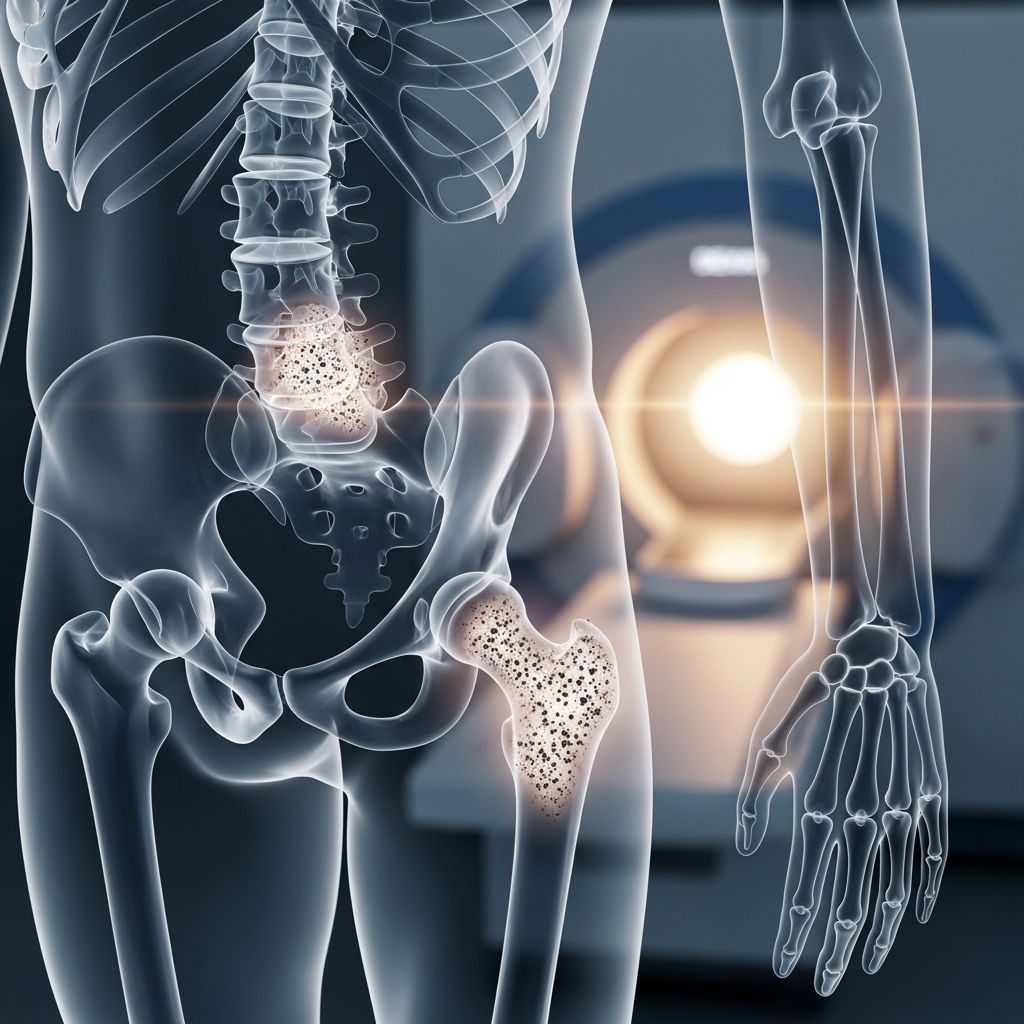
Osteoporosis is diagnosed primarily through bone mineral density (BMD) testing using dual-energy X-ray absorptiometry (DXA), where a T-score of -2.5 or lower at the hip or spine confirms the condition, or by the presence of a fragility fracture.
What Is Osteoporosis?
Osteoporosis is a systemic skeletal disease characterized by low bone mass and deterioration of bone tissue, leading to increased bone fragility and susceptibility to fractures, often remaining asymptomatic until a fracture occurs.
It develops when bone mineral density decreases or bone structure weakens, making bones brittle enough that everyday activities like bending or coughing can cause breaks.
The condition affects the entire skeleton but commonly impacts the spine, hips, and wrists, with fractures occurring from minimal trauma, known as fragility fractures.
Osteoporosis Risk Factors
Screening for osteoporosis is guided by individual risk factors, including female sex, postmenopausal status, older age (over 50 or 65), low body mass index (under 20 kg/m²), family history of hip fracture, personal history of fragility fracture, rheumatoid arthritis, diabetes, sarcopenia, prolonged corticosteroid use, tobacco smoking, excessive alcohol intake, and treatments like androgen deprivation or aromatase inhibitors.
- Non-modifiable risks: Age, sex (women at higher risk post-menopause), ethnicity (Caucasian and Asian higher), family history.
- Modifiable risks: Low BMI, smoking, heavy alcohol use (>3 drinks/day), physical inactivity.
- Secondary causes: Endocrine disorders (hyperthyroidism, hyperparathyroidism), gastrointestinal malabsorption, chronic inflammation.
A thorough medical history assessing these factors determines the need for BMD testing.
Who Should Get Screened for Osteoporosis?
Screening is recommended for all women aged 65 and older, men aged 70 and older, regardless of risk factors, and earlier for those with significant risks like prior fragility fracture or high FRAX score.
Younger postmenopausal women under 65 or men 50-69 should screen if they have risk factors such as low BMI, current smoking, or family history.
Pregnant women or those under 20 rarely need screening unless multiple fragility fractures occur; premenopausal women use Z-scores instead of T-scores for assessment.
How Is Osteoporosis Diagnosed?
Diagnosis relies on BMD testing via DXA at the hip (femoral neck) and lumbar spine (L1-L4), with a T-score -2.5 indicating osteoporosis.
A fragility fracture (from fall at standing height or less) diagnoses osteoporosis even without low BMD.
Central DXA is the gold standard: non-invasive, low-radiation, quick (10-20 minutes), measuring bone density by X-ray attenuation.
Forearm (1/3 radius) DXA is used if hip/spine scans are unreliable due to arthritis or surgery.
Bone Density Test (DXA Scan)
DXA (dual-energy X-ray absorptiometry) uses two low-energy X-ray beams to differentiate bone mineral (hydroxyapatite) from soft tissue, providing precise BMD in g/cm .
Patients lie still on a table while the scanner arm passes over the hip and spine; no needles or special prep needed beyond comfortable clothing.
Common sites: proximal femur, femoral neck, lumbar spine. Lateral spine DXA assesses vertebral fractures via vertebral fracture assessment (VFA).
Related Stories



Trabecular bone score (TBS) from DXA evaluates bone microarchitecture for better fracture risk prediction.
T-Score vs. Z-Score
T-score compares BMD to peak bone mass in young adult females (20-29 years, NHANES III database); used for diagnosis in postmenopausal women and men 50.
Z-score compares to age-matched peers; diagnostic in younger adults (<50) if -2.0.
| Category | T-Score |
|---|---|
| Normal | -1.0 |
| Osteopenia (low bone mass) | Between -1.0 and -2.5 |
| Osteoporosis | -2.5 |
| Severe osteoporosis | -2.5 + fragility fracture |
Z-scores guide investigation of secondary causes in premenopausal women or those <50; normal Z-score with fragility fracture may still diagnose osteoporosis.
Other Diagnostic Tests for Osteoporosis
Beyond DXA, vertebral fracture assessment (VFA) detects spine fractures on lateral DXA.
FRAX tool integrates BMD with 11 clinical risks (age, BMI, prior fracture, etc.) to estimate 10-year major osteoporotic or hip fracture probability, guiding treatment without BMD alone.
Post-diagnosis workup: CBC, metabolic panel, 25-hydroxyvitamin D, PTH, phosphate, 24-hour urine calcium to rule out secondary causes.
X-rays confirm fractures; labs identify hyperparathyroidism, vitamin D deficiency, celiac disease.
Understanding Your Bone Density Test Results
Results report BMD (g/cm ), T-score, Z-score, and FRAX risk.
T-score -2.5 at femoral neck or spine = osteoporosis; between -1 and -2.5 = osteopenia (precursor).
High FRAX ( 20% major, 3% hip) with osteopenia warrants treatment.
Follow-up scans every 1-2 years monitor progression or treatment efficacy.
Secondary Causes of Osteoporosis
Up to 30% of postmenopausal and 50% of premenopausal cases stem from secondary causes; evaluate with history, labs, and imaging.
- Endocrine: Hyperthyroidism, Cushing’s, hypogonadism.
- GI: Malabsorption (celiac, IBD), bariatric surgery.
- Medications: Glucocorticoids (>3 months), anticonvulsants.
- Others: Chronic kidney disease, multiple myeloma.
What Happens After an Osteoporosis Diagnosis?
Treatment starts with lifestyle: weight-bearing exercise, calcium (1200 mg/day), vitamin D (800-2000 IU/day), fall prevention, smoking cessation.
Pharmacotherapy: Bisphosphonates (alendronate), denosumab, anabolic agents (teriparatide) for high-risk; based on FRAX and fracture history.
Monitor with repeat DXA; address secondary causes.
Frequently Asked Questions (FAQs)
How accurate is DXA for diagnosing osteoporosis?
DXA is highly accurate for BMD measurement and fracture risk prediction, validated in numerous studies, though it assesses quantity not quality.
Can osteoporosis be diagnosed without a DXA scan?
Yes, a fragility fracture (e.g., hip or spine from minor trauma) diagnoses it regardless of BMD.
When should I get my first bone density test?
Women 65, men 70; earlier if risks like low BMI, steroids, or prior fracture.
What if my T-score is between -1 and -2.5?
This indicates osteopenia; use FRAX to assess treatment need.
Is DXA safe? Any radiation risk?
DXA uses very low radiation (1/10th chest X-ray), safe for all ages.
Whats the difference between T-score and FRAX?
T-score diagnoses based on BMD; FRAX predicts 10-year fracture risk using BMD + clinical factors.
References
- Osteoporosis – Symptoms, diagnosis and treatment — BMJ Best Practice. 2023. https://bestpractice.bmj.com/topics/en-us/85
- Diagnosis – International Osteoporosis Foundation — International Osteoporosis Foundation. 2024. https://www.osteoporosis.foundation/health-professionals/diagnosis
- Osteoporosis: Common Questions and Answers — American Academy of Family Physicians (AAFP). 2023-03-01. https://www.aafp.org/pubs/afp/issues/2023/0300/osteoporosis.html
- Osteoporosis: Symptoms, Causes & Treatment — Cleveland Clinic. 2024. https://my.clevelandclinic.org/health/diseases/4443-osteoporosis
- What Women Need to Know — Bone Health & Osteoporosis Foundation. 2024. https://www.bonehealthandosteoporosis.org/preventing-fractures/general-facts/what-women-need-to-know/
- Osteoporosis Causes, Risk Factors, & Symptoms — National Institute of Arthritis and Musculoskeletal and Skin Diseases (NIAMS). 2024. https://www.niams.nih.gov/health-topics/osteoporosis
- Osteoporosis – Symptoms and causes — Mayo Clinic. 2024. https://www.mayoclinic.org/diseases-conditions/osteoporosis/symptoms-causes/syc-20351968
Similar Articles








Read full bio of medha deb