Otoacoustic Emission Testing: OAE Hearing Assessment
Understanding OAE testing: A non-invasive method for objective hearing assessment in infants and children.
Understanding Otoacoustic Emission Testing
Otoacoustic emission (OAE) testing is a non-invasive, objective hearing assessment method that measures the echoes produced by the inner ear in response to sound stimulation. This innovative diagnostic technique has revolutionized hearing screening, particularly for populations that cannot participate in traditional behavioral hearing tests, such as newborns, infants, and young children. The OAE test provides valuable information about the function of the outer hair cells in the cochlea, the spiral-shaped structure within the inner ear responsible for converting sound vibrations into electrical signals that the brain interprets as sound.
How Otoacoustic Emission Testing Works
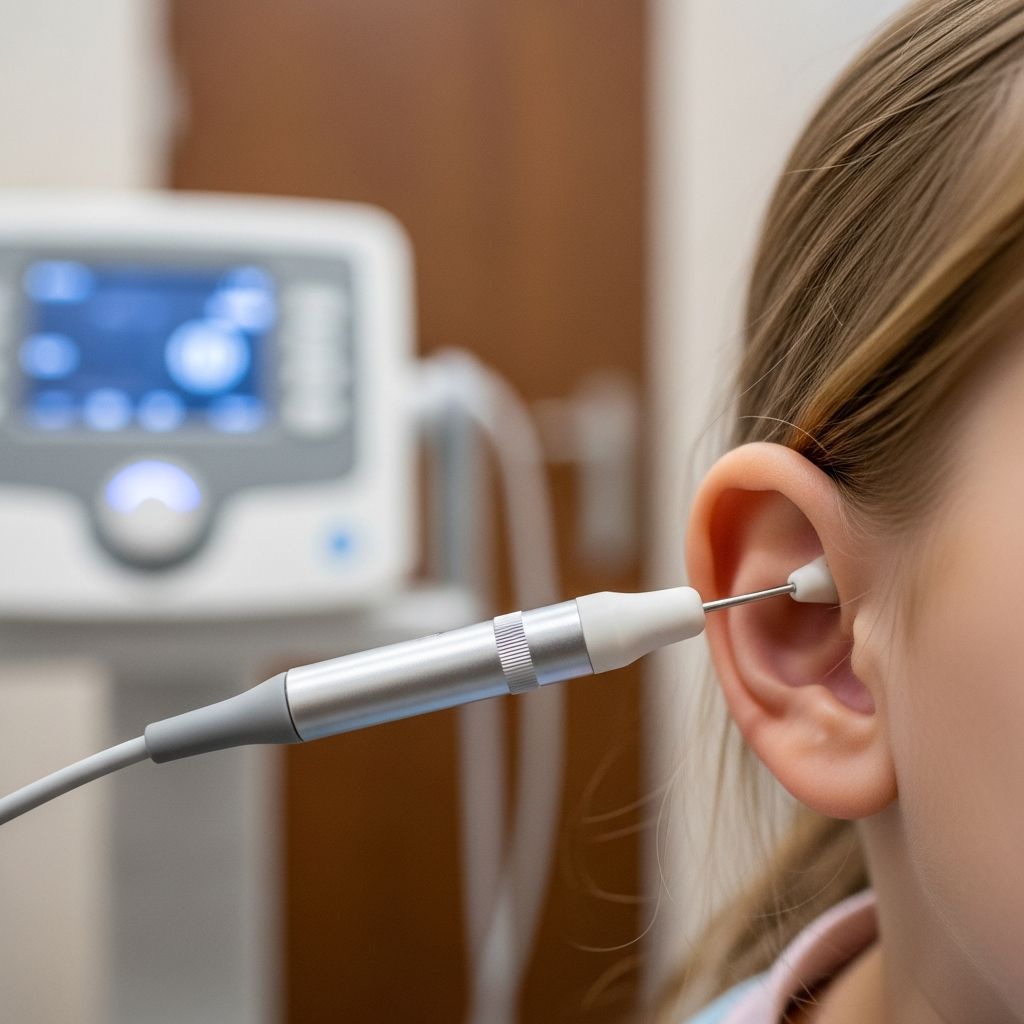
During an OAE test, a soft earpiece containing a speaker and microphone is gently inserted into the ear canal. The speaker emits specific sound frequencies, which travel through the ear canal and middle ear to reach the cochlea. If the middle ear is clear of fluid and infection and the cochlea is functioning properly, the outer hair cells will respond by vibrating and producing their own echoes. These echoes travel back through the middle ear and ear canal, where the sensitive microphone detects and records them.
The technology behind OAE testing is sophisticated and non-invasive. Sound vibrations are sent through a patient’s ear canal and middle ear to the outer hair cells of the cochlea. The test measures the returning echoes, which indicate whether the cochlear structures are responding appropriately to sound stimulation. Modern OAE equipment can analyze multiple frequency bands simultaneously, providing comprehensive information about hearing function across different pitch ranges.
Types of Otoacoustic Emissions
There are several types of otoacoustic emissions that can be measured, each providing different clinical information about hearing function. Distortion-product otoacoustic emissions (DPOAEs) are generated when two different pure tones at specific frequencies are presented to the ear simultaneously. The cochlea produces a third tone at a frequency equal to the mathematical difference between the two primary tones, which is then detected by the microphone. Transient-evoked otoacoustic emissions (TEOAEs) are produced in response to brief click sounds and provide broader frequency information about cochlear function.
Clinical Applications of OAE Testing
OAE testing has become an essential diagnostic tool in audiology and otolaryngology, with multiple clinical applications that serve different patient populations and healthcare objectives.
Universal Newborn Hearing Screening
One of the most important applications of OAE testing is in universal newborn hearing screening programs. OAE testing is used as part of universal newborn hearing screenings to identify infants with hearing loss before they leave the hospital or birthing facility. Early detection of hearing loss is critical because it allows intervention during the critical period of language development, potentially preventing delays in speech and language acquisition. Many infants born with hearing loss can develop normal speech and language skills if hearing aids or cochlear implants are fitted early and intervention services are provided promptly.
Pediatric Hearing Evaluation
OAE tests are used at pediatric medical offices as part of routine health assessments and when hearing concerns are raised by parents or healthcare providers. The test is particularly valuable in pediatric settings because it does not require behavioral responses from the child. Unlike traditional audiometry tests, which require patients to respond to sounds they hear by raising their hand or pressing a button, OAE testing is purely objective. This means that results are not dependent on a child’s ability to understand instructions, cooperate with the testing procedure, or provide reliable responses, making it ideal for very young children, children with developmental delays, or children who are unable to participate in conventional hearing tests.
Related Stories



Medication Monitoring
OAE testing is used to monitor the potential adverse effects of certain medications on hearing function. Some medications, particularly certain antibiotics, chemotherapy agents, and other drugs, can cause ototoxicity—damage to the inner ear structures that results in hearing loss. Serial OAE testing during the course of treatment with potentially ototoxic medications can detect early changes in cochlear function before significant hearing loss occurs. This monitoring allows healthcare providers to make informed decisions about continuing, modifying, or discontinuing medication therapy based on objective evidence of cochlear damage.
Differential Diagnosis
OAE testing plays an important role in the differential diagnosis of hearing loss. When a patient presents with hearing loss, OAE results can help determine whether the problem originates in the cochlea or in other parts of the auditory pathway. A positive OAE result (indicating normal outer hair cell function) in the presence of hearing loss suggests that the hearing problem may be due to factors other than cochlear dysfunction, such as middle ear problems, eighth nerve dysfunction, or central auditory processing disorders. This information helps guide further diagnostic testing and treatment planning.
What to Expect During OAE Testing
Understanding what happens during an OAE test can help patients and families feel more comfortable and prepared for the procedure.
Preparation and Setting
OAE testing is typically performed in a quiet room or sound-treated booth to minimize environmental noise that could interfere with the sensitive measurements. The patient should be in a relaxed state, as tension and movement can affect test results. For infants and young children, testing is often conducted with the child sitting on a parent’s lap or lying down, whichever position allows for the most comfortable and still positioning.
The Testing Procedure
A healthcare provider trained in audiological assessment will gently insert a soft earpiece into the ear canal. The earpiece is designed to fit snugly and comfortably without causing discomfort. Once in place, the equipment automatically delivers sound stimuli and measures the returning echoes. The entire process is painless and non-invasive, with no needles, injections, or uncomfortable sensations. The test typically takes only a few minutes per ear to complete.
Patient Cooperation
Unlike behavioral hearing tests that require active participation and response from the patient, OAE testing requires minimal cooperation. The patient simply needs to remain as still as possible and allow the earpiece to stay in place during the test. For infants and very young children, this makes OAE testing far more practical and reliable than tests that require behavioral responses.
Interpreting OAE Test Results
OAE test results are typically reported as either “pass” or “refer,” though healthcare providers may provide additional quantitative data about the amplitude and frequency of the emissions detected.
What a “Pass” Result Means
A “pass” result on an OAE test indicates that otoacoustic emissions were detected at appropriate levels across the frequency range tested. This suggests that the outer hair cells of the cochlea are functioning normally and responding appropriately to sound stimulation. In the context of newborn hearing screening, a pass result is reassuring and suggests that significant hearing loss is unlikely. However, it is important to note that OAE testing, while highly sensitive for detecting moderate to severe hearing loss, may not detect mild hearing loss or certain types of hearing loss that affect the auditory nerve or central auditory pathways.
What a “Refer” Result Means
A “refer” result on an OAE test indicates that otoacoustic emissions were not detected at expected levels, or that the test could not be completed reliably. This does not necessarily mean that a person has significant hearing loss. A refer result warrants follow-up testing with additional audiological assessments to determine the nature and extent of any hearing problem. Refer results can be caused by several factors, including fluid in the middle ear, cerumen impaction (earwax buildup), outer ear canal problems, or dysfunction of the outer hair cells themselves.
Clinical Sensitivity and Specificity
Recent clinical studies have demonstrated the high performance characteristics of OAE testing in detecting hearing loss. In a clinical study involving 201 pediatric ears across multiple healthcare sites, OAE devices detected hearing loss with 100% sensitivity and 88.9% specificity. The sensitivity of the test means that it correctly identifies the vast majority of ears with hearing loss, while the specificity indicates the test’s ability to correctly identify ears with normal hearing. These performance characteristics make OAE testing an excellent choice for hearing screening applications, where the goal is to identify individuals with hearing loss for further evaluation.
Types of Hearing Loss and OAE Findings
OAE testing can provide different types of results depending on the nature of any underlying hearing loss.
Sensorineural Hearing Loss
Sensorineural hearing loss results from dysfunction of the inner ear structures, including the hair cells of the cochlea or the auditory nerve. When sensorineural hearing loss is caused by damage to the outer hair cells of the cochlea, OAE testing typically shows abnormal or absent emissions. This pattern helps confirm that the hearing loss is due to cochlear dysfunction rather than a conductive or central auditory processing problem.
Conductive Hearing Loss
Conductive hearing loss occurs when something impedes the transmission of sound through the outer ear canal, eardrum, or middle ear structures. When conductive hearing loss is present, OAE testing typically shows normal emissions despite the presence of hearing loss. This paradoxical finding—normal OAE results in the presence of hearing loss—is actually useful clinically because it indicates that the cochlea is functioning normally and the problem lies in the conduction pathway rather than in inner ear structures.
Mixed Hearing Loss
Mixed hearing loss combines elements of both conductive and sensorineural hearing loss. In cases of mixed hearing loss, OAE results depend on the relative contributions of the conductive and sensorineural components. If sensorineural damage is present, emissions may be reduced or absent, even though a conductive component is also contributing to the overall hearing loss.
Advantages of OAE Testing
Otoacoustic emission testing offers numerous advantages compared to other hearing assessment methods, particularly for certain populations.
- Objective measurement: OAE testing does not depend on subjective responses or behavioral cooperation, making results more reliable and unbiased
- Non-invasive: The test is painless and does not involve any risk of injury or discomfort to the patient
- Quick administration: Testing can typically be completed in just a few minutes per ear
- Applicable to all ages: OAE testing can be performed on patients of any age, from newborns to elderly individuals
- Early detection capability: The test can identify hearing loss before symptoms become obvious to parents or caregivers
- No special equipment needed: Modern OAE equipment is portable and does not require specialized sound-treated rooms, though sound-treated environments improve test reliability
- Diagnostic value: OAE results provide specific information about the functional status of outer hair cells, helping differentiate between different types of hearing loss
Limitations of OAE Testing
While OAE testing is a valuable diagnostic tool, it does have certain limitations that healthcare providers must consider when interpreting results and planning follow-up care.
Detection of mild hearing loss: OAE testing is most sensitive for detecting moderate to severe hearing loss affecting outer hair cell function. Mild degrees of sensorineural hearing loss may not be detected by OAE testing alone, requiring additional testing with other modalities. Middle ear factors: The presence of fluid, infection, or eustachian tube dysfunction in the middle ear can produce false-positive refer results even when outer hair cell function is normal. Limited frequency range: While OAE testing can assess function across multiple frequencies, it may not provide complete information across the entire range of human hearing, particularly at very low and very high frequencies. Auditory nerve assessment: OAE testing specifically measures outer hair cell function and does not directly assess the integrity or function of the auditory nerve or central auditory pathways.
Frequently Asked Questions About OAE Testing
Q: Is OAE testing safe for newborns and infants?
A: Yes, OAE testing is completely safe for newborns and infants. The test is non-invasive, painless, and does not expose patients to radiation or other harmful agents. The soft earpiece is designed to be gentle and comfortable, and the sound levels used in testing are within safe limits for hearing.
Q: Can OAE testing be performed on patients with ear drainage or infection?
A: OAE testing can usually be performed even when there is ear drainage or infection present, though the presence of fluid in the ear canal or middle ear may affect test results. Healthcare providers will use clinical judgment to determine whether testing should proceed or be deferred until the infection has resolved.
Q: How long does OAE testing take?
A: OAE testing typically takes only 5 to 10 minutes to complete both ears, including time for setup and explanation of the procedure.
Q: Will my child need follow-up testing if they receive a “refer” result on newborn hearing screening?
A: Yes, a refer result on newborn hearing screening warrants follow-up audiological evaluation. Most infants with refer results on initial screening have normal hearing, but comprehensive audiological testing is necessary to rule out significant hearing loss.
Q: Can OAE testing detect all types of hearing loss?
A: OAE testing is most effective at detecting sensorineural hearing loss caused by outer hair cell dysfunction. It may not detect hearing loss caused by auditory nerve problems, central auditory processing disorders, or mild degrees of hearing loss.
References
- Otoacoustic Emission (OAE) Testing – Head & Neck Surgery — Weill Cornell Medicine. 2024. https://ent.weill.cornell.edu/patients/clinical-specialties/conditions/otoacoustic-emission-oae-testing
- An off-the-shelf otoacoustic-emission probe for hearing screening — National Center for Biotechnology Information (NCBI), PubMed Central. 2023. https://pmc.ncbi.nlm.nih.gov/articles/PMC9717525/
- Hearing Loss: Causes, Diagnosis and Treatment — Walgreens. 2024. https://blog.walgreens.com/health/senior-health/hearing-loss-causes-diagnosis-and-treatment.html
- Hearing Impairment — Johns Hopkins University School of Medicine, Johns Hopkins Guides. Updated October 14, 2024. https://www.hopkinsguides.com/hopkins/view/Johns_Hopkins_Diabetes_Guide/547060/all/Hearing_Impairment
Similar Articles








Read full bio of medha deb