Pachydermodactyly: Benign Finger Thickening Guide For Teens
Benign digital fibromatosis causing asymptomatic thickening around finger joints, primarily in young males.
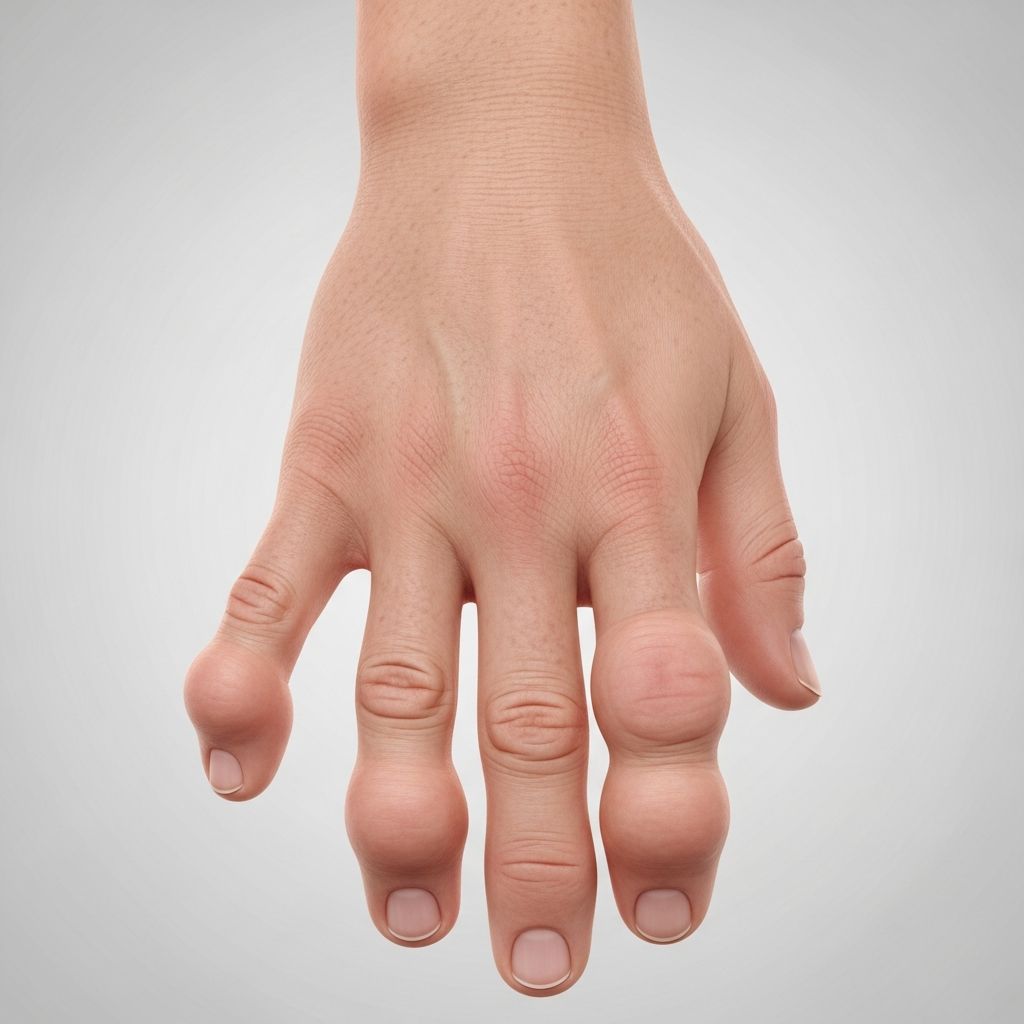
Pachydermodactyly is a rare, benign form of digital fibromatosis characterized by progressive, asymptomatic thickening of the soft tissue surrounding the proximal interphalangeal (PIP) joints of the fingers. This condition typically manifests as symmetrical swelling on the lateral aspects of the index, middle, and ring fingers, sparing the thumbs and little fingers in most cases. Unlike inflammatory joint diseases, it does not impair finger mobility or cause pain, distinguishing it as a dermatological rather than rheumatological entity.
Introduction
Pachydermodactyly, derived from Greek terms meaning ‘thick skin’ (pachy-), ‘derma’ (skin), and ‘dactyl’ (finger), was first described in the medical literature in 1973. It represents a superficial dermal fibromatosis, leading to non-inflammatory hypertrophy of the periarticular skin and soft tissues. The condition is self-limiting in many instances, progressing during adolescence and stabilizing thereafter. Its benign nature ensures no long-term functional deficits, but accurate diagnosis is crucial to rule out more serious pathologies like juvenile idiopathic arthritis (JIA).
Clinically, it presents as fusiform, poorly circumscribed swellings that are bilateral and symmetrical. The overlying skin may exhibit subtle changes such as mild erythema, hyperkeratosis, or lichenification, but epidermal disruption is minimal. Radiographic imaging reveals soft-tissue enlargement without bony erosions or joint space narrowing, further supporting its non-erosive profile.
Demographics
Pachydermodactyly predominantly affects adolescent and young adult males, with a marked male-to-female ratio of approximately 4:1. Symptoms typically onset during puberty, between ages 11 and 16, coinciding with hormonal surges and increased physical activities. While rare in females and older adults, isolated cases have been documented across all age groups and both sexes.
- Peak incidence: Puberty in males (11-16 years).
- Sex distribution: 80% male cases.
- Rarity: Fewer than 100 cases reported worldwide since initial description.
This demographic skew suggests potential hormonal influences, particularly androgens, in pathogenesis, though definitive evidence remains elusive.
Causes
The precise etiology of pachydermodactyly remains unknown, but it is strongly associated with repetitive mechanical trauma to the PIP joints in genetically susceptible individuals. Common triggers include habitual finger manipulations such as interlacing, rubbing, cracking, or stretching fingers, often linked to obsessive-compulsive behaviors, excessive gaming, or occupational/professional activities.
- Mechanical irritation from computer/mouse use, weightlifting, martial arts, climbing, or musical instrument playing.
- Obsessive-compulsive disorder (OCD) with hand tics or rubbing habits.
- Pubertal hormonal changes, possibly exacerbating fibroblast proliferation.
- Rare associations: Tuberous sclerosis, Ehlers-Danlos syndrome, and potentially post-viral triggers like COVID-19.
Pathophysiologically, repeated microtrauma induces fibroblast hyperplasia, leading to excessive deposition of types III and V collagen in the dermis. Histology shows thickened dermis with increased collagen bundles extending into subcutaneous tissue, reduced elastic fibers, and occasional mucin deposition. Hyperkeratosis may be present without significant inflammation.
Clinical Features
The hallmark of pachydermodactyly is symmetrical, asymptomatic soft-tissue swelling confined to the lateral aspects of the PIP joints of the second, third, and fourth fingers. Swellings are firm, non-tender, and measure 5-15 mm in thickness, creating a ‘knob-like’ appearance. Thumbs and fifth fingers are spared, and extension to metacarpophalangeal (MCP), distal interphalangeal (DIP), or wrist joints is exceptional.
Related Stories



Skin changes are subtle: occasional hyperpigmentation, lichenification, or fine scaling. No systemic symptoms, nail dystrophy, or Raynaud’s phenomenon occur. Finger range of motion remains fully preserved, with no synovitis or joint effusion.
| Feature | Description |
|---|---|
| Location | Lateral PIP joints of fingers 2-4, bilateral |
| Symptoms | Asymptomatic; no pain, stiffness, or limitation |
| Skin | Firm swelling ± hyperkeratosis, lichenification |
| Progression | Slow over months, stabilizes after 1-2 years |
In rare variants, dorsal hand involvement or unilateral presentation occurs, potentially mimicking garrod’s pads or knuckle pads.
Differential Diagnoses
Pachydermodactyly must be differentiated from inflammatory and neoplastic conditions due to overlapping appearances. Key differentials include:
- Juvenile idiopathic arthritis (JIA): Symmetrical but painful, with morning stiffness, elevated inflammatory markers, and synovial thickening on ultrasound.
- Rheumatoid arthritis: Erosions on X-ray, positive RF/anti-CCP, systemic involvement.
- Psoriatic arthritis: Nail pitting, dactylitis, psoriasis history.
- Scleroderma: Raynaud’s, sclerodactyly, telangiectasia.
- Knuckle pads: Dorsal MCP/PIP, often post-traumatic, more circumscribed.
- Hypertrophic osteoarthropathy: Clubbing, periostosis, associated with malignancy.
Absence of pain, normal labs, and characteristic histology aid distinction.
Diagnosis
Diagnosis is primarily clinical, supported by imaging and histopathology. No single test is pathognomonic.
- History: Repetitive habits, pubertal onset, male predominance.
- Examination: Symmetrical PIP swelling without functional impairment.
- Imaging: X-rays show soft-tissue swelling sans bony changes; ultrasound/MRI confirms dermal thickening without synovial involvement.
- Labs: Normal ESR, CRP, RF, ANA to exclude rheumatologic disease.
- Biopsy: Indicated if atypical; reveals dermal fibrosis, fibroblast proliferation, collagen excess.
Recent case reports suggest post-infectious triggers, warranting viral serology if temporally linked.
Treatment
As pachydermodactyly is benign and self-limiting, conservative management is first-line: cessation of triggering habits (e.g., finger rubbing) leads to stabilization or partial regression in 70-80% of cases.
- Intralesional steroids: Triamcinolone (10-20 mg/mL) for persistent lesions; 2-4 sessions.
- Topical therapies: High-potency corticosteroids or calcipotriol for hyperkeratosis.
- Other: Cryotherapy, excision (rare, for cosmesis), or 5-FU injections.
- Observation: Preferred, as spontaneous resolution occurs post-puberty.
Surgical excision risks recurrence due to ongoing trauma; behavioral therapy aids OCD-associated cases.
Outcome
Prognosis is excellent: swellings stabilize within 1-3 years and may regress spontaneously, especially after habit modification. No malignant potential or joint damage ensues. Long-term follow-up confirms preserved hand function.
Cosmetic concerns drive most interventions, with high satisfaction post-conservative measures.
Frequently Asked Questions (FAQs)
Is pachydermodactyly painful?
No, it is entirely asymptomatic with no pain, stiffness, or functional limitation.
Can pachydermodactyly affect thumbs or little fingers?
Rarely; it predominantly spares thumbs and fifth fingers.
Does pachydermodactyly progress to arthritis?
No, it is a dermal condition without joint or bone involvement.
How is pachydermodactyly treated?
Primarily by stopping repetitive finger habits; steroids if needed.
Is pachydermodactyly hereditary?
Not typically, though genetic predisposition with trauma is hypothesized.
References
- Pachydermodactyly — DermNet NZ. 2023. https://dermnetnz.org/topics/pachydermodactyly
- Pachydermodactyly – Wikipedia — Wikipedia. 2024-01-15. https://en.wikipedia.org/wiki/Pachydermodactyly
- Can COVID-19 infection be a trigger for development of rare diseases such as pachydermodactyly — Acquaint Publications. 2022. https://www.acquaintpublications.com/article/can_covid_19_infection_be_a_trigger_for_development_of_rare_diseases_such_as_pachydermodactyly
- Pachydermodactyly: Soft Tissue Enlargement of the Fingers in a Teenage Boy — NIH PMC. 2023-08-15. https://pmc.ncbi.nlm.nih.gov/articles/PMC10425703/
- Pachydermodactyly — VisualDx. 2024. https://www.visualdx.com/visualdx/diagnosis/pachydermodactyly?diagnosisId=53242&moduleId=101
Similar Articles








Read full bio of medha deb