Paederus Dermatitis: Causes, Symptoms & Treatment Guide
Understanding Paederus dermatitis: causes, symptoms, diagnosis, treatment, and prevention of this irritating beetle-induced skin condition.
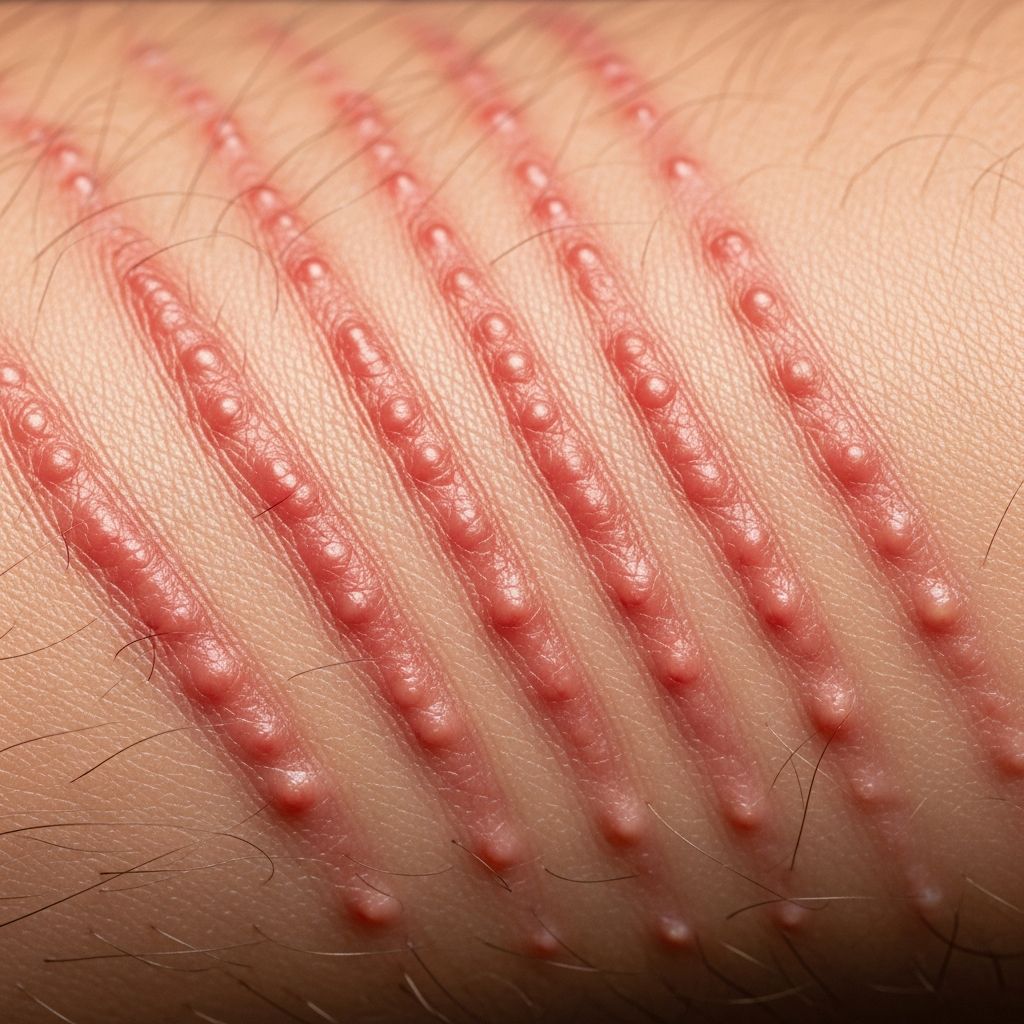
Paederus dermatitis, also known as dermatitis linearis or blister beetle dermatitis, is an irritant contact dermatitis caused by inadvertent skin contact with the hemolymph of rove beetles from the genus Paederus. These beetles do not bite or sting but release a potent vesicant toxin called pederin when crushed or handled, leading to characteristic linear or geometric skin lesions.
What is Paederus dermatitis?
Paederus dermatitis arises from exposure to pederin, a highly toxic substance found in the blood (hemolymph) of Paederus beetles, which belong to the family Staphylinidae. Unlike true beetles that bite, these slender insects reflexively release hemolymph when threatened, such as when rolled onto skin during sleep or swatted indoors. Pederin inhibits DNA synthesis and triggers an inflammatory response, resulting in erythema, vesicles, and bullae that mimic a chemical burn.
The condition is prevalent in tropical and subtropical regions, including Southeast Asia, India, Africa, and parts of South America, especially during rainy seasons when beetle populations surge near lights and water sources. Outbreaks often coincide with agricultural activity or monsoons, affecting exposed skin areas like the face, neck, arms, and legs.
Who gets Paederus dermatitis?
Anyone can develop Paederus dermatitis, but it is more common in tropical climates where Paederus species thrive. Farmers, outdoor workers, and residents in rural or peri-urban areas during wet seasons are at higher risk due to increased beetle activity. Children, tourists, and military personnel in endemic zones report cases, with no predisposition by age, sex, or immunity.
- High-risk groups: Agricultural workers, soldiers in field conditions, travelers to endemic areas.
- Seasonal peaks: Rainy/monsoon periods when beetles migrate indoors at night.
- Global distribution: Asia (India, Sri Lanka, Thailand), Africa (Kenya, Nigeria), Australia, South America.
What causes Paederus dermatitis?
The primary cause is mechanical rupture of the beetle, releasing pederin—a cytotoxic amide more potent than some chemotherapeutic agents. Pederin penetrates intact skin, causing epidermal necrosis and subcorneal vesicles within hours. Lesions form linear patterns where the beetle is dragged across the skin or “kissing lesions” where opposed skin surfaces touch, transferring toxin.
Beetles are attracted to lights, entering homes at night. Common scenarios include rolling over a beetle in bed or crushing it while turning off lights. The toxin is stable and not deactivated by water alone, but soap aids removal.
| Type | Description | Characteristics |
|---|---|---|
| Linear | Straight or curved erythematous streaks | From dragging crushed beetle; 54.3% of cases |
| Kissing | Mirrored lesions on opposing surfaces | 28.4% prevalence; e.g., flexures |
| Erythematovesicular | Red patches with vesicles/bullae | 70% of lesions; burnt appearance |
| Annular | Ring-shaped | 46.9%; necrotic center |
| Periorbital (Nairobi eye) | Edema, keratoconjunctivitis | From hand-to-face transfer |
What are the clinical features of Paederus dermatitis?
Symptoms begin 12-36 hours post-exposure (Type II delayed form) or immediately (Type I). Initial stinging/burning evolves into intense itching, pain, and tenderness. Lesions start as erythematous patches, progressing to vesicles, pustules, bullae, and grey necrotic crusts over days. Healing occurs in 1-3 weeks with postinflammatory hyperpigmentation lasting months, but no scarring.
Related Stories



- Symptoms: Pain (90%), itching (83%), redness (59%), tenderness (56%); rare fever (4%), discharge
- Progression: Erythema → vesicles → bullae → crusting → desquamation
- Distribution: Exposed sites (face 40%, limbs); spares covered areas
- Severe cases: Extensive blistering, neuralgia, arthralgia, vomiting
In a study of 81 patients, mean rash duration was 13 days with 100% recovery.
Diagnosis
Diagnosis is clinical, based on history of beetle exposure in endemic areas and characteristic linear/kissing lesions with grey necrotic centers. Dermoscopy reveals “railroad track” vesicles. Differentials include herpes zoster (unilateral dermatomal), contact dermatitis, bullous impetigo, or phytodermatitis. Biopsy shows subcorneal vesicles, acantholysis, and sparse inflammation; toxin assay is impractical.
- Key diagnostics: Linear geometry, exposure history, evolution timeline
- Aids: Dermoscopy, skin scraping to exclude infection
- Biopsy (rare): Epidermal necrosis, no viral inclusions
Treatment
Immediate washing with soap/water removes residual pederin, halting progression. Symptomatic relief includes topical corticosteroids (potent for severe cases), oral antihistamines for pruritus, and emollients. Oral steroids for widespread involvement; antibiotics if secondarily infected. Cold compresses soothe; avoid popping blisters to prevent infection. Condition is self-limiting.
- Wash area immediately post-exposure.
- Apply mid-to-high potency topical steroid (e.g., betamethasone) twice daily.
- Oral antihistamine (e.g., cetirizine) for itching.
- Petrolatum for barrier; monitor for infection.
- Severe: Short-course oral prednisone.
Mean recovery: 13 days with steroids.
Complications
Primary issue is pain/itching disrupting sleep/work. Secondary bacterial infection (rare, <5%) from scratching leads to impetiginization. Ocular involvement causes chemosis, conjunctivitis. Transient hyperpigmentation; no long-term sequelae.
Prevention
Avoid crushing beetles—brush off gently outdoors. Use screens, insect repellents (DEET), light traps. Wear long sleeves at night in endemic areas; shake clothes/bedding. Educate on recognition during outbreaks.
- Do not swat indoor insects near skin.
- Close windows at dusk; use yellow lights.
- Post-exposure: Wash promptly.
Differential diagnosis
| Condition | Key Features | Distinguisher from Paederus |
|---|---|---|
| Herpes zoster | Dermatomal vesicles | Unilateral, pain precedes; Tzanck positive |
| Phytodermatitis | Linear from plant sap | History of plants; no necrosis |
| Bullous impetigo | Pustules, honey crusts | Culture positive for Staph |
| Allergic contact dermatitis | Diffuse erythema | Itchy, no linear pattern |
| Arthropod bites | Central puncture | Grouped, not linear |
Frequently Asked Questions
Is Paederus dermatitis contagious?
No, it is not infectious or contagious; solely from direct toxin contact.
How long does Paederus dermatitis last?
Acute phase 1-2 weeks; hyperpigmentation up to months.
Does it scar?
Typically no scarring, though pigmentation changes occur.
What if I get it in my eye?
Seek ophthalmology; causes severe edema (Nairobi eye).
Can I pop the blisters?
No—risks infection; keep intact and apply dressings.
Is treatment with steroids always needed?
Symptomatic; self-resolves but steroids speed relief.
(Word count: 1678)
References
- Paederus Dermatitis: Signs, Causes, And Treatment — Medicover Hospitals. 2023. https://www.medicoverhospitals.in/diseases/paederus-dermatitis/
- Clinical description and treatment outcomes of Paederus dermatitis — PMC (NIH). 2023-07-20. https://pmc.ncbi.nlm.nih.gov/articles/PMC10395627/
- Paederus dermatitis — VisualDx. Accessed 2026. https://see.visualdx.com/visualdx/diagnosis/?moduleId=102&diagnosisId=55800
- Paederus dermatitis — DermNet NZ. 2024. https://dermnetnz.org/topics/paederus-dermatitis
- Literature review of the causes, treatment, and prevention of dermatitis linearis — Oxford Academic (Journal of Travel Medicine). 2016-04-27. https://academic.oup.com/jtm/article/23/4/taw032/2748113
- Paederus dermatitis — PMC (NIH). 2024. https://pmc.ncbi.nlm.nih.gov/articles/PMC11288999/
- Paederus dermatitis — Wikipedia (references primary sources). 2026. https://en.wikipedia.org/wiki/Paederus_dermatitis
Similar Articles








Read full bio of medha deb